
- Hindi News
- Business
- GST Council Meeting | Tax Officers Arrest Power Reform & Business Relief
New Delhi38 minutes ago
- copy link
The GST Council may approve major reforms in the country’s indirect tax system in its meeting to be held on October 7. Under the new proposal, there is a preparation to withdraw the power of direct arrest from the tax officials and increase the limit of criminal cases of fraud.
After the rate rationalization i.e. change in GST rates in September 2025, the government is now working on simplifying tax administration and providing relief to businessmen under ‘Next-Generation GST’.
Know every important thing related to this big change in questions and answers…
Question: What big proposal related to arrest is being brought in the GST Council meeting?
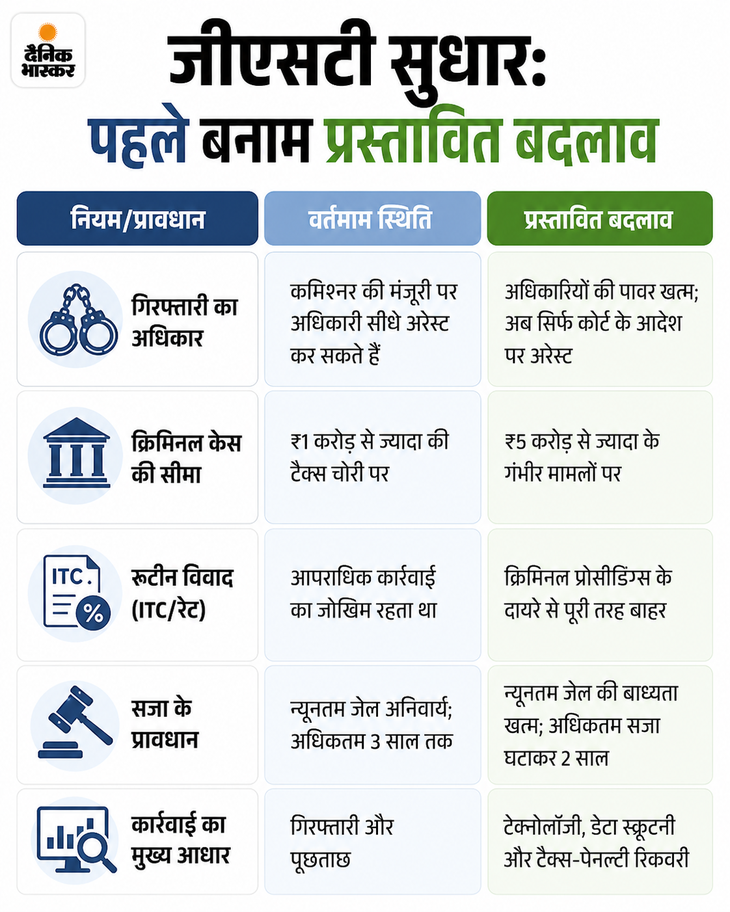
answer: Under the new proposal, there is a preparation to amend Section 69 of the CGST Act. Till now, GST officers could directly arrest a person after getting commissioner level approval.
After the new changes, this power will be withdrawn from the officers. Now court order (judicial approval) will be mandatory for any arrest.
Question: What will be the change in the limits of criminal proceedings?
answer: At present, there is a provision for criminal action and arrest in cases of tax evasion or fake Input Tax Credit (ITC) claims of more than Rs 1 crore.
According to the proposal, it has been recommended to directly increase this limit for prosecuting a criminal case from ₹ 1 crore to ₹ 5 crore. That means, no criminal case will be registered in cases involving less than ₹5 crore.
Question: Can one have to go to jail now even in routine tax disputes?
answer: No. The government has clarified that routine disputes regarding classification, valuation or Input Tax Credit (ITC) will be kept out of the scope of criminal proceedings.
Sometimes business and tax authorities may have different opinions regarding the definition of a transaction, such cases will no longer be considered a criminal offense.
Question: What is the main reason for withdrawing arrest power from GST officials?
answer: When GST was implemented on July 1, 2017, the automated system to detect fake invoices and tax evasion was not strong. Therefore the fear of arrest was necessary. Now the data-driven and automated invoice-matching system of GST has become very strong.
The system itself catches fake credit in the beginning. Moreover, most of the arrested people easily got bail from the courts and businessmen used this as a means of harassment by the authorities.
Question: If the arrest power is removed, how will the government recover the tax?
answer: Losing the arrest power of officers does not mean tax exemption at all. The civil powers of the government to collect tax, impose interest and penalty will remain completely intact. In small and routine cases, taxpayers will be able to settle the case by paying the outstanding tax, interest and penalty.
Question: Will the system of punishment in cases of serious fraud or fraud be abolished?
answer: No. Serious cases of deliberate major fraud and tax evasion will be prosecuted through the court. However, the provisions of punishment are also being made practical. It is proposed to completely abolish 9 out of 24 criminal sections and retain 11.
The court will also have the option of removing the minimum jail requirement and imposing only a fine. Also, it is proposed to reduce the maximum punishment in medium category crimes from 3 years to 2 years.
Question: How will businessmen and traders benefit from this decision?
answer:
- Stopping the arbitrariness of officials: The fear of arrest before the final decision of any tax dispute will end.
- Ease of Doing Business: The burden of legal litigation on small and medium businessmen will reduce.
- Trust will increase: An environment of trust will be created between the government and businessmen, which will make doing business easier.
- Exemptions and Relief: There are also preparations to waive late fees and make penalties logical for small taxpayers.
Question: What will change in the way tax administration works?
answer: According to experts, this is a major change in India’s indirect tax system. Now tax enforcement will be based on ‘technology, data and civil recovery’ instead of ‘intimidation and arrest’.
GST officers will focus on tax collection instead of arresting like the police, while serious criminal cases will be handed over to investigating agencies and courts.
Question: This reform is a part of which major policy of the government?
answer: The move is part of the central government’s ‘Public Trust (Amendment of Provisions) Act, 2026’ and its campaign to decriminalize economic offences.
Earlier in September 2025, there was a major change in GST rates (GST 2.0) and slabs of 5%, 18% and 40% were made for luxury goods. Now in the second phase, the emphasis is on making administration easier.
Know what is Section 69 of CGST Act?
Section 69 of the CGST Act empowers the Tax Commissioner to authorize any officer to arrest that person if he has reason to believe that a person has committed specified serious tax offences. In the new proposal, it has been said that this direct right will be abolished and linked to the court order.

Source link
[ad_3]

