
New Delhi1 minute ago
- Copy link
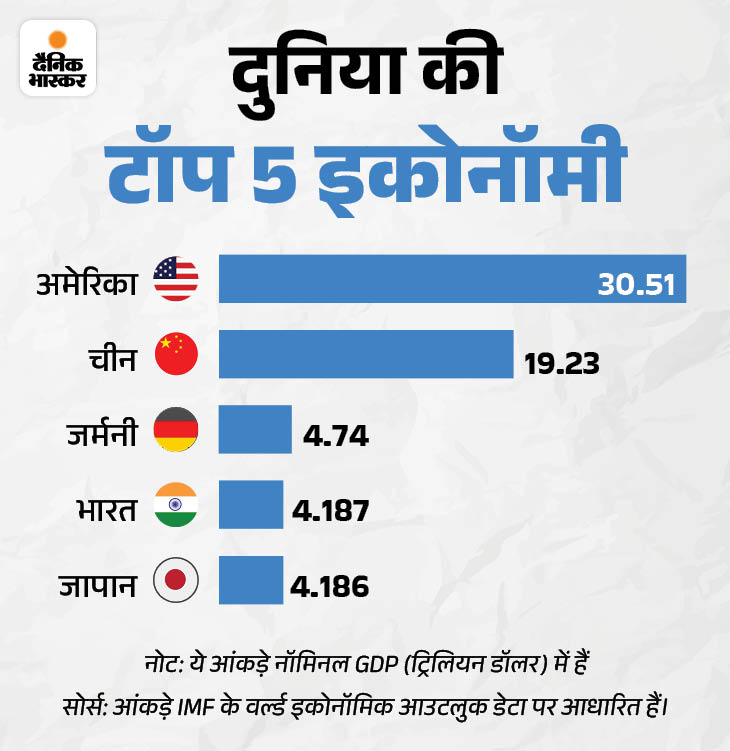
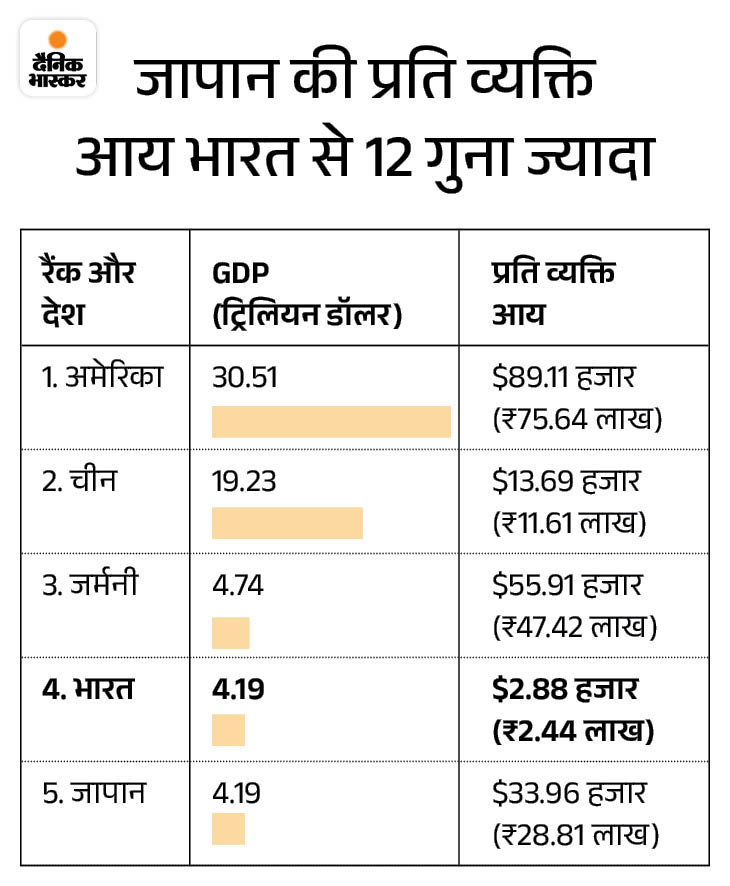
India has become the fourth largest economy in the world, leaving behind Japan. However, he is still far behind in terms of per capita income.
In such a situation, the question in the minds of many people is that it is better for our country and common people to become the fourth big economy or per capita income is better.
It is necessary to compare the effects of both, as both of them are different economic indicators. They have different effects on common people.
Learn in 5 questions here what better for the common man in GDP and per capita income:
Question 1. What does it mean to be the fourth largest economy of India?
answer: Being a big economy means that India is emerging as a global economic power. It gives India the ability to attract foreign investment.
Benefits:
- More resources and investment: Big GDP shows that the country has more economic resources. The government is getting more revenue for investment in road, rail, hospital, education, and health services. This can provide better facilities to the common people.
- Employment opportunities: Rapid growing economy expands industry, service sector, and startups, increasing jobs. Employment is increasing in areas such as IT, manufacturing, and renewable energy in India.
- Global effects: The big economy gives India more strength on the global platform, which benefits business, investment, and diplomatic relations. It can indirectly benefit common people as better products and services.
Limits:
- uneven distribution: In a country like India, income inequality is high. Top 1% has 41% assets. The advantage of GDP growth is often limited to the rich.
- Common people do not get immediate benefit. India’s population is 142.86 crore. For this reason, the benefit of GDP weakens per capita level.
Question 2. What does Capita income mean per capita income?
Benefits:
- Better standard of living: More per capita income means that every person can take advantage of better food, education, health, and lifestyle. The per capita annual income in Japan is 33.96 thousand dollars. India has 2.88 thousand dollars.
- Perchegnings Power: More per capita income increases people’s ability to buy, so that they can buy better products and services. At the same time, governments are able to implement schemes like social security, free treatment and good education better.
Limits:
- Effect of inequality: Per capita income is an average. If income inequality is high, it can be average misleading. Even in India, the high income group draws per capita income, but the lower income group gets less benefits.
Question 3: Why is India behind Japan in per capita income? answer: The main reason for this is:
- Economic Structure: Japan is a developed economy, where high productivity, advanced technology, and matures are industrial and service sectors. India is an emerging economy, where the contribution of agriculture and unorganized sector is large, and per capita productivity is low.
- Income inequality: The distribution of income in India is uneven. The top 1% population has 41% assets, while the lower 50% has only 3%. This makes the average of per capita income low.
- Difference of population: India’s population is 142.86 crore, while Japan’s only 12.45 crore. Due to such a large population, India’s GDP is divided into more people, due to which per capita income is low.
Question 4: China’s population is also more, then why is the per capita income more there?
- China’s economic reform: In 1978, China led by Deng Shiaoping began the market -related reforms, including promoting foreign investment and focusing on export oriented manufacturing. This increased China’s industrial production and export rapidly. At the same time, India started market-oriented reforms in 1991.
- China’s productivity: China invested heavily in infrastructure such as Three Gorges Dam, high-speed rail, which increased productivity. India has lagged behind China in infrastructure development such as roads, rails, electricity. In 2000-2017, China’s per capita GDP grew from 8.71% CAGR, while India’s 5.31% CAGR.
- Chinese urbanization: As of 2024, 67% of China’s population lives in urban areas, while in India it is 34.5%. Urbanization increased employment in factories and service sectors in China. People working in the city have more income than rural workers. Most of India’s population is still dependent on agriculture and unorganized sectors, where income is low.
Question 5. What is more important for common people than GDP or per capita income?
answer: It is more important for the common people to have more per capita income, as it directly affects their standard of living and proclaiming power. Due to Capita income on higher in a country like Japan, common people enjoy better health, education, and lifestyle, while most of the population has to struggle for basic needs due to low per capita income in India.
However, it is also important to become a large economy, as it provides resources to the government, which can improve infrastructure, employment, and social welfare schemes in the long term. But its benefit reaches the common people only when the government focuses on inclusive development. Due to income inequality and low per capita income in India, the benefit of GDP growth is not yet fully reaching the common people.
—————————–
Read this news too …
India became the fourth largest economy in the world: surpassing Japan, beating Germany by 2028 to reach third place
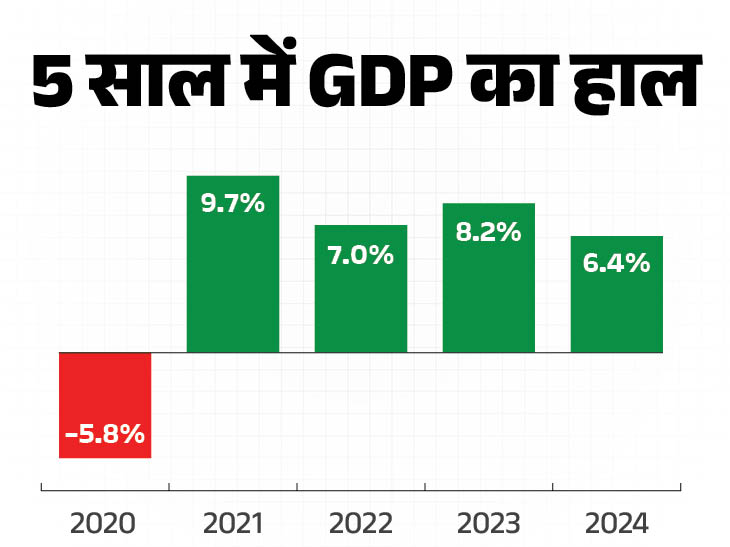
India has officially become the fourth largest economy in the world, leaving behind Japan. CEO BVR Subrahmanyam of NITI Aayog gave this information at a press conference on 24 May. India has achieved this achievement due to its economic policy.
Source link
[ad_3]

