
New Delhi1 hour ago
- copy link
Finance Minister Nirmala Sitharaman said on Monday (May 25) that the government will suffer a revenue loss of ₹ 1 lakh crore by reducing excise duty on petrol and diesel.
Along with this, he rejected the gloomy atmosphere being created regarding India’s economic growth and defended the economic condition of the country.
The Finance Minister said this at the 37th Foundation Day celebration of Small Industries Development Bank of India (SIDBI) in Mumbai.
Oil companies increased prices for the fourth time in 10 days
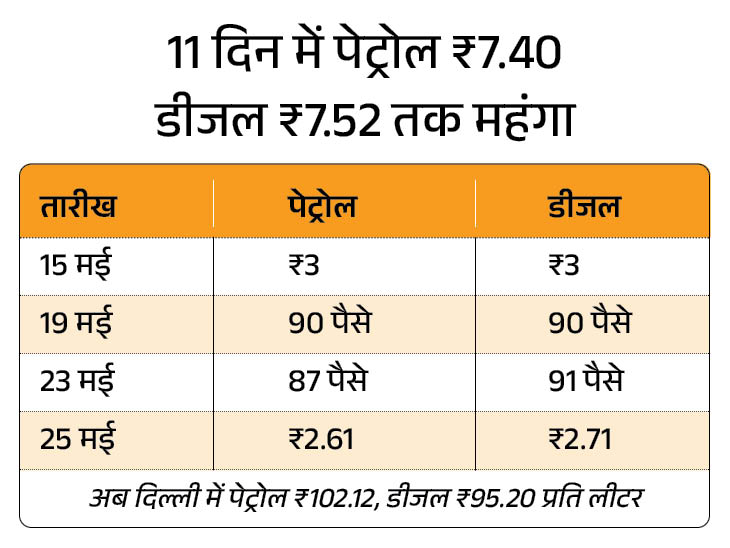
- Oil marketing companies (OMCs) in the country on Monday increased fuel rates for the fourth time in the last 10 days.
- On May 15, the prices of petrol and diesel were increased for the first time after a long gap.
- From then till the fourth hike today, the prices of both petrol and diesel have increased by about ₹7.5 per litre.
General public got relief due to reduction in excise duty
Due to the government’s cut in excise duty, consumers across the country are having to pay lower prices at petrol and diesel pumps.
The move provides direct relief to households and businesses at a time when global energy markets remain under deep pressure due to the ongoing crisis in West Asia.
India’s challenges are mainly external
Finance Minister Sitharaman said that whatever pressure is being seen on the Indian economy, it is not India’s own policies but the main reasons outside the country’s borders that are responsible for it. He said that India remains one of the fastest growing major economies in the world. Several high-frequency indicators prove that industrial demand and economic momentum in the country remain strong.
The Finance Minister said that the challenges before us are more external than internal. We need foreign exchange to import gold, fuel and fertilizers. All three things are affected by global commodity cycles and currency fluctuations.
It is not right to create a wrong narrative on the economy
Nirmala Sitharaman gave a direct reply from the stage in Mumbai to those who are trying to cast doubt on India’s economic achievements in this era of external pressures. He said that some sections want to condemn our own achievements amid the challenges posed by the West Asia crisis.
He termed such comments as completely wrong and inappropriate. The Finance Minister said that some people are deliberately trying to create a depressing narrative, which is not correct at all.
Facing criticism on the domestic front
This comment of the Finance Minister has come at a time when there is a debate in the country about India’s growth rate and its quality.
Critics are constantly targeting the government over increasing pressure on domestic consumption, inflation and currency fluctuations.
Strict instructions to government companies
Along with talking about the macro economy and fuel prices, the Finance Minister gave a strong and direct message to the Public Sector Undertakings (PSUs/Government Companies).
He asked the government companies to strictly adhere to the mandatory deadline of 45 days for payments to Micro, Small and Medium Enterprises (MSMEs) and clear their dues on time.
Excise duty on petrol and diesel was reduced by Rs 10 each.
On March 27, the government had reduced the special excise duty by ₹ 10 each to keep the prices of petrol and diesel stable. Duty on petrol was reduced from ₹13 per liter to ₹3, while that on diesel was reduced from ₹10 to zero. A total excise duty of ₹ 21.90 was collected by the Central Government on one liter of petrol.
After reduction in special additional excise duty, it came down to ₹ 11.90. Similarly, the total central excise duty on one liter of diesel was reduced from ₹17.8 to ₹7.8. This decision of the government was to keep the prices of petrol and diesel stable. Due to this decision the prices of petrol and diesel did not increase. Read the full news…
What is excise duty?
It is an indirect tax imposed by the Central Government on products manufactured or sold within the country (such as petrol-diesel). This reduction not only provides relief to the customers but also causes direct loss to the government treasury (revenue).
What is the 45 day rule for MSME?
According to government rules, it is mandatory for any big or government company to make payment for goods or services from small industries (MSME) within 45 days of receiving them, so that there is no shortage of cash in small businesses.

Source link
[ad_3]

