
Mars is about to get a new communications link with Earth, and this time, Nasa is turning to Jeff Bezos’ Blue Origin to build it.
Nasa has awarded Blue Origin a contract worth up to $700 million to develop its Mars Telecommunications Network (MTN), a new spacecraft designed to relay data between Mars and Earth.
The network is expected to be operational on Mars by 2030.
The spacecraft is not being sent to Mars primarily to make scientific discoveries of its own.
Instead, it will act more like a communications hub, helping spacecraft around and on Mars send science data, images, navigation information and other mission communications back to Earth.
WHY DOES MARS NEED ANOTHER ORBITER?
Mars already has spacecraft helping relay information between the Red Planet and Earth.
NASA’s Mars Odysseylaunched in 2001, and Mars Reconnaissance Orbiter, launched in 2005, perform this job while also carrying out their own scientific work.
Europe’s Mars Express and Trace Gas Orbiter are also present to provide support.
But these spacecraft are getting older, while the number and complexity of missions heading to Mars is expected to grow.
Nasa is preparing for increasingly ambitious robotic exploration and, eventually, human missions. That means more spacecraft could need to exchange far more information with Earth.
The MTN is therefore being designed specifically to handle that growing communications demand rather than dividing its time between communications and science.
BLUE ORIGIN’S BLUE RING TO HEAD TO MARS
Blue Origin plans to build the Mars telecommunications spacecraft around its Blue Ring platform, which is designed to carry payloads and move through space using both solar-electric and chemical propulsion.
The company said the Mars spacecraft is already in production at its facility in Huntsville, Alabama.
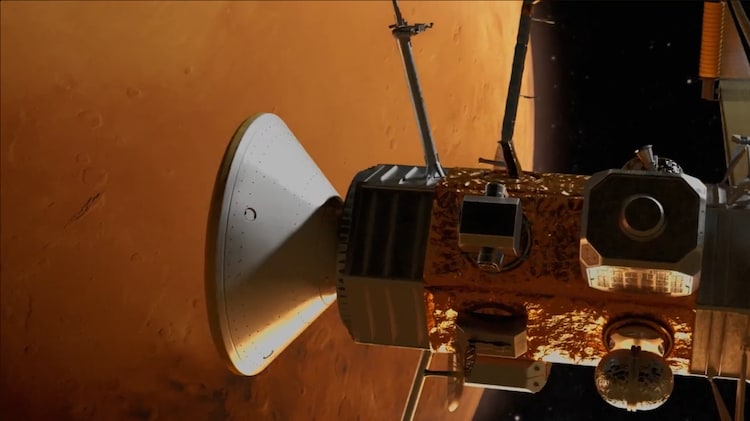
Blue Origin is responsible not just for building it, but also for integrating, launching and operating the mission.
The spacecraft must be delivered to Nasa by December 31, 2028, with the network expected to be operational at Mars by 2030.
The move is part of a broader shift in Nasa’s Mars strategy, which includes building the communications infrastructure first, so future spacecraft, and eventually astronauts, have a stronger connection with Earth.
As Blue Origin CEO Dave Limp put it: “We’re going to Mars.”
– Ends
Source link
[ad_3]

