
Dhaka7 minutes ago
- copy link
Bangladesh’s ruling party BNP has expressed happiness over BJP’s victory in West Bengal. Speaking to news agency ANI, BNP Information Secretary Azizul Bari Helal congratulated BJP on the victory and said that it can strengthen India-Bangladesh relations.
He accused the Mamata Banerjee government of delaying the Teesta water sharing agreement and said it was the biggest hurdle in it. He claimed that this agreement was wanted by both the Bangladesh government and the Modi government.
Helal expressed hope that the government formed under the leadership of Suvendu Adhikari will improve relations between India and Bangladesh and help in taking the Teesta Agreement forward.
He said that among the states of India, West Bengal has the longest border with Bangladesh. Therefore, the politics there directly impacts the relationship between the two. Change of power there is good for both the countries. This may also improve border issues between the two countries.
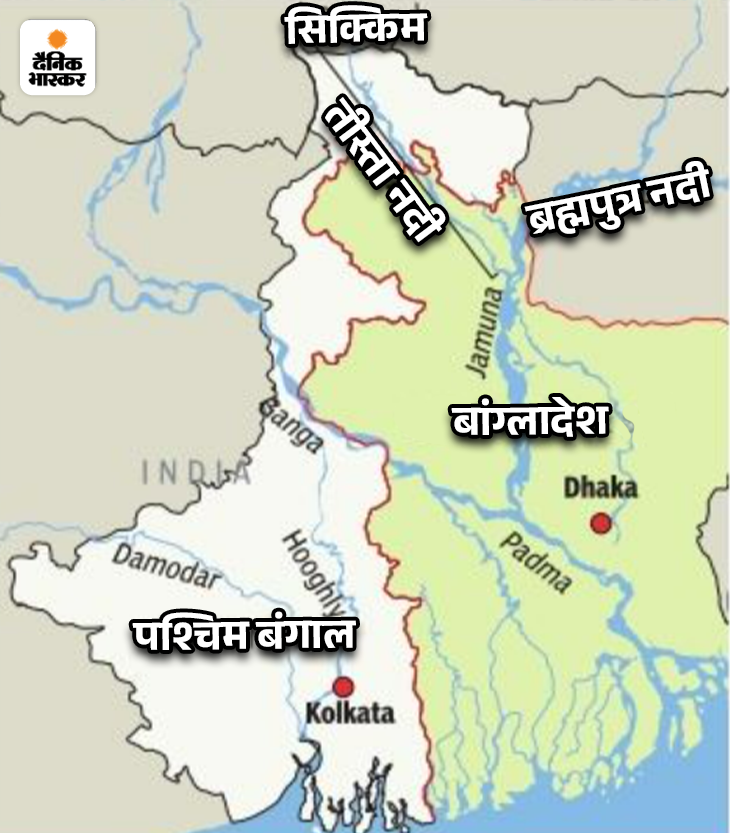
Bangladesh wants 50% water of Teesta river
Teesta River originates from the Pahunri Glacier in the Himalayas. It flows from Sikkim to Bangladesh via West Bengal and later joins the Brahmaputra. This river covers a total distance of 414 kilometers. The livelihood of 2 crore population of Bangladesh and 1 crore population of India is connected with this river.
During this long journey, 83% of the Teesta River’s journey takes place in India and 17% of its journey takes place in Bangladesh. There has been a dispute between India and Bangladesh regarding the sharing of Teesta river water for many years.
Bangladesh wants rights over 50 percent of Teesta water. Whereas India itself wants 55 percent water. According to experts, if Teesta river water agreement is signed then West Bengal will not be able to use the water of the river as per its wish. This is the reason why Mamata Banerjee kept postponing it.
Water sharing agreement has been stuck for a long time
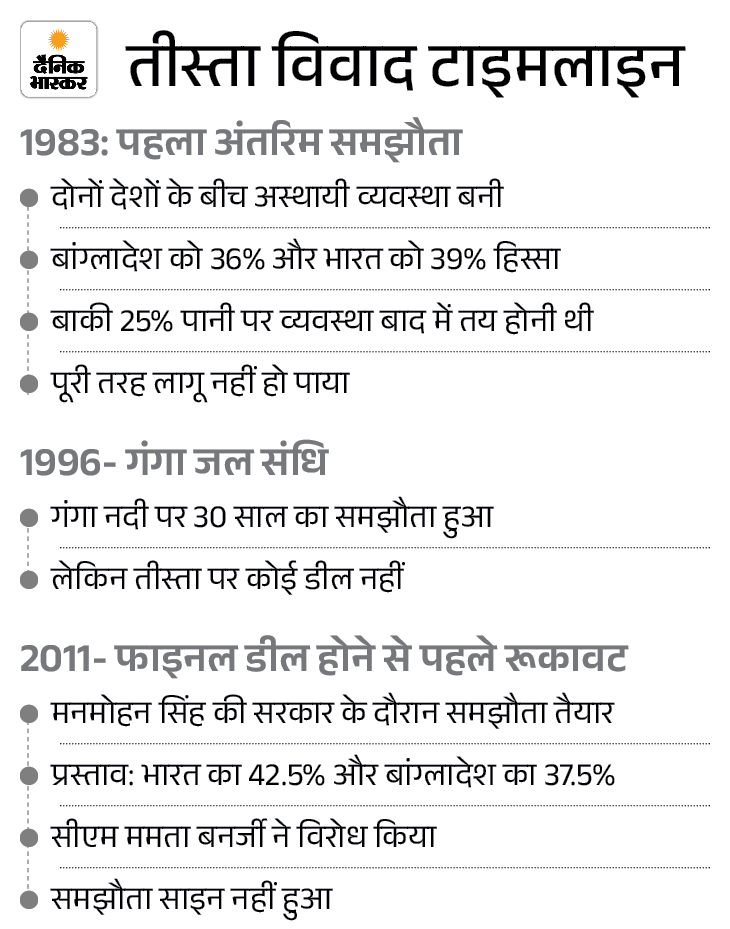
In 1815, there was an agreement between the King of Nepal and the East India Company regarding the water of Teesta River. The king then handed over control over large parts of the river to the British. An agreement was signed between the two countries in 1983, 12 years after Bangladesh’s independence. Bangladesh accounted for 36% of the water and the rest for India.
But later Bangladesh started saying that the amount of water it is getting is less than its requirement. In drought he is not able to survive with so much water. After Sheikh Hasina became the PM in 2008, the demand of Bangladesh started increasing.
In 2011, when Congress was in power, India was ready to sign the Teesta River Water Agreement. In this, there was talk of giving 37.5% water to Bangladesh and 42.5% water to India. The remaining 20% was not decided to be given to any country. This was considered ‘unallocated’ or reserve water.
This part is released according to the natural flow of the river, environment and need, so that the river does not dry up and the ecosystem remains intact. However, due to Mamata Banerjee’s displeasure, the Manmohan government had to step back.
In the year 2014 when Narendra Modi became PM. A year later, he went to Bangladesh with Bengal CM Mamata Banerjee. During this, both the leaders had assured Bangladesh of a consensus on the division of Teesta. But even after 11 years, a solution to the Teesta River Water Agreement has not been found yet.
Why did Mamata government keep opposing this agreement?
West Bengal Chief Minister Mamata Banerjee has been continuously opposing the Teesta and Farakka water sharing agreements. According to him, this will have a direct impact on the livelihood of the people of the state.
Their argument is that the flow of water in the Teesta river has already reduced, so if additional water is shared with Bangladesh, the irrigation and drinking water crisis in North Bengal may deepen. Also, diversion of water from Farakka Barrage is considered necessary to maintain the navigation capacity of Kolkata Port.
Mamta government has also been saying that no compromise should be made in such sensitive decisions without taking the state government into confidence, because the local people are affected the most.
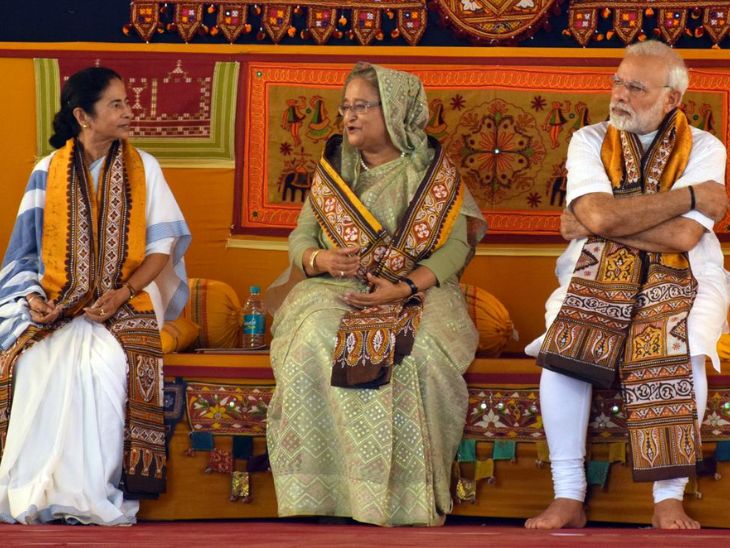
This picture of Prime Minister Modi, Bangladeshi PM Sheikh Hasina and Bengal Chief Minister Mamata Banerjee is from 2016. All three had reached a program in Shanti Niketan.
Role of rivers in India-Bangladesh relations
Even during Prime Minister Narendra Modi’s visit to Dhaka in 2015, hopes were raised for a solution to the Teesta river issue, but till now no agreement has been reached. India and Bangladesh share 54 rivers, which are directly linked to agriculture, drinking water, electricity and livelihood of millions of people.
However, till now formal agreements have been reached only on Ganga (1996) and Kushiyara river, due to which there remains dissatisfaction regarding other rivers, especially Teesta. The Ganga River Agreement was signed in 1996 on a 30-year agreement. Its validity is ending this year.
When India is unable to strike a deal on a river, it sends a message to Bangladesh that India is not giving priority to its neighbour’s concerns because of its domestic political reasons. Whereas for India it is an issue of balance. On one hand diplomatic relations with the neighboring country, on the other hand the needs of our states.
In such a situation, river agreements are not just technical or environmental issues, but directly affect bilateral trust, regional cooperation and strategic relationships.
——————————–
Read this news also…
Troubled by debt, Pakistan started exporting liquor: Supply to non-Muslim countries, it was banned 50 years ago citing Islam.
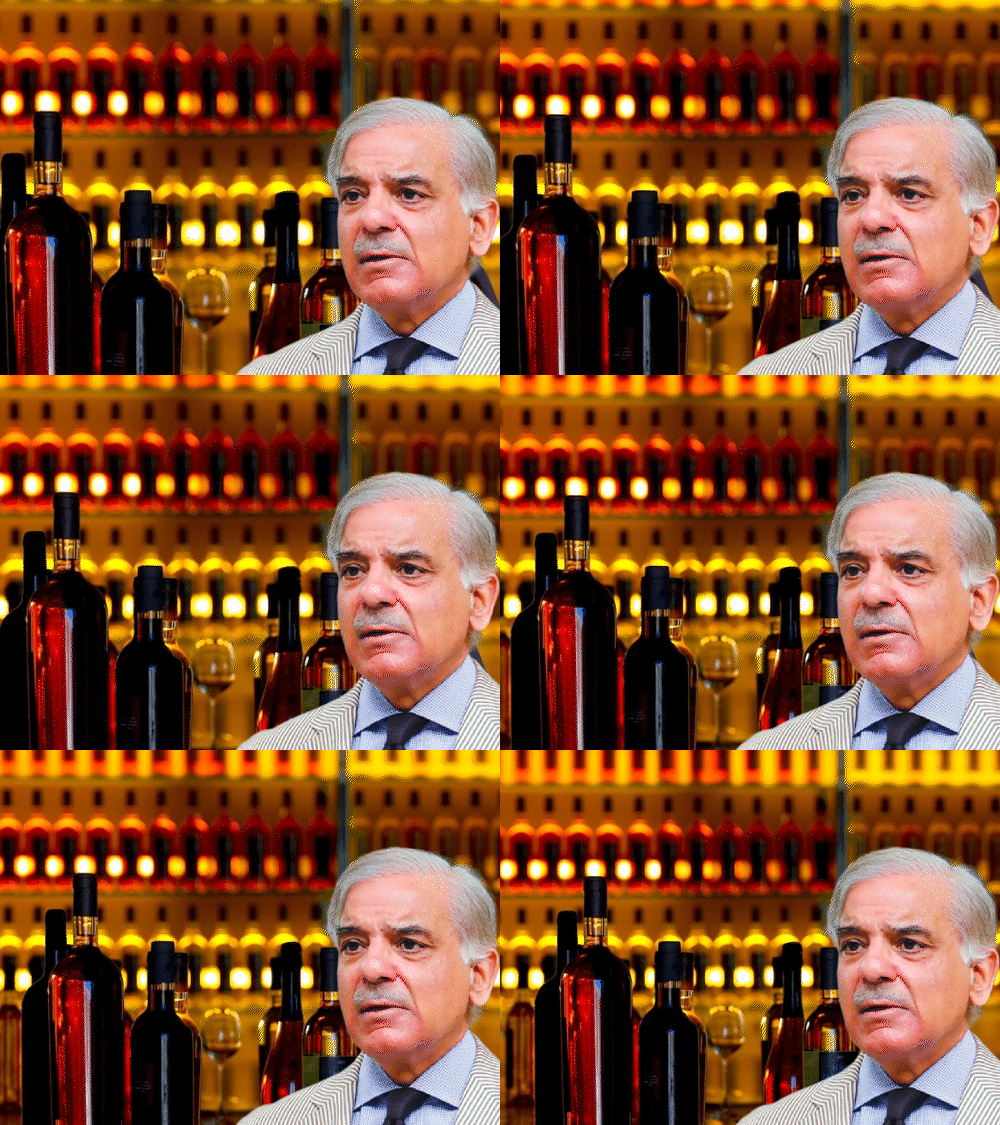
Pakistan, which is struggling with debt, has again started selling liquor to other countries after 50 years. The country’s only local company, Murree Brewery, has exported beer and other alcoholic drinks to countries like Britain, Japan, Portugal and Thailand in April 2026.
According to the company’s export manager Rameez Shah, initially a network is being built abroad and there are plans to increase production in future.
Liquor was banned in Pakistan for the Muslim population about 50 years ago citing Islamic rules. After this the export of liquor also stopped. However, there were some exemptions for non-Muslims in Pakistan. Read the full news…

Source link
[ad_3]

