
Last Updated:
Gallup data shows tech workers who don’t use AI regularly face triple the layoff risk. For India’s six-million-strong IT workforce, the numbers hit harder than anywhere else.




News18
Tech workers who do not use artificial intelligence at least once a month face three times the layoff risk of colleagues who do, according to new research from Gallup. The finding arrived on Tuesday from a February survey of more than 23,000 US workers, including 660 respondents who lost their jobs to layoffs.
Among tech workers who used AI monthly or more, the predicted probability of being laid off was roughly 6 per cent. For those who used it less frequently, the figure was 18 per cent.
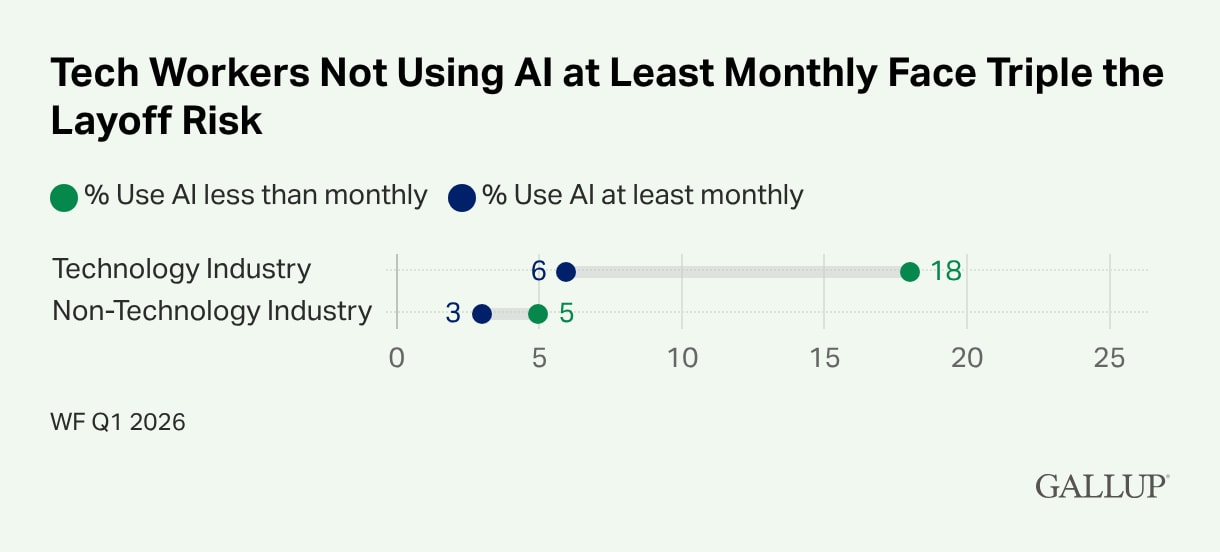
The gap held after controlling for age, education, industry, and the length of time since being laid off, according to Gallup researchers. Outside the technology sector, infrequent AI users also face elevated layoff risk compared to more frequent users, though the gap is smaller.
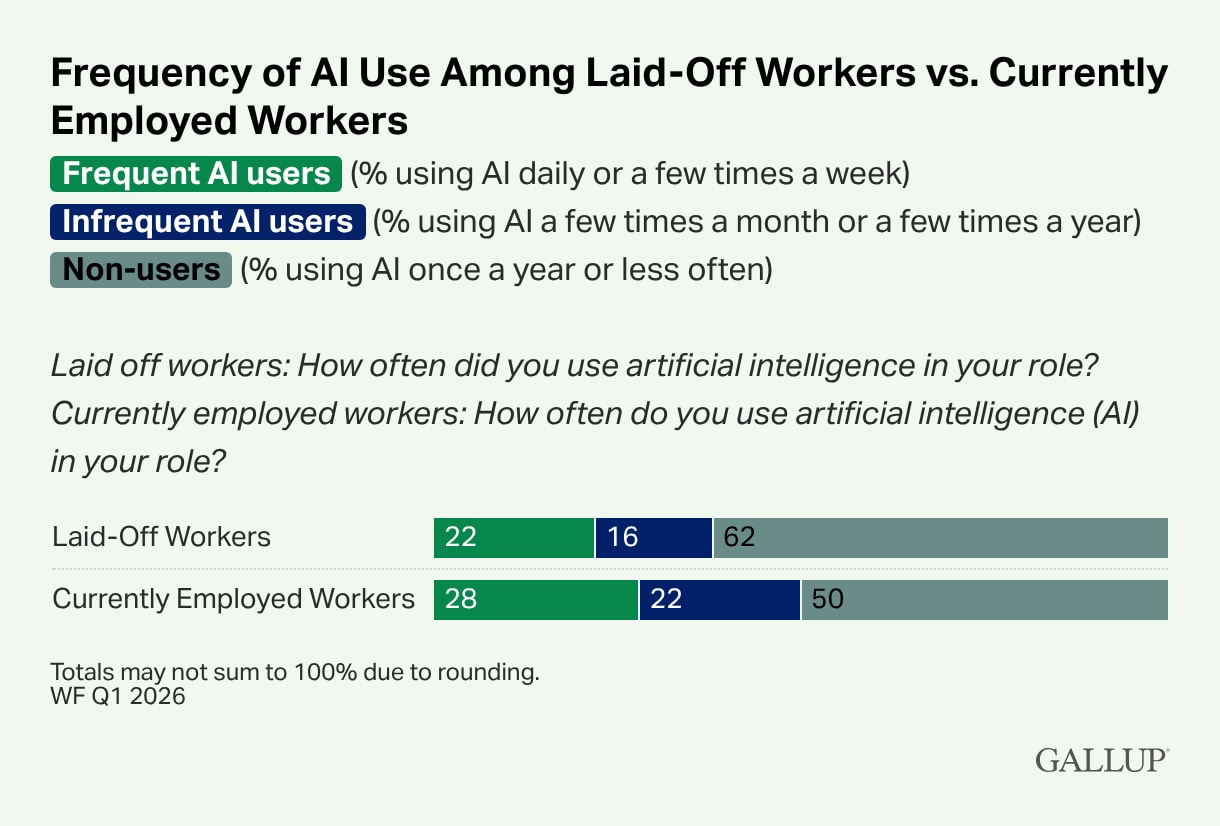
The data produced one striking contradiction. Only about 1 per cent of laid-off workers attributed their job loss directly to AI, with most citing organisational restructuring, cost-cutting, or economic conditions instead.
The Gallup researchers themselves said this figure may understate AI’s indirect influence on layoff decisions. Jim Harter, chief scientist for Gallup’s workplace management and wellbeing practice, said the disconnect surprised him. “They didn’t just blame AI,” he said.
That gap between worker perception and corporate action is wide. AI was the top reason companies cited for job cuts last month, accounting for roughly 40 per cent of such announcements, according to outplacement firm Challenger, Gray & Christmas.
Harter cautioned against reading the numbers as a case for measuring employee productivity by AI usage frequency. Tying performance reviews to how often someone prompts a chatbot would push workers to game the system. “The real bottom line is: Are they more productive?” he said.
China’s Parallel Problem
The same pressure is playing out differently in China, where Beijing has set a target of 70 per cent AI adoption across key sectors by next year while simultaneously telling companies to protect jobs.
The country’s largest private-sector tech firms, from Alibaba to Tencent, are leading AI deployment but their executives have taken pains to signal commitment to employment. JD.com founder Richard Liu recently pledged to do everything possible to protect his company’s 900,000-strong workforce from automation.
The pledge runs against JD.com’s own reported operations. As recently as last year, Liu told a conference that robots had replaced 90 per cent of humans at the company’s Beijing sorting centre. Alibaba, valued at $266 billion, has quietly begun headcount reductions through gradual cuts and attrition, according to Reuters, citing an engineer at the company.
Citibank estimates that 9.6 per cent of Chinese jobs, roughly 70 million roles, are highly exposed to AI-driven displacement at a time when youth unemployment stands at around 17 per cent. A record 12.7 million graduates are entering the workforce this summer.
Reuters Breakingviews described Beijing’s conflicting policy goals as a constraint that could slow Chinese AI innovation relative to Western competitors who face fewer restrictions on restructuring.
What It Means for India
The Gallup numbers land differently in India, where the stakes around IT employment are not simply corporate but socioeconomic.
India’s IT sector employs roughly six million people and has, for over three decades, absorbed a substantial share of the country’s engineering graduates, with the sector previously taking in around 1.5 million new hires per year.
In the past three years, that figure has declined to near zero, according to analysts cited by Outlook India. Fresh graduate recruitment at the four largest IT exporters collapsed by 70 per cent between fiscal years 2023 and 2024, falling from 225,000 to 60,000 hires, while TCS and Infosys shed a combined 38,000 employees in fiscal 2024, the sector’s first workforce contraction in decades.
The downstream effects are visible. House sales in India’s top cities fell 13 per cent in the first quarter of 2026, with economists at CareEdge Ratings pointing to IT sector layoffs as a contributing factor.
Demand for paying-guest accommodations in Bengaluru dropped sharply enough that PG owners publicly attributed it to the tech slowdown.
A 2025 analysis by EY estimated that entry-level IT roles had already declined by 20 to 25 per cent due to automation.
NASSCOM reported that workforce growth in India’s tech sector slowed to 2.3 per cent in FY26, even as the broader industry continued to expand.
The skills picture makes the Gallup finding directly relevant. NASSCOM projects that AI-related job demand in India will cross one million roles by 2026, but as of the Ministry of Electronics and IT’s last estimate, only about 16 per cent of Indian IT professionals are AI-skilled.
Nearly 51 per cent of AI and machine learning roles remain unfilled, according to the World Economic Forum.
NASSCOM estimates that 60 to 65 per cent of India’s current workforce will need significant reskilling by 2030. McKinsey’s research goes further, projecting that AI and related technologies could automate tasks accounting for up to 70 per cent of employees’ time across industries.
The Gallup data offers a specific frame for what that gap costs at the individual level. Workers who do not make AI a regular part of their daily workflow are not just losing a productivity edge. They are, the data suggests, losing job security. For an IT workforce that once reliably converted engineering degrees into white-collar stability, that is a structural shift with no obvious floor.
One must also note that Reuters itself has mandated that its staff use AI at least 20 times a month as baseline literacy, with Jane Barrett, the agency’s head of AI strategy, calling prompting skills no longer optional. “This is now an edict,” she said. “This is something everyone has to do.”
About the Author

Anoshito Banerjee is a digital journalist at CNN-News18, specialising in Indian foreign policy, global diplomacy, South and West Asian geopolitics, and strategic affairs. His reporting spans hard news…Read More
Read More
Source link
[ad_3]

