
India’s southwest monsoon continues to struggle across large parts of the country, with fresh data from the India Meteorological Department (IMD) showing a sharp rainfall deficit over key regions even as the crucial June rainfall season enters its second half.
According to the IMD’s region-wise rainfall map issued on June 19, the country has recorded only 3 mm of rainfall against a normal of 6.1 mm, leaving India with an overall rainfall deficit of 50 per cent. The situation is particularly concerning over Central India, which has emerged as the worst-hit region with a 60 per cent rainfall shortfall.
The data shows Central India received just 2.7 mm of rainfall compared to a normal of 6.7 mm. South Peninsular India is also facing a severe deficit of 58 per cent, while Northwest India remains 26 per cent below normal. East and Northeast India have recorded a deficit of 28 per cent.
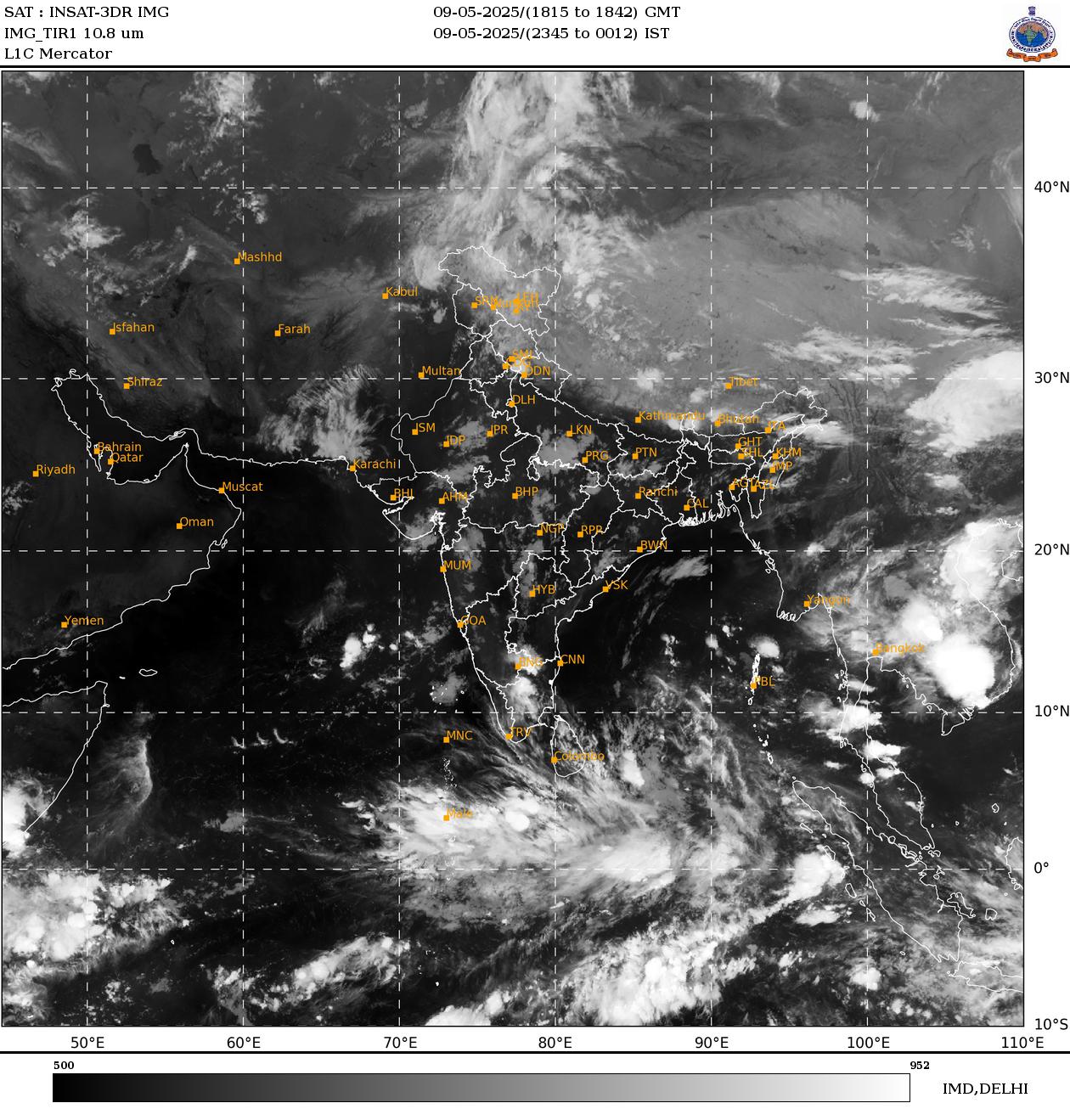
The latest satellite imagery released by IMD paints an equally worrying picture. Large swathes of Central India, including Madhya Pradesh, Chhattisgarh, Vidarbha and adjoining regions, remain largely cloud-free, indicating the absence of widespread rain-bearing systems.
Dense cloud bands are concentrated over the eastern Bay of Bengal, parts of the Northeast, and areas north of the Himalayas, while much of the monsoon core zone remains under weak convective activity.
Meteorologists say the monsoon has effectively “hit a wall” after its rapid advance during late May and early June. The current stall is being driven by a combination of factors, including persistent dry air intrusion from northwest India, a weaker-than-normal monsoon trough, and the absence of strong low-pressure systems over the Bay of Bengal.
The satellite image also reveals extensive cloud cover over Tibet and areas north of India, suggesting that weather systems are currently displaced away from the monsoon heartland. This has prevented moisture-laden winds from penetrating deep into central and northern parts of the country.
The prolonged break-like conditions are beginning to raise concerns for agriculture, particularly in rain-fed regions of Madhya Pradesh, Maharashtra and Chhattisgarh, where farmers are awaiting widespread sowing rains.
Delayed rainfall can impact crop planting schedules and soil moisture availability during the critical kharif season.
Forecasters, however, expect conditions to gradually improve after June 20 as the Somali Jet strengthens and moisture transport from the Arabian Sea increases. Weather models indicate that the weakening of dry air intrusion and the possible formation of fresh weather systems over the Bay of Bengal could help revive monsoon activity during the final week of June.
Until then, much of Central India remains stuck under clear skies, with the monsoon clouds still frustratingly out of reach.
– Ends
Source link
[ad_3]

