
New Delhi32 minutes ago
- Copy link
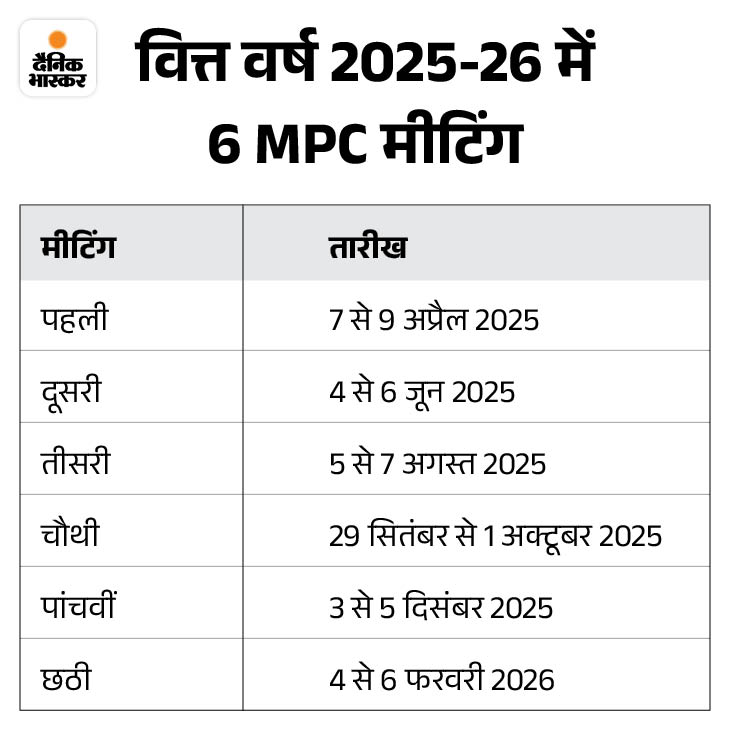
RBI’s Monetary Policy Committee consists of 6 members. Of these, 3 are of RBI, while the rest are appointed by the central government. This meeting takes place every two months.
The meeting of the Monetary Policy Committee (MPC) of the Reserve Bank of India (RBI) is starting today i.e. on Monday, August 4. After this three -day meeting, on Wednesday, August 6, Governor Sanjay Malhotra will give information about the decisions taken at the meeting.
RBI is expected to deduct 25 basis points (0.25%) in interest rates this time too. Experts also believe that America’s tariff war and global uncertainty can affect GDP growth. In such a situation, RBI can make one last cut so that growth can support.
There has been 1% cut in 3 consecutive times
RBI has cut interest rates by 1% in three consecutive times this year. In the meeting held in February, the interest rates were reduced from 6.50% to 6.25%. This deduction was done by the Monetary Policy Committee after about 5 years.
The interest rate was reduced by 0.25% in the meeting held in April for the second time. The rate was cut for the third time in June. Currently the repo rate is at 5.50%. The repo rate is the interest rate on which banks take loans from RBI.
When RBI reduces the repo rate, banks get cheaper debt, and they bring this advantage to the customers. That is, loans like home and auto will become cheap by 0.50% in the coming days.
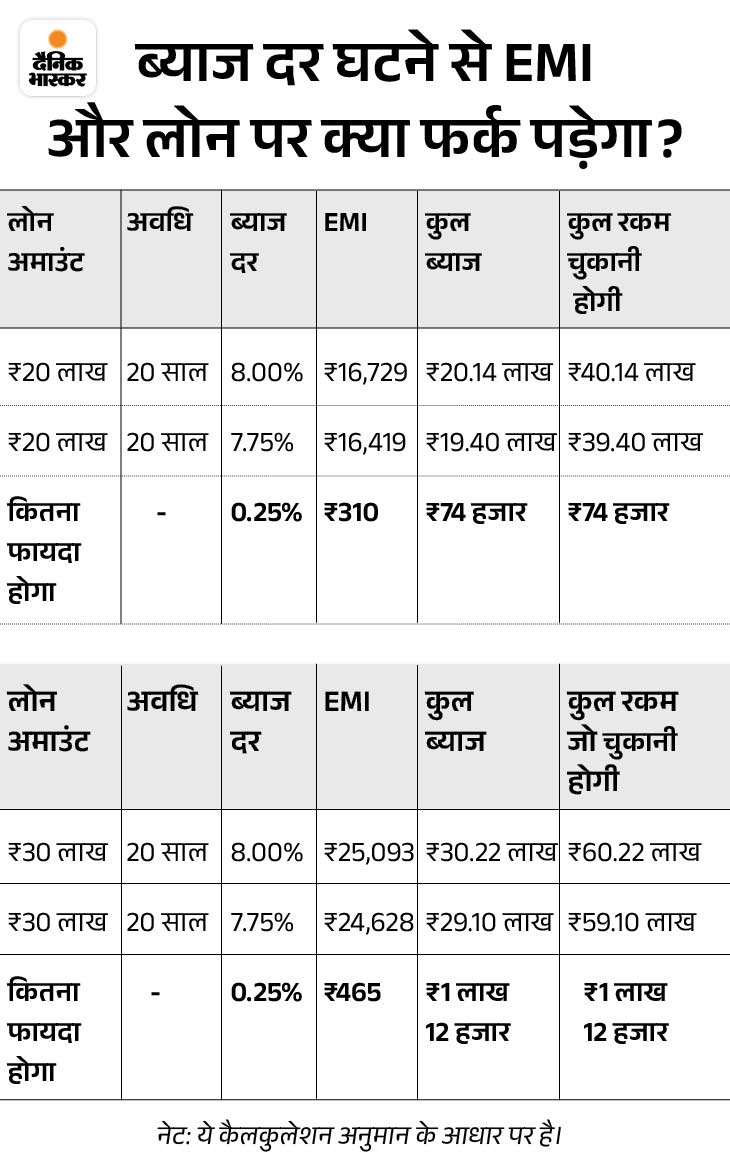
What will be the change due to decrease in repo rate?
After decreasing the repo rate, banks can also reduce their interest rates on loans like housing and auto. All your loans can be cheap and EMI will also decrease. If the interest rates are low, housing demand will increase. More people will be able to invest in real estate.
Why does the Reserve Bank increase and reduce the repo rate?
Any Central Bank has a powerful tool to fight inflation as a policy rate. When inflation is very high, the Central Bank tries to reduce money flow in the economy by increasing the policy rate.
If the policy rate is high, then the loan from the Central Bank to the banks will be expensive. In return, banks make loans expensive for their customers. This reduces money flow in the economy. If the money flow is low, there is a decrease in demand and inflation decreases.
Similarly, when the economy goes through a bad phase, there is a need to increase money flow for recovery. In such a situation, the Central Bank reduces the policy rate. This makes banks cheaper from central bank and customers also get loans at a cheaper rate.
———————–
Read this news too …
1. Now paying a loan will not be charged on earlier time: RBI’s new rule will be applicable from 1 January 2026, know the important things related to it
The Reserve Bank of India i.e. RBI has given relief to those taking loans. Actually, RBI has decided to abolish pre-payment charge on loans with floating interest rate. This new rule of the Reserve Bank will be applicable from 1 January 2026.
2. Loans will be cheap, RBI reduced the interest rate by 0.50%: In 20 years, the benefit of about ₹ 1.48 lakh on a loan of 20 lakhs; Understand complete mathematics
Loans will become cheap in the coming days. The current EMI will also decrease. RBI has reduced the repo rate from 0.50% to 5.50%. The decision to cut this deduction was taken in the meeting of the Monkey Policy Committee from June 4 to 6. RBI Governor Sanjay Malhotra gave this information on 6 June.
Source link
[ad_3]

