
Last Updated:
Nicobar Tribal Council demands withdrawal of 2022 certificate recognizing forest rights, citing it’s false and requests for island development before the trans-shipment port.




Great Nicobar lies on the western approaches to the Strait of Malacca, one of the world’s busiest maritime corridors. (Getty)
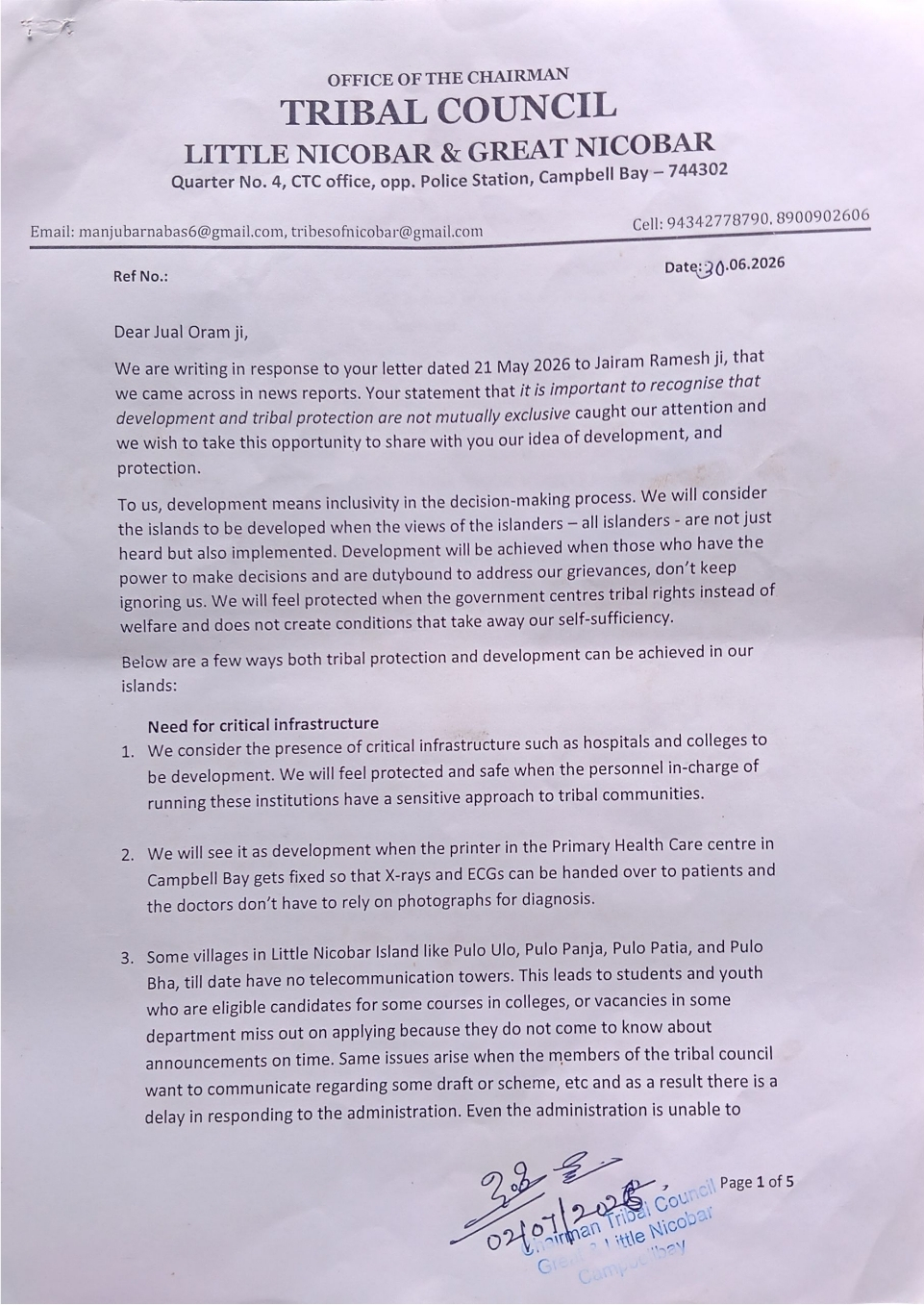
On June 30, the Tribal Council of Little Nicobar and Great Nicobar wrote to Union Tribal Affairs Minister Jual Oram, demanding he withdraw a 2022 government certificate that declared forest rights on their land “recognised and settled.”
The council, which represents Nicobarese tribal communities across the two islands, called the certificate false in a signed letter, and said it had cleared the way for a Rs 81,000-crore infrastructure project that requires felling close to a million trees across their ancestral forest.
In Campbell Bay, the island’s administrative headquarters, doctors at the primary health centre still diagnose patients using photographs of X-rays and ECGs, because the facility’s printer does not work.
The tribal council raised it directly in their letter: fix the printer, they wrote, and patients would not have to wait on a diagnosis made from a photograph.
The letter was obtained by News18 through Dr Pankaj Sekhsaria, associate professor at the Indian Institute of Technology (IIT) Bombay’s Centre for Technology Alternatives for Rural Areas (CTARA). To view the letter in its entirety, please click here.
What’s Being Built
The Great Nicobar Island project covers 166 sq km on the island’s southern coast and includes a transshipment port, a civil and military airport, a township, and a 450-MVA gas and solar power plant.
About 130 sq km of the project area lies on forest land, and clearing it will require felling close to a million trees. Two tribal groups live on the forest the project will clear: the Nicobarese, who live along the coast, and the Shompen, a largely uncontacted community in the island’s interior.
The Dispute Over The “False” Certificate
At the centre of the tribal council’s demand is a Recognition of Forest Rights (RoFR) certificate issued on August 18, 2022, by the Deputy Commissioner of Nicobar district. The certificate stated that forest rights over the project-affected land had been recognised, settled, and approved for diversion under the Forest Rights Act, 2006, a law that requires forest rights claims to be settled before forest land can be diverted for a project.
That certificate is what allowed the Environment Ministry to grant clearances for the Great Nicobar project later that year. The tribal council disputes that any such settlement took place. In a five-page letter dated June 30 and addressed to Oram, the council and its village captains demanded the certificate’s withdrawal, calling it false.
The sequential timeline behind the certificate is on point. The Lieutenant Governor constituted a Sub-Divisional Level Committee (SDLC) on July 26, 2022. Sixteen days later, on August 12, a gram sabha “unanimously resolved” to allow the diversion of 166 sq km of forest land. The SDLC met the next day, August 13, and concluded that no rights were being infringed.
The Deputy Commissioner’s office issued the certificate five days after that, on August 18. Titus Peter, a Nicobarese leader from Pulo Bhabi village in Great Nicobar and a signatory to the June 30 letter, told Mongabay-India in January that no formal recognition of forest rights had been made under the Forest Rights Act.
A separate case in the Calcutta High Court, filed by former Union government secretary Meena Gupta and admitted for hearing in May 2026, alleges that the gram sabha was led primarily by non-tribal settlers and that “not a single claim for forest rights… has been processed,” on the island.
The letters from the Gram Sabha, and from the Office(s) of the Deputy Commissioner of Nicobar have been obtained courtesy of Mongabay India.
Who Signed The Letter?
- Barnabas ManjuChairman, Tribal Council of Little and Great Nicobar Islands
- Moses IsraelVice Chairman / Deputy Chairperson, Tribal Council of Little and Great Nicobar Islands
- Titus Peter1st Captain, Pulo Bhabi, Great Nicobar
- Burnet1st Captain, Chingenh, Great Nicobar
- Augustine Nicodemus1st Captain, Pulo Panja, Little Nicobar
- Haggie1st Captain, Pulo Bha, Little Nicobar
- Benjamin2nd Captain, Pulo Ulo, Little Nicobar
- Titus RufusCaptain, Afra Bay, Great Nicobar
- Andrew1st Captain, Makachua, Little Nicobar
- Timothy1st Captain, Pulo Patia, Little Nicobar
What “Development” Means To The Islanders
The council’s June 30 letter was a direct response to a statement by Oram, who had written to fellow MP Jairam Ramesh on May 21 that “it is important to recognise that development and tribal protection are not mutually exclusive.”
The tribal chiefs used the letter to lay out, point by point, what development means to them. “To us, development means inclusivity in the decision-making process,” the council wrote.
“Development will be achieved when those who have the power to make decisions and are dutybound to address our grievances, don’t keep ignoring us.” The letter listed sixteen specific grievances.
Among them:
- Denial of basic amenities: The council was denied permission to clear a few trees for a children’s playground in the New Chingenh tribal colony because the land is classified as forest, even as far larger stretches of forest and coastline have been cleared for the project.
- Decaying infrastructure: Tsunami shelters at Rajiv Nagar, where displaced families have lived since the 2004 tsunami, were built more than 20 years ago and need repair. The council says the local administration cites a lack of budget, while telling residents they can have “anything” they want once they surrender their land for the project.
- Digital exclusion: Pulo Ulo, Pulo Panja, Pulo Patia and Pulo Bha have no telecommunication towers, which the council says cuts off residents from job and college applications and from mandatory online registration for schemes like MGNREGA.
- Ration failures: Villages including Pulo Bha, Pulo Panja, Pulo Ulo and Makachua get electricity for only eight hours a day, and the shift to digitised ration collection means residents who walk to the ration shop sometimes find the device cannot operate.
- Lack of connectivity: A footpath between Pulo Panja and Makachua, requested for years, remains unbuilt. Without it or a phone network, the council says Pulo Panja’s residents are cut off in emergencies and from inter-island ferries at Makachua jetty.
A Plea For Autonomy And Protection
The letter also raises concerns that go beyond infrastructure. The council wants wildlife sanctuaries declared on Little Nicobar, Menchal and Meroe, which it says were notified without consultation, to be withdrawn.
It objects to geo-surveillance and area demarcation proposed under the Great Nicobar project, calling it intrusive and a violation of the rights of both the Nicobarese and the Shompen. The council is also asking for strict implementation of SC/ST reservation in government postings, pointing to a recent recruitment for Auxiliary Nurse Midwife where it says no reservation was applied despite qualified candidates being available locally.
It also wants buffer zones set up to keep commercial trawlers from depleting fish stocks that tribal families depend on for food. The letter closes by returning to the council’s original point: development, to the tribal chiefs, means being included, not excluded.
“To us, development is having an inclusive mindset, and making the best use of existing land and infrastructure in this remote area,” it says. “We refuse being bystanders while our lands and seas get ravaged by outsiders’ notions of development, and the consequences of which will be borne by our future generations.”
The Deputy Commissioner of Nicobar’s office did not respond to requests for comments. The story will be updated in case a reply is received.
About the Author

Anoshito Banerjee is a digital journalist at CNN-News18, specialising in Indian foreign policy, global diplomacy, South and West Asian geopolitics, and strategic affairs. His reporting spans hard news…Read More
Read More
Source link
[ad_3]

