
India has more wild tigers today than at any point in half a century. It is also, right now, losing them to a disease most people associate with domestic dogs.
In Madhya Pradesh’s Kanha Tiger Reservea tigress and her four cubs died in quick succession in late April and early May. Conservationists waited for the laboratory results to ascertain what caused it.
The primary suspect behind the death? Canine Distemper Virus (CDV).
WHAT IS CDV AND HOW DOES IT INFECT TIGERS?
CDV is a highly contagious illness that passes between dogs through respiratory droplets, saliva and close contact.
For decades, it was a domestic animal problem, but it has now seemed to have spread across India’s tiger population.
Forests have shrunk in recent decades, and villages have crept closer to tiger reserve boundaries. The land now shared by man and beast has led to the virus moving through the same corridors that tigers use.
Tigers are thought to contract CDV through direct contact with infected animals. That contact could happen in a number of ways.
Stray and feral dogs near buffer villages are considered one potential source behind the spread of the virus. The virus could spread to tigers who end up hunting and eating the dogs, or even if they eat another carnivore that might have eaten an infected dog.

It’s a legitimate mode of transmission, but science is less settled on dog encounters being the sole reason.
A 2020 study found that other local wildlife, apart from domestic dogs, was the primary source of CDV transmission to tigers.
WHAT DOES CDV DO TO TIGERS?
CDV, like any other virus, impacts its host in a devastating manner. And as of now, it remains without a treatment.
Once it makes its way to a tiger’s body, the virus initially attacks the respiratory and gastrointestinal systems before progressing to the central nervous system. Once there, the virus acutely affects the behaviour of the infected tiger. Some behavioural signs include a blatant loss of fear and absence of normal aggressive responses.
In some cases, tigers have been seen staggering through the forests, unaware of their surroundings, barely walking in a straight line, as if they were inebriated.
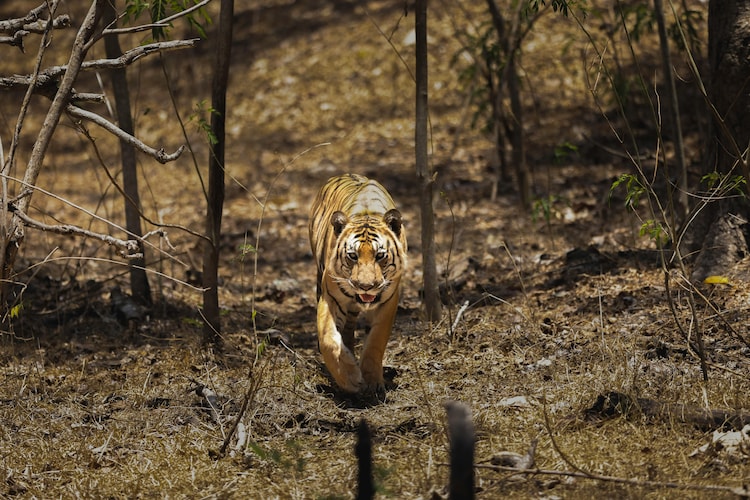
Furthermore, neurological cases in wild tigers are invariably fatal. And unlike a case of poaching or a wound due to a territorial fight with another tiger, CDV leaves no obvious trace.
Sick tigers often vanish deep into the forest before they die.
That invisibility is what makes CDV so dangerous.
In reserves with high tiger density, one infected animal can expose cubs, siblings and mating partners, sometimes an entire social cluster, to the fatal disease before anyone even gets a hint of an outbreak.
A WILDLIFE CRISIS
India’s 2022 tiger census recorded an estimated 3,682 wild tigers, approximately 70% of the global wild tiger population.
That number, celebrated as a conservation triumph, is now in jeopardy because of CDV.

More tigers, living closer together, in landscapes increasingly fractured by human settlement, means more opportunities for the disease to move.
Madhya Pradesh, which holds the country’s highest concentration of tigers, recorded 55 tiger deaths in 2025, the highest annual toll since the launch of Project Tiger in 1973.
This year the state has already seen 28 tiger deaths recorded by early May alone.
Though not all of those deaths involved CDV. Other factors like electrocution, road and rail accidents, poaching and territorial fights also contributed.
But wildlife scientists warn that the infectious disease has crept onto this list without receiving anywhere near the same attention as threats that leave more visible evidence.
LOOKING AHEAD
The challenge is that it’s hard to assess the scale of the problem or provide treatment in the wild.
Wild tigers cannot be isolated, or easily captured for treatment in dense forest regions. That leaves prevention as the only realistic solution to the problem. And in the case of CDV, prevention means looking beyond the tigers themselves.
Forest departments are stepping up carcass testing and surveillance around reserve boundaries. Vaccination drives for village dogs at the forest’s edge are gaining traction.
And it needs to.
Because the next threat to India’s national animal may not come from a trap or a gun but from a virus bouncing between dogs and tigers.
– Ends
Source link
[ad_3]

