
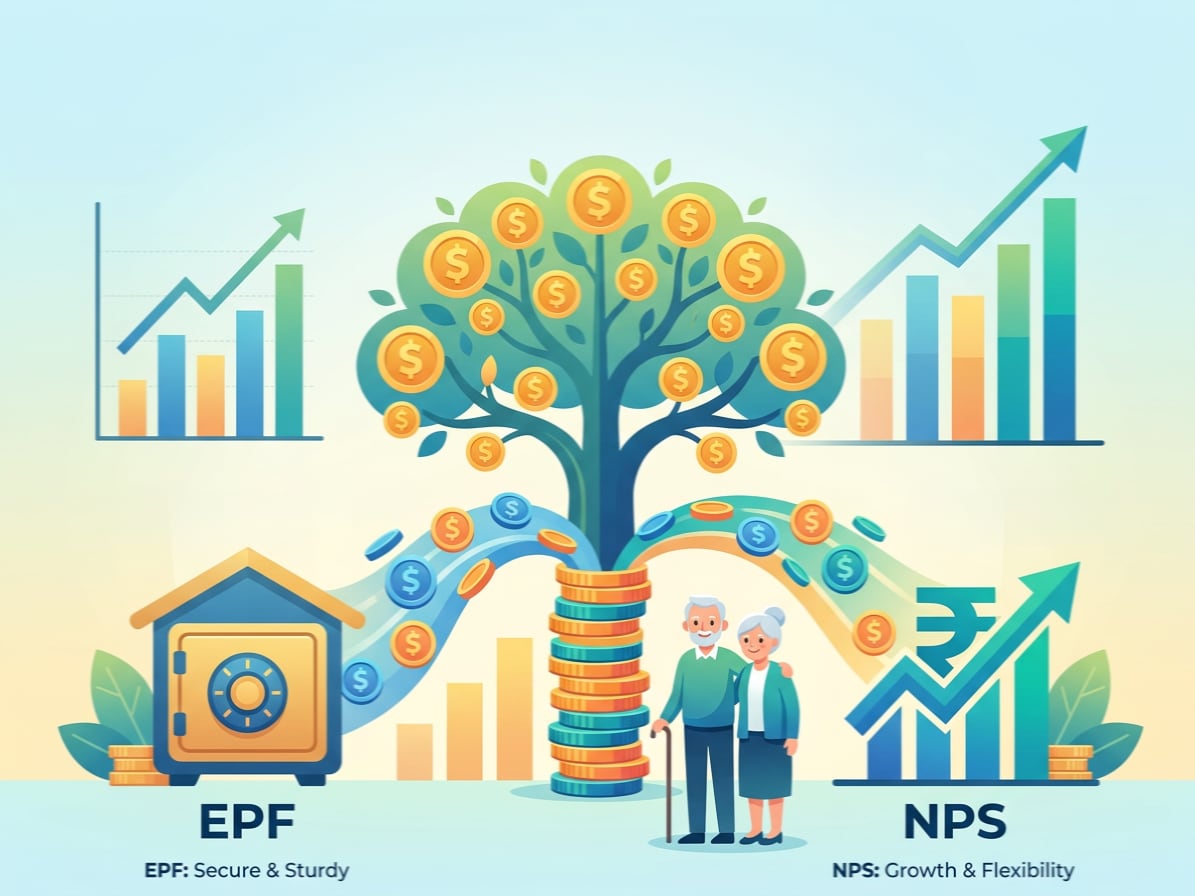
When it comes to retirement planning, salaried employees often think they have to choose between EPF and NPS. But it does not have to be an either-or decision. Eligible employees can have both EPF and NPS, allowing them to build retirement savings through two different avenues. While EPF is linked to your salary and employer, NPS is a market-linked retirement investment option. Understanding how the two work together can help you plan your long-term finances better. (Image: AI-Generated)
Can You Have EPF And NPS Together?
Yes. Having an EPF account does not prevent an employee from subscribing to NPS. The two are separate retirement savings schemes and can be maintained simultaneously, subject to the applicable rules. EPF is generally part of the retirement benefits provided through employment. Both the employee and employer make contributions under the applicable EPF rules. NPS, on the other hand, is a defined-contribution pension system in which the accumulated money is invested in market-linked assets. (Image: AI-Generated)
How Does EPF Work?
Under the standard EPF contribution structure, an employee contributes 12% of eligible wages, while the employer also makes a contribution. A part of the employer’s contribution goes towards the Employees’ Pension Scheme (EPS), subject to applicable rules. EPF provides a structured way of building retirement savings through regular contributions made from your salary. (File Photo)

How Does NPS Work?
NPS allows subscribers to invest regularly for their retirement, with the money invested in market-linked asset classes. Depending on the applicable model and employer’s policy, contributions can be made by the employee, employer or both. Unlike EPF, NPS offers different investment choices and is designed specifically as a long-term retirement product. (File Photo)

Can Your Employer Contribute To Both?
This depends on the retirement-benefit structure offered by your employer. Some organisations provide NPS as an additional benefit alongside EPF, while others may offer it as part of their salary or retirement-benefit structure. Employees should therefore check their company’s NPS policy and salary structure to understand whether an employer contribution is available. (File Photo)

What About Tax Benefits?
EPF and NPS have different tax provisions. NPS can offer deductions for eligible contributions, including employer contributions under Section 80CCD(2), subject to applicable limits and the tax regime chosen. The tax treatment of contributions, interest, withdrawals and retirement benefits can differ, so it is important to check the latest rules before making a decision. (File Photo)

Why Use Both EPF And NPS?
The two schemes work differently and can therefore serve different roles in retirement planning. EPF can continue to provide regular, employment-linked retirement savings, while NPS can add a separate market-linked investment component. However, NPS has specific rules governing withdrawals and exit, and its returns are linked to the performance of the underlying investments. (Image: AI-Generated)
Source link
[ad_3]

