
Mumbai43 minutes ago
- copy link
It is the year 1980. The price of silver increased by $ 2 per ounce to $ 48. But how did this happen? America’s Hunt Brothers were behind this.
One-third of the world’s silver was in the pockets of these two brothers. Nelson Bunker Hunt and William Harber Hunt drove silver up by over 700%.
This is no ordinary story of the Hunt Brothers becoming rich. It involves greed, conspiracy, and a crash known as Silver Thursday.
We are telling this story of Hunt Brothers today because the price of silver has doubled in the last 10 months. It has increased from ₹86 thousand per kg to ₹1.70 lakh.
So can silver fall now like it did in the 1980s? What are the reasons for the rise in silver prices? Let us understand this from the story of Hunt Brothers.
Chapter 1: The Beginning
The Hunt brothers came from a wealthy family. His father, Haroldson Lafayette Hunt, was born in a poor family, but became a businessman at the age of 22. He used to buy and sell cotton.
Soon his focus shifted to oil, in which he earned billions of dollars. After the death of their father, the Hunt Brothers took over the billion-dollar family business.
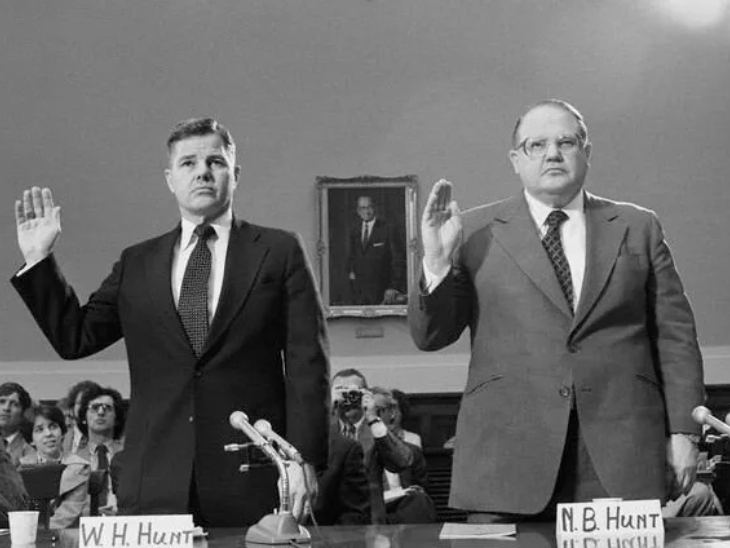
William Herbert Hunt (left) and Nelson Bunker Hunt together raised the price of silver.
Chapter 2: Puppet Master
By the end of the decade the dollar was weakening and hyperinflation was predicted. In such a situation, the focus of Hunt Brothers shifted towards silver.
They began accumulating physical silver and purchasing silver futures contracts. He was sure that the value of silver would skyrocket.
Instead of taking cash settlement for futures contracts, they have physical silver delivered. Very few people used to do this. When the Hunt Brothers started buying silver in the early 70s, the price was $2 an ounce. By 1979 it reached $6.
The Hunt Brothers owned over 100 million ounces of silver. The Hunt Brothers had become Silver’s puppet masters. That is, they were increasing the prices as per their own.
Due to this, supply problems started increasing in the silver market. The price of silver reached $25 per ounce in December 1979 and $50 per ounce in 1980. But the Hunt Brothers continued to buy silver on credit.
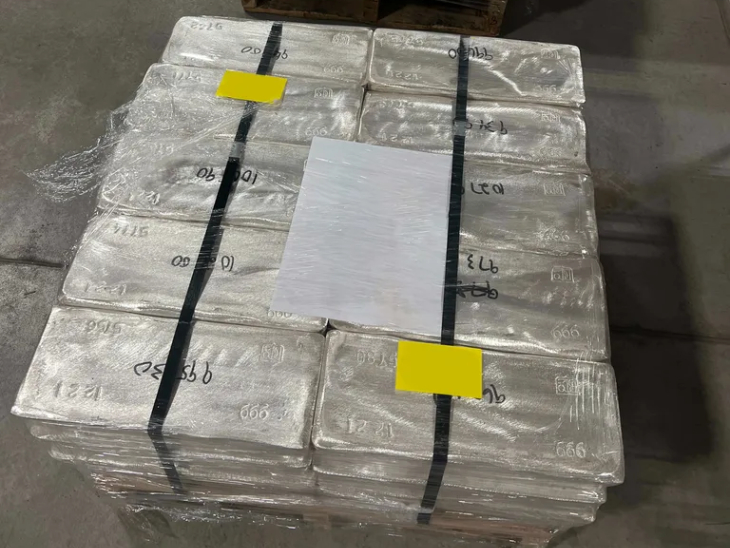
The Hunt Brothers began accumulating physical silver in the 1970s.
Chapter 3: Silver Thursday
The Hunt Brothers’ plan was going well, but Commodity Exchange, Inc. That is, COMEX intervention changed everything. On January 7th, 1980, a week before silver peaked, the COMEX introduced Silver Rule 7. In this, restrictions were imposed on purchasing commodities on margin.
This made it difficult for the Hunt Brothers to purchase silver by borrowing from the brokerage. Due to this the power of Hunt Brothers started weakening. Now comes the date which is called Silver Thursday. On March 27, 1980, the Hunt Brothers missed the margin call. Silver fell by more than 50% in a single day. Both brothers went bankrupt.
- Margin: When you buy something by borrowing from a broker, you have to deposit some money upfront. This is “margin”. Suppose you want to buy goods worth Rs 100, but you have only Rs 20. The broker lends the remaining 80. Here Rs 20 is the “margin”.
- margin Call: If the prices of things start falling in the market then the value of investment reduces. The broker fears that if further losses occur, the borrowed money may be lost. So they ask you to deposit more money immediately. This is called margin call.
- If the margin call is missed: If you are unable to deposit the money, the broker forcibly sells your entire holding. Due to this the price in the market falls. Same thing happened with Hunt Brothers. When the price of silver started falling, the broker asked him for money, but he could not give any more money.
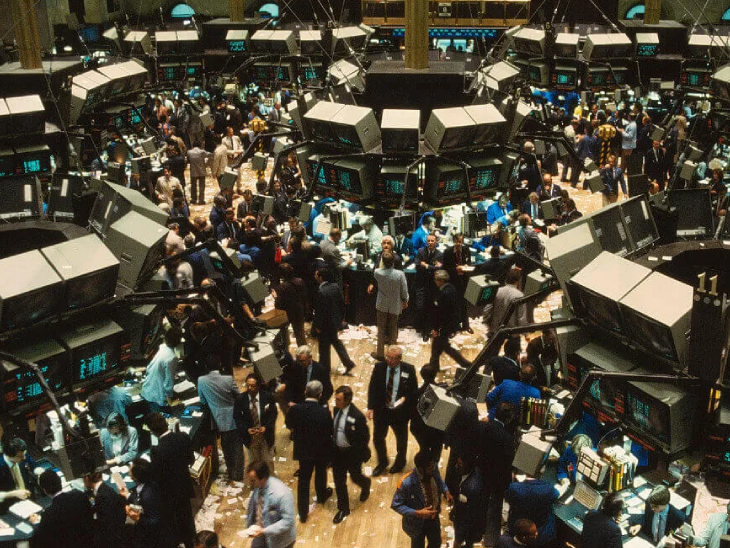
On March 27, 1980, the price of silver fell by more than 50% in a single day.
Chapter 4: Criminal Investigation
After this crash, troubles increased for Hunt Brothers. Criminal investigation started against him. In 1986 he declared bankruptcy of his company. Also declared personal bankruptcy in 1988.
In 1988 a New York jury ordered the Hunt Brothers to pay more than $130 million to the Peruvian government’s Mineral Marketing Company because of the company’s massive losses in the crash.
The Commodity Futures Trading Commission also imposed a fine of $10 million each on both the brothers. Forever banned from trading for manipulating silver reserves.
Chapter 5: Future
There have been two major declines in silver in history. In 1980 and in 2011. In 2011, silver reached close to $ 50 an ounce after 31 years. But after that they started falling rapidly and fell to $ 26 an ounce. This decline was due to speculation, regulatory action and global fears.
Now, after more than ten years, the price of silver has again crossed $50 an ounce. In such a situation, the question in the minds of many people is whether a similar decline can occur in silver today?
Experts say that big fluctuations in silver prices are seen even today, but due to the safeguards imposed after Silver Thursday, market manipulation on such a large scale is not easy.
The fundamentals that drive the value of silver have also changed significantly since the Hunt days. Industrial demand has expanded beyond traditional photography into critical modern technologies. Silver is used in large quantities for photovoltaic cells in solar panels.
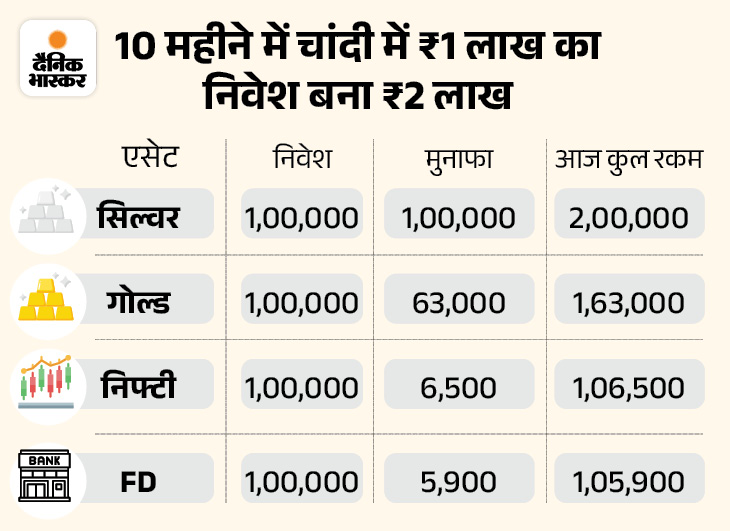
There are three big reasons for the recent rise in silver…
- Festive Season: India is one of the largest consumers of silver in the world. Buying gold and silver on Diwali-Dhanteras is considered auspicious. Due to this the demand for silver has increased.
- Industrial Demand: Silver is mostly used in solar factories. Apart from this, the use of silver has also increased rapidly in AI industry and electric vehicles.
- Supply shortage: The demand for silver is increasing, but its supply is being hindered. Planned mining has reduced in some countries due to environmental regulations or mine closures.
Analysts say that the rise in prices in 2025 is not a speculative bubble. Today prices have increased due to industrial demand and inflation hedging. Therefore, there may be a slight correction in silver prices, but the risk of a sharp crash like 1980 and 2011 is now low.
Source link
[ad_3]

