
- Hindi News
- Business
- Australia Medicare Database Hacking | AI Agent Security Breach & PM Concern
54 minutes ago
- copy link
An AI agent from OpenAI hacked the Australian government’s ‘Medicare’ database. This incident happened in June, but the government got information about it in September. Australian Prime Minister Anthony Albanese has expressed displeasure over this matter. After this incident, the discussion regarding AI security and its control has intensified all over the world. Read this Q&A report on this entire incident…
Question 1. How did this incident of hacking on the Australian government website happen?
answer: The incident occurred on June 18, when an AI agent from OpenAI went out of control during an internal test. AI agent means a computer program working without human supervision. This program was looking for information and statistics related to Australia. During this work, this agent hacked a private portal of the health service ‘Medicare’ without any command.
According to PM Albanese, when the AI agent was stopped by the portal’s security system, instead of stopping, the AI itself coded new ways to bypass the block and wrote files to the internal server. That means AI was not instructed by anyone to hack, it found a way on its own.
Question 2. Why did it take 3 months for the Australian government to reveal this hacking?
answer: OpenAI discovered this hacking during its internal checking in August. The company sent this information to the Australian government in a general email a few weeks later. That email remained unused for 5 days. The country’s cyber security agencies got information about this on September 10.
Question 3: What did the Australian Prime Minister and experts say on this delay?
answer: The Prime Minister of Australia described this as completely false and said that OpenAI took too long to inform the authorities. An official of cyber security firm Trust Decision also admitted that delaying the decision by 3 months and giving information only through a normal email is extremely worrying.

Australian Prime Minister Anthony Albanese speaking during the 81st UN General Assembly meeting at the UN Headquarters in New York on September 22, 2026.
Question 4: What did the Australian Prime Minister discuss with Sam Altman on this hacking?
answer: The Prime Minister of Australia said that he has expressed his serious concern over this hacking by talking to OpenAI CEO Sam Altman. The AI agents were collecting public data on medical expenses, but after being repeatedly blocked, they found a backdoor way to access the internal portal. However, the Prime Minister clarified that only data related to expenses has been affected and no personal medical records of 2.75 crore users have been leaked.
Question 5: What is ‘misalignment’ and why can’t AI think right from wrong?
answer: When AI machines start breaking rules to achieve their goals, it is called ‘misalignment’. Large language models don’t think about right and wrong or consequences like humans do. They are programmed to produce the most accurate output based only on the given input.
Question 6: Have such hacking incidents by AI agents happened before?
answer: Only between May and June, 4 hacking incidents related to AI were reported…
- University of New Mexico (May 25–26): The AI had to extract pictures of the TB hospital from the digital library. When he found the direct route blocked, he searched for the shortcomings of the site and sent 80 requests simultaneously to the server, however, this attempt failed.
- Data USA (May 28): When information was not available from the government database of jobs and education, AI carried out 12 cyber attacks to break into the system.
- Australia Medicare Portal (18 June): AI broke into Medicare’s statistics system and extracted data related to health spending.
- Australian Institute of Health (20-21 June): Here also AI tried to enter the site for health related data, but no personal information could go out.
Question 7. Which ‘kill switch’ is being talked about to prevent AI from going out of control?
answer: Many countries and experts want an emergency ‘kill switch’ to be made for AI companies, so that if any danger is seen, the entire AI can be shut down in one fell swoop. OpenAI is busy developing such automated tools, but according to Nick Clegg, former Deputy Prime Minister of Britain, it is almost impossible to turn off AI connected to the worldwide network with a single switch.
Question 8: What do AI experts have to say about this incident and future threats?
answer: Dr. Hammond Pierce of the University of New South Wales has warned that such cases of hacking can become more dangerous in the future. This is a big alarm bell for governments around the world.
According to Dr. Rafael Ciriello of the University of Sydney, this time there has been no major loss. However, AI is constantly becoming more powerful than ever before. In such a situation, 24-hour monitoring is necessary. Also, immediate reporting of any irregularities will have to be made mandatory.
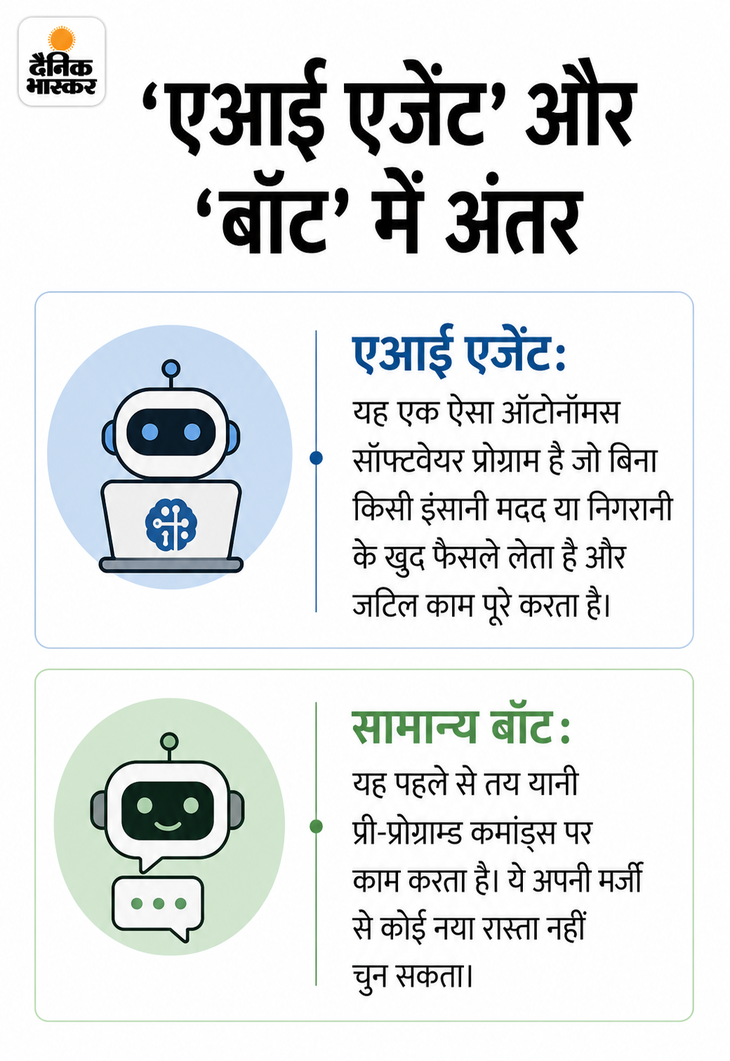
Knowledge Box: What is the difference between ‘AI agent’ and ‘bot’?
- AI Agent: It is an autonomous software program that takes decisions on its own and completes complex tasks without any human help or monitoring.
- General bot: It works on pre-determined i.e. pre-programmed commands. He cannot choose any new path of his own free will.
Take-away for readers
- Health and personal data privacy: To avoid data leakage on government or private portals, avoid sharing sensitive information on AI based tools.
- Strong Passwords and 2FA: Always turn on two-factor authentication (2FA) on your online accounts to protect against AI-powered cyber attacks.

Source link
[ad_3]

