
New Delhi:
Three months’ security. One month’s advance rent. Zero liability for the hostel if anything goes wrong. That is the deal students at Delhi’s now-collapsed ‘Hostel Daze‘ hostel appear to have signed up for, according to a rent agreement now circulating widely online, one day after the building came down and killed seven of its residents.
“The PG authorities are not responsible against any casualties or risk to me (student),” a line buried deep in the agreement’s fine print reads.
When one reads the document, it becomes impossible to ignore how one-sided the paperwork for renting out student accommodation in Delhi really is. Students hand over months of rent and security deposits upfront. In return, they get an agreement that appears to absolve the hostel of responsibility for their safety, even as it holds them to strict, non-negotiable terms on nearly everything else.
The rent agreement for Hostel Daze lists out the tenant’s obligations in detail. It requires payment of three months’ security along with one month’s advance rent, states that the security deposit will not be refunded under any circumstances before the agreement period ends, and warns that any damage to furniture or fixtures will be deducted from that deposit.
Read: From Dog Walk Row To Delhi Tragedy: IAS Officer Sanjeev Khirwar In Spotlight
It also bars students from sticking posters or stickers on the walls, and states that if a student leaves before their agreed period is up, for any reason, including expulsion on disciplinary grounds, no refund of hostel fees or security money will be given.
A separate terms and conditions document tied to the same hostel states that in case of “personal injury suffered/loss/damage of personal belongings of the tenant due to reasons beyond the control of the P.G. vize sealing/fire/earthquake/heavy rains/other natural calamities etc., the hostel will not be liable for paying any compensation.” It also gives hostel management the right to change a student’s room or hostel location whenever “circumstances” require it, and to evict any student immediately for disciplinary issues, with no refund.
The building at the centre of this, a five-storey structure in Satya Niketan that housed a boys’ hostel, was reportedly nearly 50 years old. It stood on around 55 square yards of land in a resettlement colony where permission had only ever been granted for a two-storey structure, according to a senior MCD official, and no building plan had been approved.
A few months ago, the building was in a dilapidated state, worn down by age and neglect. Its location, close to Delhi University, where thousands of students from across the country come to study, made it a valuable opportunity. The owner, Hari Ram Bansal, spent several months renovating the structure, and in August this year, the building began taking in tenants, most of them students, across around 30 rooms meant to house two to three students each.
However, construction work was reportedly still incomplete when the building collapsed. Labourers were working in the basement at the time, and two of the eleven people rescued were labourers, one of whom died in the incident.
Read: ‘Dad, You Will Be Proud’: Delhi Tragedy Victims’ Family Holds On To Memories
On 6 September, the Municipal Corporation of Delhi had issued an order for the neighbouring property, no. 13 in Satya Niketan, directing its owner or occupier to tear the structure down, citing a threat to residents, visitors, passers-by and neighbouring buildings. The building that collapsed was property no. 14, according to an MCD statement.
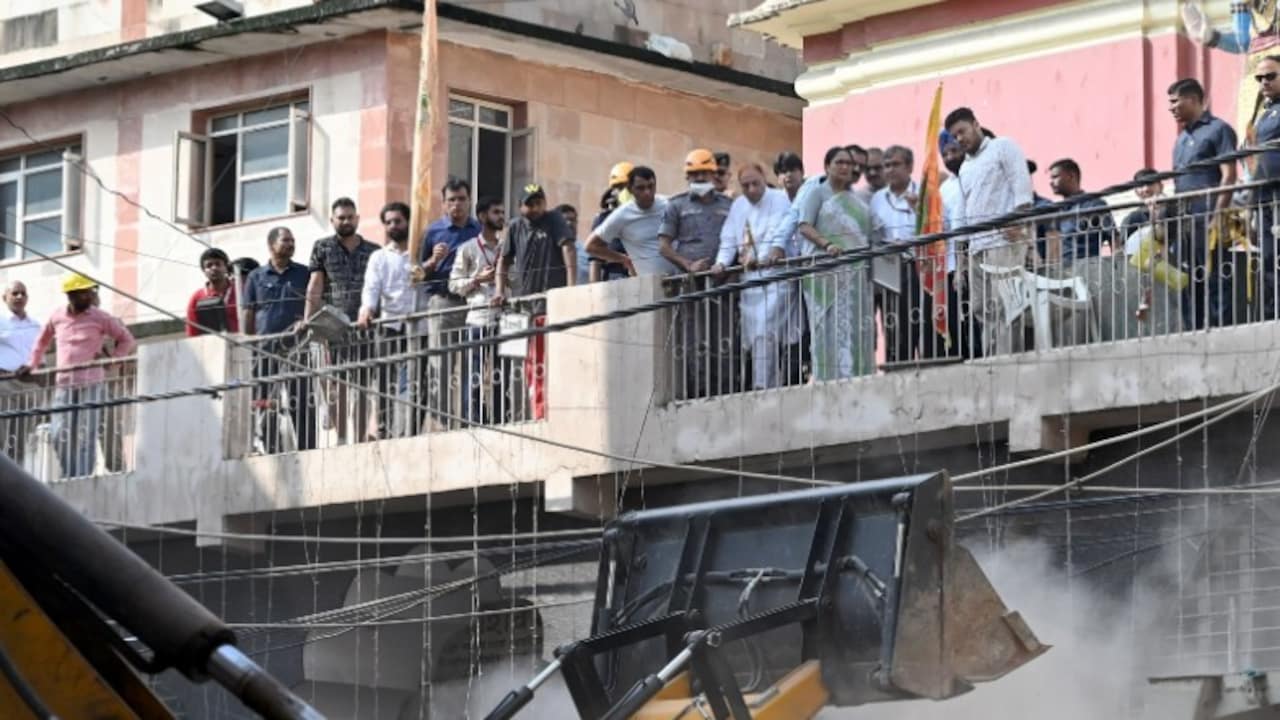
Notably, the building was residential, not meant for commercial use such as running a paying-guest hostel, raising further questions about how it came to house dozens of students in the first place.
The Delhi High Court has ordered a high-level investigation into the collapse, and observed that hostel facilities for students coming from outside the city are in a “pathetic condition.”
A day after the tragedy, the Delhi civic body suspended five officials with immediate effect: Deputy Commissioner (South Zone) Rakesh Kumar, Superintending Engineer Ranvir Singh, Executive Engineer (Building) Lalit Kumar Goel, Assistant Engineer (Building) Sunil Chauhan, and Junior Engineer (Building) Ashish Kumar of the South Zone.
Source link
[ad_3]

