
22 minutes ago
- copy link
Most ships passing through the Strait of Hormuz are hiding their identity or route. According to Al Jazeera’s report, 236 ships passed here between August 1 and 19, but the path of 148 ships could not be clearly traced.
These data indicate that despite Trump’s threats, many ships are using the Iranian route. This raises the question whether America or Iran currently has more influence in the Strait of Hormuz.
US President Donald Trump claims that the US military has control over maritime traffic passing through the Strait of Hormuz. He has also indicated that America may try to take responsibility for this area into its own hands.
At the same time, Iran says that no ship can pass through the Strait of Hormuz without the approval of Tehran. In such a situation, the biggest question between the claims of both the countries is who actually has control over this route.

Commercial ships passing through Hormuz near Bandar Abbas Port, Iran.
Different claims of Iran and America
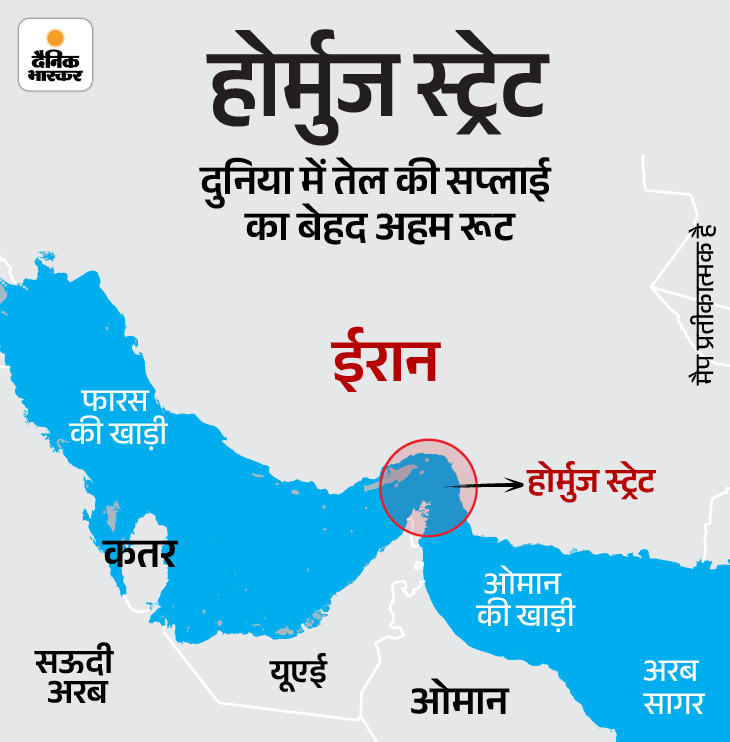
Trump has also threatened to bomb Oman. Oman is an ally of the US and is located on the other side of the Strait of Hormuz opposite Iran. The maritime area of the strait comes under the jurisdiction of both Iran and Oman.
Trump’s threat is said to be aimed at preventing Muscat from reaching an agreement with Tehran to jointly operate the Strait of Hormuz.
Hormuz divided into two paths after the war
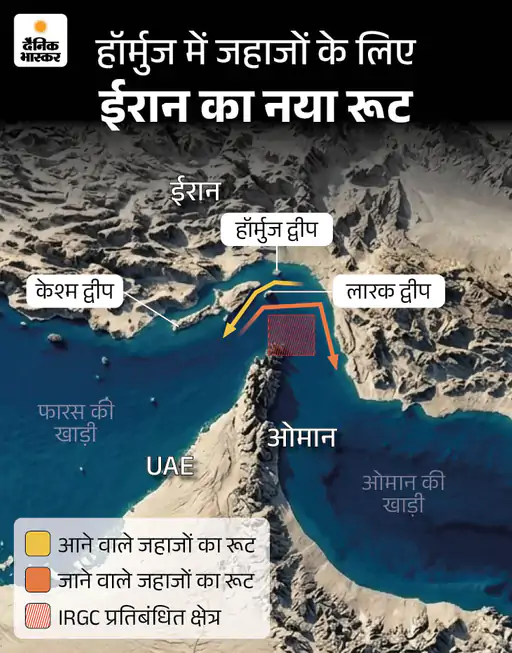
Before the war started, Hormuz was considered the only sea route. Ships used to pass through fixed routes. Their route was decided by looking at the port, the settlement of the ship and the safety. But after the tension between America and Iran increased, there was talk of two different paths.
Iranian way: It is near the coast of Iran in the northern part of Hormuz. It passes close to Larak and Qishm islands and goes to Iran’s ports and oil terminals.
Omani way: It is in the southern part of the Strait of Hormuz, close to Oman and off the coast of Iran. America insists on ships passing through this route. Many commercial ships operating under the protection of the US Navy also use this route.
The route of more than 80% of the ships is not known
According to maritime intelligence company Kpler, between August 1 and 19, 112 ships carrying oil, LPG and LNG passed through the Strait of Hormuz.
Of these, 21 ships openly went through the Iranian route, while only 2 ships used the Omani route.
The path of the remaining 89 ships was not clear. This means that during this period, the movement of more than 80% of the oil and gas ships passing through Hormuz could not be completely tracked.
This happens when ships turn off their Automatic Identification System (AIS). Sometimes the ship’s AIS data did not even match Kepler’s planned Iranian or Omani routes. In such a situation, it becomes difficult to find out which route the ship actually passed.
Iranian way ahead in all types of ships also
A total of 236 ships passed through the strait between 1 and 19 August. Apart from oil and gas, these also included ships carrying dry goods and chemicals.
- 83 ships went through Iranian route
- 3 ships passed through Omani route
- 2 ships took the old route
- The route of 148 ships could not be traced
That means, it could not be clearly known which route more than 6 out of every 10 ships passed through.
Why are ships turning off AIS?
After the war started, both Iran and America warned ships that did not follow their designated sea routes or rules. In some cases there were also attacks on ships.
For this reason many ships are switching off their transponders. This makes it difficult to ascertain their exact position and which path they are taking.
Neil Quilliam, associate fellow at Chatham House, a British think tank, told Al Jazeera that turning off transponders makes ship movements less visible. However, this also increases the risk to maritime security.
According to him, some shipping companies want to continue their business despite the danger, because they feel that the benefits from it outweigh the risks.
Goods are also being exchanged between ships en route.
One reason for switching off transponders is the transfer of goods between two ships at sea.
Energy expert Mark Ayub told Al Jazeera that some Gulf countries, including Saudi Arabia, Iraq and Kuwait, sent some consignments through the Omani route. For this, tracking of some ships was stopped and goods were handed over to other ships en route.
According to him, some Iranian ships are also using the Omani route. Its purpose is to avoid sanctions and US blockade.
Are the figures pointing towards Iran’s dominance?
148 Because the routes of the ships were not clear, it is difficult to determine how many ships actually passed through the Iranian or Omani route.
Still, one thing emerges from the available data. One in five ships openly passed through the Iranian route despite the US blockade and Trump’s threats.
Taking all types of ships together, 35% of ships publicly used the Iranian route. In comparison, the number of ships passing through the Omani or old route was very less.
This indicates that many ships are willing to use the Iranian route despite US threats. That means, in the current situation, the fear of angering Iran appears to be more effective than Trump’s threats.
Why is Hormuz so important to the world
Before the start of the US-Israeli war against Iran, about one-fifth of the world’s oil and LNG supplies passed through the Strait of Hormuz.
At that time about 130 ships used to pass through here every day. In comparison, only 236 ships passed through here in 19 days of August.
Iran closed the strait in early March and allowed only its friendly ships to pass through. Even after the signing of MoU with America on June 17, this waterway remains the biggest dispute in the talks between the two countries.
This crisis also affected the global oil market. Before the conflict began, Brent crude oil was around $66 per barrel. It reached $119 in March. The price later declined, but rose again as tensions increased. On Thursday morning, Brent crude oil was at $ 92.9 per barrel.
According to Neil Quilliam, if Tehran’s influence on shipping movements is perceived to be decreasing, then an important weapon of Iran’s pressure in negotiations with the US could be weakened.
—————————-
Read this also…..
Trump said – Economic attack will cut off Iran from the world: The countries which support Iran are ready to face the consequences.
US President Donald Trump has announced the biggest economic action ever against Iran. Read the full news here…

Source link
[ad_3]

