
Nearly 50 years after rebel Bengali poet Kazi Nazrul Islam was buried near the Dhaka University Mosque in 1976, Inquilab Manch student leader Sharif Usman Hadi has now been laid to rest. Hadi was murdered as part of a well-planned conspiracy.
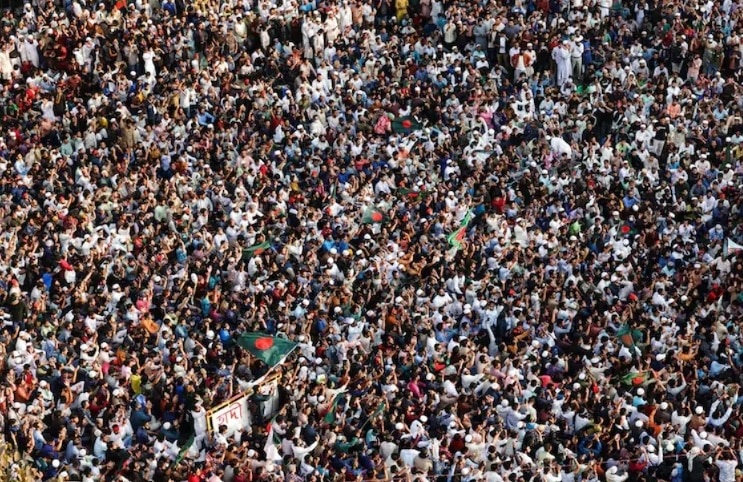
Hadi to be laid to rest on Saturday Dhaka A crowd gathered in the area. Millions of people took to the streets, thousands from nearby towns and cities reached the capital Dhaka and the entire city was filled for Hadi’s funeral procession.
Hadi has now been laid to rest next to ‘rebel poet’ Qazi Nazrul Islam. But bangladesh Many people are considering this similarity as natural. The way Nazrul’s poems became a weapon for Hadi, as can be seen in the viral reels and shorts. Similarly, the student leaders of ‘New Bangladesh’ have started presenting Hadi, a staunch leader opposed to Sheikh Hasina, as a ‘Biplobi’ i.e. revolutionary.
Hadi used to recite the lines of Qazi Nazrul Islam in his rallies. He used to repeat these lines and say that I am the storm, I am the whirlwind. I am the indomitable Rudra, the restless roar. The sky bursts with my laughter, the sky starts floating with my touch. I come as a flood, embrace the waves. I uproot trees, break roofs, play all the games of fear. I am a fire-breathing whirlwind, the dance of death floating in water. People tremble, cities tremble, dust falls at my feet.
Now it seems that after the anti-Sheikh Hasina rebellion, Hadi has been made Nazrul’s self-proclaimed successor. Sharif Osman Hadiwas the spokesperson of the anti-Sheikh Hasina political platform ‘Inquilab Manch’. The group emerged during the July-August 2024 movement that overthrew Sheikh Hasina. 32-year-old Hadi was one of the prominent faces of that movement.
Hadi ‘India’s influence in Bangladesh’ And Sheikh Hasina He was a vocal critic of the Awami League and often gave anti-India statements. He was going to contest as an independent candidate in the February 2026 general elections from Dhaka-8 seat. He was traveling in a battery-operated rickshaw on December 12 when unknown assailants shot him. He later died during treatment in a hospital in Singapore.
This attack took place at a time when the Election Commission of Bangladesh had announced that the first general election after the ouster of Sheikh Hasina from power would be held on 12 February 2026. The alleged shooter Faisal Karim had told his girlfriend the night before the incident that “Something is going to happen that will shake the whole of Bangladesh.”
After Hadi’s death, hundreds of people took to the streets of Dhaka. Islamist elements infiltrated into this crowd and the capital fell into violence and anarchy. Cultural centers were vandalized, Sheikh Mujibur Rahman’s house was attacked again.
Indian diplomatic missions were targeted in many cities including Dhaka and anti-India slogans were raised. Even media outlets like The Daily Star and Prothom Alo were set on fire, while they Mohammad Yunus The government has been critical of both.
All this happened at a time when only a few months are left for the national elections and the Islamist-backed Mohammad Yunus interim government is in power. Slogans against Sheikh Hasina, Awami League and Chhatra League kept echoing in Dhaka on Saturday, while the security forces were on full alert. Mohammad Yunus, chief advisor to the interim government, himself participated in Hadi’s namaz-e-janaza.
During this, Yunus said that dear Usman Hadi, we have not come to bid you farewell. You are in our hearts and as long as Bangladesh exists, you will remain in the hearts of every Bangladeshi. He gave this emotional speech before the funeral in Parliament House. Meanwhile, security arrangements were made very tight. Police, Rapid Action Battalion (RAB), Ansar and Army were deployed around the funeral procession.
According to Channel 24, the crowd gathered at Dhaka’s Shahbagh Circle demanded punishment for Hadi’s killers and raised slogans, “Not Delhi, Dhaka. Dhaka-Dhaka.” This slogan has been echoing in all the anti-India protests in Bangladesh in recent times. Inquilab Manch has demanded to change the name of Shahbagh Circle to ‘Shaheed Hadi’.
Hadi’s grave next to Kazi Nazrul Islam, debate intensifies
On Saturday, preparations for Hadi’s funeral began next to the grave of Kazi Nazrul Islam on the Dhaka University campus. Just after midnight on Friday, university proctor Saifuddin Ahmed confirmed that Hadi would be buried near Nazrul’s grave.
He said that this decision was taken in the emergency online meeting of Dhaka University Syndicate held at 10:30 pm on Friday night. According to Dhaka Tribune, the decision was taken after two applications were received from the Cabinet Division and Dhaka University Central Students Union (DUCSU). After inspecting the site, a map of vacant spaces was prepared and then final approval was given.
Since September, DUCSU is under the control of Islami Chhatra Shibir, the student organization of Jamaat-e-Islami. Cabinet Division is the executive office of Chief Advisor Mohammad Yunus. According to The Daily Star, Inquilab Manch said in a social media post that Hadi’s family had decided to bury him next to Qazi Nazrul Islam. A heated debate has erupted regarding this decision.
Awami League supporter Mostofa Amin wrote on X that Qazi Nazrul was a symbol of Islamic tolerance and secularism. Osman Hadi represented bigotry and identity-based hatred. In such a situation, burying him next to Nazrul is a purely political decision.
Former Chittagong journalist A Rehman Mitu wrote, This is a special blessing of Allah… It should be the wish of all of us to have the graves of rebel poet Kazi Nazrul Islam and today’s martyr Usman Hadi on the same axis. A user on the Secular Bangla subreddit wrote that it is shameful that this goon was buried with the great Kazi Nazrul Islam.
Who was Sharif Osman Hadi?
Sharif Usman Hadi was born in 1993 in Jhalokathi district. After coming to Dhaka, he entered university politics. Dhaka University itself became the laboratory of his political life. The huge crowd gathered at her funeral is an indication of how big Hasina’s popularity was in post-Hasina Bangladesh. This is the era where politics is deciding who will be made a hero and whose legacy will be questioned.
The same place near the mosque where Qazi Nazrul Islam was buried in 1976 has now become Hadi’s final resting place. Hadi was a radical, anti-Sheikh Hasina leader. His presence on stage was like electricity. During the July-August 2024 movement, he enthused the youth by reciting Nazrul’s poem ‘Bidrohi’. Now, as he is buried next to the same poet, the debate has intensified in Bangladesh whether an attempt is being made to give Hadi the same status as the national poet.
—- End —-
Source link
[ad_3]

