Leader of Opposition in Lok Sabha Rahul Gandhi on Thursday, taking a dig at Prime Minister Narendra Modi’s foreign policy and his ‘hug-diplomacy’, shared an anecdote of the conversation between his grandmother Indira Gandhi and mother Sonia Gandhi. According to Rahul, when Indira Gandhi returned from the official dinner at the White House during her US state visit in 1982, she told Sonia Gandhi, “Look, Ronald Reagan’s wife wore a dress similar in color to my saree.” According to Rahul Gandhi, Indira Gandhi had further said that “These Americans consider me a fool, think that I will fall under their influence.”
Through this anecdote, Rahul Gandhi tried to show how serious and focused Indira Gandhi was regarding her foreign policy and national interest. While Prime Minister Modi hugs the heads of other countries, he forgets that others are strangling him. We will talk further on PM Modi’s ‘hug-diplomacy’, first let us understand why Indira Gandhi was so cautious about the American leadership in 1982?
After becoming Prime Minister in 1966, Indira Gandhi had closely observed and suffered the anti-India attitude of American Presidents. Let us understand what was the geo-political background of that period and how etiquette, diplomacy and national interest are dealt with in international relations in the eyes of international relations experts.
That period of great tension and distrust of 1970-80
When Indira Gandhi reached Washington DC in 1982, relations between India and America were going through deep strategic tension. Indira Gandhi was facing pressure from American policies since 1966, but this tension reached its peak in the 1970s. During the Bangladesh Liberation War of 1971, the attitude of US President Richard Nixon and his National Security Advisor Henry Kissinger was very aggressive towards India.
Former Foreign Secretary J.N. Dixit writes in his book ‘India’s Foreign Policy and its Neighbors’ that the 1970s were the most bitter period of India-US relations, where America adopted every diplomatic and military maneuver to suppress India. The US White House tapes made public later proved that Kissinger and Nixon had used very vulgar and derogatory language for Indira Gandhi and the Indian leadership. Apart from this, America had also sent its naval fleet to the Bay of Bengal to scare India and help Pakistan.
In 1981, Ronald Reagan became President of America. Indira Gandhi knew that India would have to open negotiations with the United States for its technological needs, such as fuel for the Tarapur Nuclear Power Plant, and for economic benefits. Despite the 1971 security treaty with the Soviet Union, India wanted to maintain balance in its foreign policy.
American diplomat Henry Kissinger has written in his book ‘Diplomacy’ that the real purpose of diplomacy is to keep emotions aside and pursue national interests with a cool mind. That is, whatever Indira’s views might have been regarding Nancy Reagan’s dress in 1982, showing her courtesy would be considered an ‘ice-breaker’ in terms of diplomacy. Even though in the background Indira Gandhi was completely alert about American intentions.
Meaning of close relations with Fidel Castro and Yasser Arafat
Despite opening the window of talks with America, India did not compromise with its non-aligned image and independent decision-making policy. During the Non-Aligned Movement (NAM) conference held in New Delhi in 1983, Cuban communist and anti-American leader Fidel Castro warmly embraced Indira Gandhi on a public platform. Similarly, Indira Gandhi also considered Palestinian leader Yasser Arafat as her ‘younger brother’ and India openly supported the cause of Palestine by distancing itself from Israel.
Well-known scholar of international relations Joseph Nye explains in his book ‘Soft Power’ that the influence of a country is determined not only by military power but also by its cultural, moral and diplomatic image. Despite pressure from the West, America’s deep relations with its adversaries showed that talking to America with a smile did not mean joining its group, but it was a part of India’s independent foreign policy.
Basic rules of language and body language of diplomacy
In international relations, the way leaders meet and meet has its own strategic importance. Be it shaking hands, smiling or hugging. Yale University Professor Paul Kennedy explains in his book ‘The Rise and Fall of the Great Powers’ that big powers always keep flexible channels of negotiation open for their economic and strategic balance.
The common perception is that hugging or smiling is a sign of agreement or bowing to pressure, whereas the geo-political reality is that it is merely a means of facilitating negotiations and creating space to get one’s terms met. Similarly, tension or distance does not mean that the two countries have become enemies forever, rather it means disagreement on a particular issue, while negotiations continue behind the scenes. In foreign policy, personal relationships are a means to achieve national interest, not the national interest itself.
Foreign Policy: From Indira Gandhi to Narendra Modi
Rahul Gandhi’s statement brings forward a comparison of diplomatic styles of two different eras. In both the eras, the basic principle of India’s foreign policy has been that India itself will decide the country’s decisions. Foreign Minister S. Jaishankar writes in his book ‘The India Way: Strategies for an Uncertain World’ that in the current multi-polar world, India has to adopt the path of ‘multi-alignment’ (building relationships with everyone) so that its national interests can be protected.
During the era of Indira Gandhi, the world was divided into two camps, where India maintained a balance between the two big powers. Even while talking to America, security relations with the Soviet Union were strengthened. Today, in the era of Narendra Modi, there are many powers in the world and India adopts the policy of building relations with everyone.
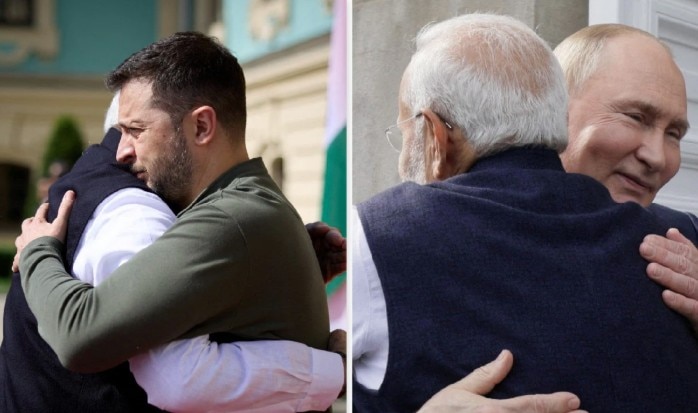
Strategic goals are hidden behind Prime Minister Modi’s ‘hug-diplomacy’ and building personal relationships with foreign leaders. For example, during the Russia-Ukraine war, India continued to buy oil from Russia despite pressure from Western countries and maintained talks with Russian President Vladimir Putin as well as Ukrainian President Zelensky. Apart from this, on one hand India is a part of ‘Quad’ with America, Japan and Australia, while on the other hand it is also present in ‘BRICS’ with Russia and China.
India-US relations have soured since President Donald Trump came to power. Both the countries have not been able to make a trade agreement for a year citing their respective national interests. Amidst this reality, whatever views Trump may have about India, in his statements he always addresses Prime Minister Modi as dear friend, close friend, great leader.
Trump’s statements do not mean that he is a big fan of Modi or India. But, this has to be said in diplomacy. And Modi also knows this very well.
—- End —-
Source link
[ad_3]

