
New Delhi41 minutes ago
- Copy link
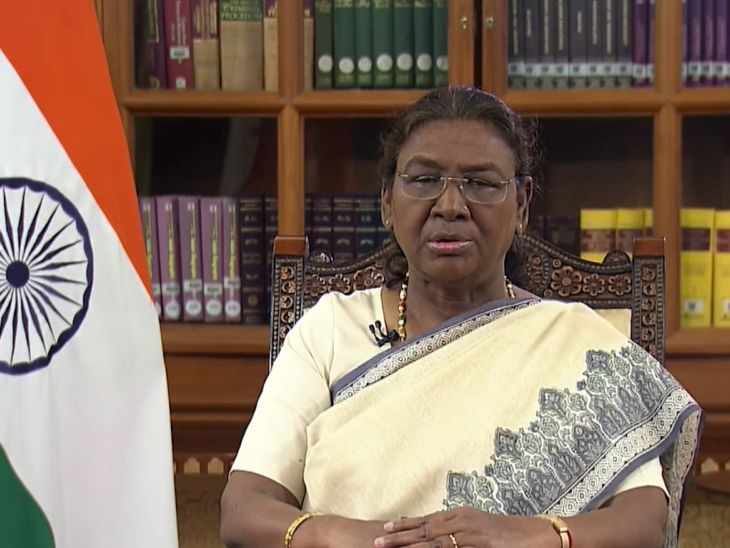
On May 15, President Murmu asked 14 questions to the Supreme Court regarding the deadline for the Governor-Pressurer. (File)

Can any time limit be set under judicial orders to take decisions on the bills passed by the Assembly through the President and the Governor?
On July 22, the 5 -member Constitution Bench of the Supreme Court was ready to investigate it. The court has issued notices to the Center and all states. The next hearing will be held on 29 July.
The bench is headed by CJI BR Gavai. He is accompanied by Justices Vikram Nath, Suryakant, PS Narasimha and Atul Chandurkar.
The debate began on 13 May from the Supreme Court by President Draupadi Murmu, in which he raised 14 constitutional questions.
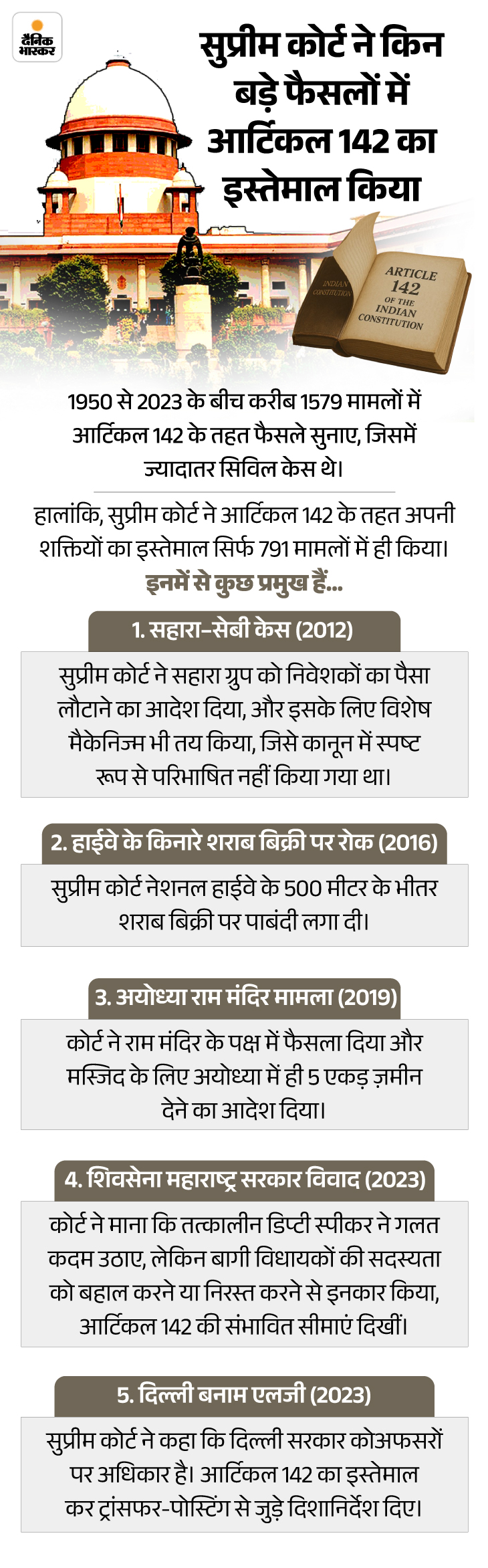
Earlier on April 8, a two -judge bench of the Supreme Court, using Article 142, said that the President should give a decision within 3 months.
The case is related to the Supreme Court’s decision of April 8, in which the Supreme Court had decided to pass a bill for the President and Governor using Article 142 of the Constitution.

The Supreme Court’s decision of April 8. The court had termed the Tamil Nadu Governor’s ban on 10 essential bills of the state government as illegal.
First know where this matter started …
In fact, 12 bills were passed between 2020 and 2023 in the Tamil Nadu Assembly. They were sent to Governor RN Ravi for approval. He did not take any action on the bills, kept it pressed.
In October 2023, the Tamil Nadu government approached the Supreme Court. After this, the Governor returned 10 bills without signing and sent 2 Bills to the President for consideration. The government passed 10 bills again and sent it to the Governor. The Governor sent them to the President this time.
The Supreme Court on 8 April 2025, in an important decision, called the Governor stuck in such a way illegal. A bench of Justice JB Pardiwala told the governor- ‘You walk through the Constitution, not with the will of the parties.’
The governor did not work with ‘honesty’. Therefore, the court ordered that these 10 Bills be considered passed. This was the first time the bill was passed without the approval of the Governor.
The approval of the bill is not prescribed in the constitution It has not been determined in the constitution that the Bill passed from the Legislative Assembly will have to be approved or rejected within how many days to the Governor or the President. It is only written in the constitution that they have to take a decision as soon as possible.
Supreme Court ‘As soon as possible’ Defined ….
- If the state government sends a bill for approval, then the Governor will have to take action within a month.
- If the Governor sends the Bill to the President, then the President will also have a time of 3 months to take a decision on it. When it is more than this, they have to give appropriate reason.
- If the Governor or the President does not take any action within the time limit, the state government can go to court.
What is Article 143?
Under Article 143 in the Constitution of India, the President gets the right to ask for opinion from the Supreme Court. This helps to solve constitutional difficulties. It mainly has different clauses for two types of opinions-
Article 143 (1): The President can ask for the opinion of the Supreme Court on any legal or factual question. It is not necessary that those questions are related to any existing controversy. If you understand from the example, before making a new law, its constitutional validity can be consulted.
Article 143 (2): If any dispute is related to any such treaty, agreement or other documents that were going on before the Constitution to come into force i.e. 26 January 1950, then the President can ask the Supreme Court.
Now the whole matter in dates …
April 8: Supreme Court said- Governor has no veto power
A bench of Justices JB Pardiwala and Justice R. Mahadevan had said that the Governor has no veto power. The President will have to take a decision within 3 months on the bill sent by the Governor. May 15: President Draupadi Murmu asked 14 questions from Supreme Court
On fixing the deadline for the President and the Governor, President Draupadi Murmu sought an opinion from the Supreme Court under Article 143 (1).
President Murmu had sought clarification on the powers of the President-Governor, judicial intervention and time-limit.
The President had asked that there is no such system in the Constitution, so how the Supreme Court can decide for the President-Governor to set a deadline for approval on bills.

4 points of Supreme Court on the bill sent by the Governor to the President
1. Bill must decide: The Supreme Court had said that Article 201 says that when the assembly passes a bill. He should be sent to the Governor and the governor should send him to the President for consideration. In this situation, the President will have to approve the bill or tell that they are not giving approval.
2. Judicial review will be: The Supreme Court had said that the decision of the President under Article 201 could be judged. If the decision of the central government is given priority in the bill, the court will review the bill on the basis of arbitrariness or malicious.
The court said that the state’s cabinet has been given priority in the bill and if the Governor has decided contrary to the assistance and advice of the Council of Ministers, the court will have the right to legally investigate the bill.
3. The state government will have to give the reasons to the Governor: The Supreme Court clarified that when a time-limit is fixed, a decision should be taken within a reasonable time line. It will be mandatory for the President to take a decision within 3 months of receiving the bill. If there is a delay, the reasons for the delay have to be mentioned.
4. Bills cannot be sent back again and again: The court said that the President sends a bill back to the state assembly for amendment or reconsideration. If the assembly passes it again, the President will have to take the final decision on that bill and stop the process of returning the bill again and again.
17 April: Dhankhar said- courts cannot order the President

Vice President Jagdeep Dhankhar said on 17 April that the courts could not order the President. The special rights received by the court under Article 142 of the Constitution have become 24×7 available nuclear missile against democratic powers. The judges are acting like a super parliament. Read full news …
April 18: Sibal said- President nominal head in India
Rajya Sabha MP Kapil Sibal said that when the executive does not work, the judiciary will have to intervene. The President is the head of the nominal head in India. The President-Governor has to work on the advice of governments. I am surprised to hear the Vice President, I am also sad. They should not talk to any party. Read full news …
………………………………… Read this news related to deadline case too …
Legal debate on the deadline for governor-father-in-law: Former law minister said- there will be conflict in government and courts, lawyers said- President will run only on the advice of the Council of Ministers
The law debate has started on the Supreme Court’s decision to build a deadline for the President and the Governor. Former Law Minister Ashwini Kumar said- This may create a conflict situation between the government and the courts, which is necessary to resolve. It is expected that the bench of the Supreme Court will give a clear opinion on this. Read full news …
Source link
[ad_3]