
islamabad2 hours ago
- copy link
In Pakistan, Asim Munir is going to be more powerful than the President and Prime Minister. He is being made the Chief of Defense Forces (CDF) of the three armies. As soon as he gets this post, he will get the command of nuclear weapons.
Shahbaz government is making changes in the constitution for this. The bill related to this was presented today in both the houses of Parliament, Senate and National Assembly. Voting is going on on this. This is being called the 27th constitutional amendment. Through this, the government is also going to reduce the power of the Supreme Court and the courts.
The government has the necessary votes
This bill is being considered as the biggest and controversial proposal in the history of Pakistan. It is being said that this will change both the justice system and military structure of the country.
To pass the 27th Constitution Amendment Bill, two-thirds majority will be required. That means 64 votes in the Senate and 224 votes in the National Assembly.
The ruling coalition has a total of 65 votes in the 96-member Senate, one vote more than the required majority. At the same time, the government has the support of a total of 233 MPs in the National Assembly with 326 active members.
Based on these figures, the government has enough majority to pass the amendment in both the houses. After passing it will be sent to the President for signature.

Nuclear command will go into the hands of the army
A very special part of the 27th Constitutional Amendment is the formation of the National Strategic Command (NSC). This command will monitor and control Pakistan’s nuclear weapons and missile systems.
Till now this responsibility was with the National Command Authority (NCA), which was headed by the Prime Minister, but from now on the responsibility will be with the NSC.
Although the commander of NSC will be appointed with the approval of the Prime Minister, this appointment will be done only on the recommendation of the Chief of Army Staff (CDF). Most importantly, this post will be given only to Army officers. With this, the control of the country’s nuclear weapons will now be completely in the hands of the army.
All three armies will move under the orders of Asim Munir
Article 243, which earlier declared ‘the President to be the Supreme Commander of the Armed Forces’, will now make the Army Chief supreme in practice. In Pakistan, legally all three services are under the command of the President and the President appoints the Army Chief, Navy Chief and Air Force Chief on the advice of the Prime Minister.
Under the new provision, a new post named Chief of Defense Forces (CDF) is being created. With this, the post of existing Chairman Joint Chiefs of Staff Committee (CJCSC) will be abolished on 27 November 2025. On the same day, current CJCSC General Sahir Shamshad Mirza is retiring.
After the formation of CDF, the Chief of Army Staff (COAS) will get constitutional authority over the entire military services Army, Navy and Air Force. With this, the post of Army Chief will be permanently enshrined in the Constitution as the supreme military power for the first time.
the president Will remain nominal supreme commander
Till now CJCSC used to work to create mutual coordination between the three armies. Whereas the real power used to be with the Army Chief, now both the things will be with the CDF.
In the report of Pakistani newspaper Dawn, quoting experts, it has been said that this will make the army more powerful in the country. Experts said that the ongoing amendment to the Constitution will permanently enshrine the rights of the Army in the Constitution.
This means that no future civilian government will be able to reverse these changes easily. That means, in practice, the role of ‘President Supreme Commander’ will remain only formal.

Government’s interference in judiciary will also increase
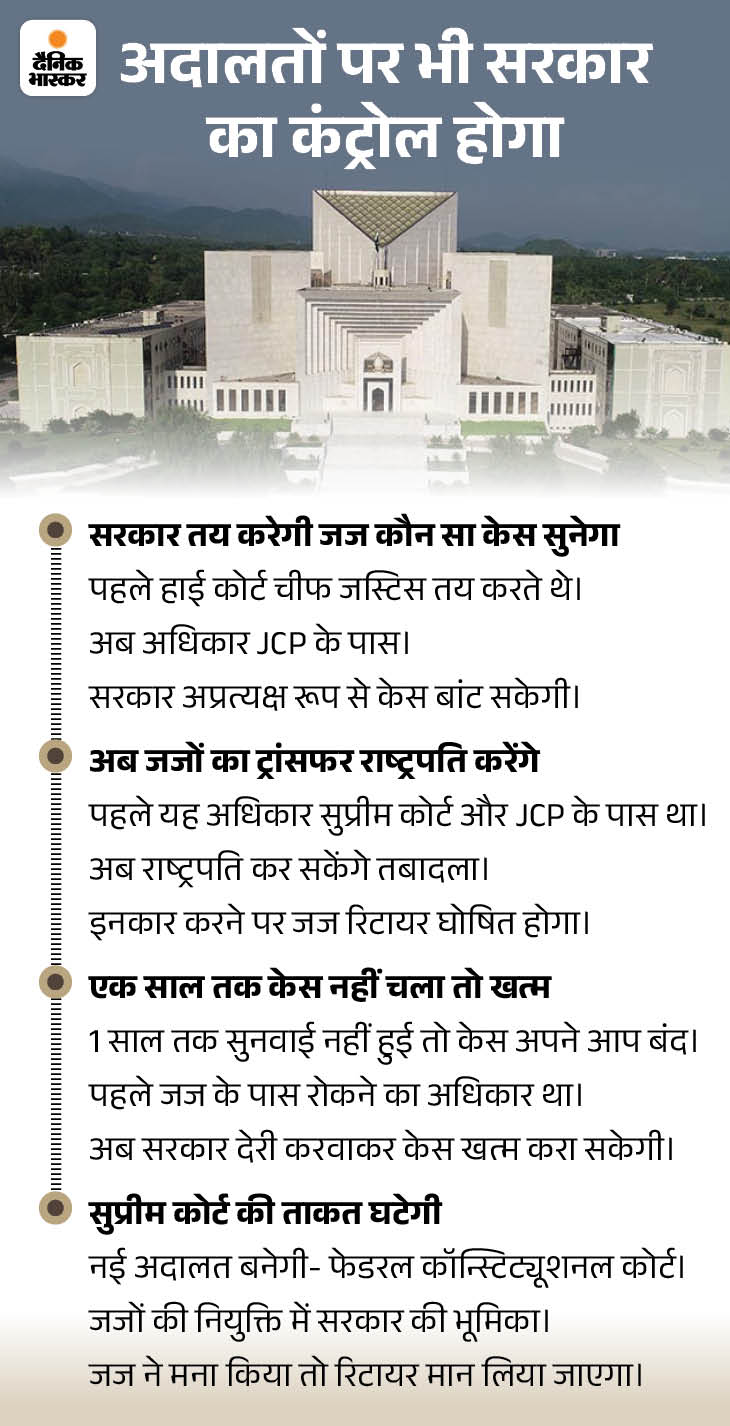
This bill will affect the strength of the army as well as the judiciary. As soon as it is passed, the government’s interference will increase in everything from appointment to transfer of judges. Judges who go against the government will be forcibly retired. This bill will reduce the power of judges in 4 ways.
1. The government will decide which case the judge will hear.
The biggest impact of this amendment will be on the courts. Till now, if any citizen disagreed with the government’s decision, he could go to the High Court and challenge it. This right will still be there, but the difference will be that now such cases will be heard in special constitutional benches.
Earlier, the right to decide which case should be given to which judge was with the Chief Justice of that High Court, but now this right has been given to the Judicial Commission of Pakistan i.e. JCP.
Legal experts say that this change will reduce the power of the courts to a great extent. He believes that if the government decides which judge will hear which case, then the decisions will no longer be impartial. This will affect the independence of the judiciary and will increase the risk of decisions being taken in favor of the government.
2. President will transfer judges
Another major change in the bill is that now the Chief Justice of the Supreme Court or the Judicial Commission will not have the right to transfer High Court judges. This power will be given to the President. This means that now the President can send a judge from one state to the High Court of another state and if the judge does not obey this order, he will be considered retired.
Legal experts say that this amendment is an attempt to bring the courts under the control of the government. This will end the independence of the judiciary and the government will be able to take decisions as per its wish. Opposition parties have also called it an attack on democracy and the soul of the Constitution.
3. If hearing is not held for one year, the case will be closed
According to the new rule, if a case does not proceed for a year i.e. it is not heard, then that case will automatically be considered closed. Earlier this limit was of six months, but then the court had the authority to decide whether the case should be closed or not.
If the judge felt the case was urgent, he could have proceeded with it, but that will not happen now. After this amendment, this decision will not be decided by the court but by the law, that is, if the case does not proceed for one year, then whether the judge wants it or not, that case will be closed.
This change can be very dangerous because if the government or administration wants to end a case, all it has to do is stop the hearing of that case. If the police does not submit the report, the government lawyer does not appear in the court or there is deliberate delay, then the case will automatically be considered closed after one year.
4. Government will have direct interference in the functioning of the court
Under the 27th Constitutional Amendment, a new court will be created, which will be named the Federal Constitutional Court.
This court will hear only matters related to the Constitution, such as disputes between the central and provincial governments, the validity of any law or issues related to the constitutional rights of citizens.
Till now, the Supreme Court hears such cases in Pakistan, but after this new change, this power of the Supreme Court will end and this responsibility will go to the new court. This means that major decisions related to the Constitution will no longer be taken by the Supreme Court, but by this new court to be formed under the control of the government.
Both the President and the Prime Minister will have a role in the appointment of judges of this new court. Parliament will decide how many judges there will be and for how long they will be appointed. That means the government will have direct influence from the formation of the court to its functioning.
The most controversial thing is that if a Supreme Court judge is sent to this new Constitutional Court and he refuses to go, he will be declared retired.
Shahbaz government went ahead of dictator Zia
Makhdoom Ali Khan writes in Dawn that the work of weakening the Supreme Court which powerful people like former military rulers General Zia-ul-Haq and Pervez Musharraf could not do in their times, is now going to be done by the elected Parliament.
This amendment will prove that Parliament has the power to change everything. Also, if she wants, she can break the backbone of the judiciary.
Big change in the funds received by the states
A major decision in the 27th Amendment is that now the rules for distribution of money between the Center and the States (provinces) can change. Currently, the National Finance Commission (NFC) in Pakistan decides how much of the tax income will remain with the Center and how much will go to the states.
There is a rule in the Constitution, Article 160(3A). It is written in it that until a new agreement (NFC Award) is made, the old one will continue and the share of the states cannot be reduced. That means the states are guaranteed to get at least a fixed share.
However, now in the new amendment there is talk of changing or removing this rule. If this happens, the central government will be able to reduce the money received by the states if necessary.
Meaning, if the country’s income decreases or the economic condition worsens, the government can say that the states cannot be given the same share as before.
The central government says that currently most of the tax money goes to the states, while the center has to bear the huge expenses of loans, army and development projects. Therefore, flexibility in distribution of money is necessary.
On the other hand, states like Sindh and Balochistan are opposing it. They say this will reduce their funding and is against the Constitution, which gives financial powers to the states.
The President will not be prosecuted even after leaving office
The President has also been benefited under Constitutional Amendment 27. He has been kept free from any kind of legal accountability.
Till now, under Article 248 of the Constitution, the President gets protection from criminal cases during his tenure, that is, when he is in office, he cannot be prosecuted.
But now by changing the Constitution, the person who was the President has been given lifetime protection. This means that even after leaving the post, he will not be prosecuted, nor will he be arrested.
Opposition parties and jurists have called this provision unconstitutional, a threat to democracy and an ‘attack on the judiciary’.
——————————
Read this news also…
Pakistan Constitution is changing for Asim Munir: He will become the chief of all three armies, this post was created for the first time; Became Field Marshal in May

Pakistan is making changes in the constitution to make Army Chief Asim Munir the head of the three armies. Now he will be made the country’s first Chief of Defense Forces (CDF). It will be like the Chief of Defense Staff (CDS) of India. Read the full news here…
Source link
[ad_3]

