
30 minutes ago
- copy link
Japan has made a major change in its pacifist policy after the Second World War. Prime Minister Sanae Takaichi’s cabinet has lifted the decades-old ban on the export of lethal weapons. Under this, Japan will now be able to sell weapons like fighter jets, missiles and warships to other countries.
Posting on X on Tuesday, Takaichi said that transfer of all defense equipment will now be possible. He said that weapons will be given only to those countries which promise to use them as per the UN Charter (Constitution).
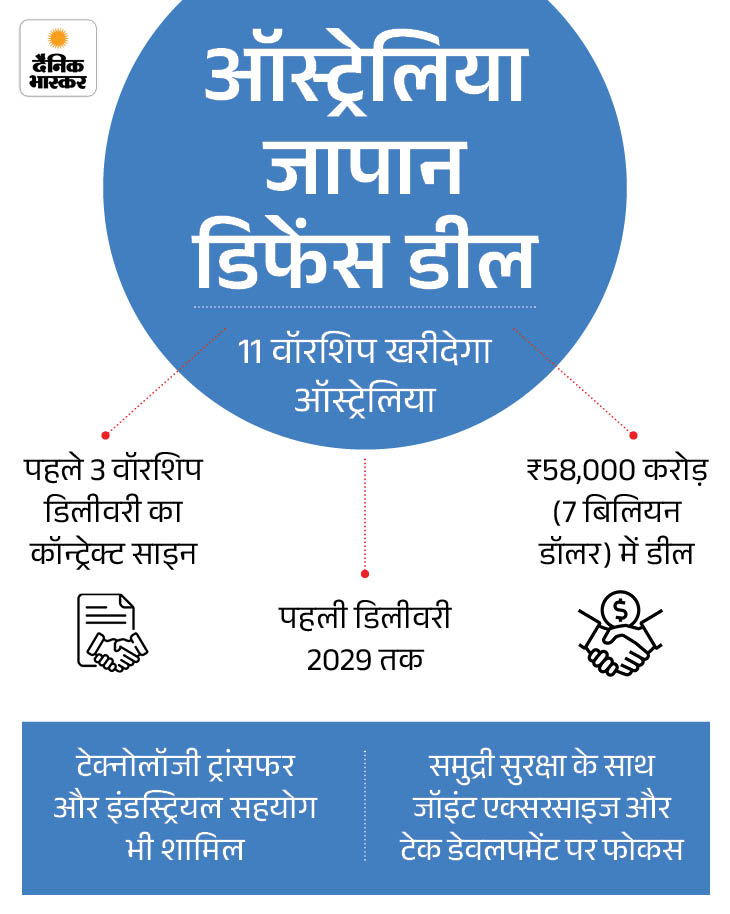
Japan’s Defense Ministry said that many countries are showing interest in purchasing Japanese weapons. Recently an agreement worth 7 billion dollars has been signed between Japan and Australia. Under this, Mitsubishi Heavy Industries will build the first 3 out of 11 warships for the Australian Navy.
Earlier, under provisions implemented in 1976, Japan could export only non-lethal military equipment. These included equipment such as surveillance and mine sweeping.

Australia’s Defense Minister Richard Marles and Japan’s Defense Minister Koizumi Shinjiro signed the memorandum in Melbourne.
What was Japan’s ‘pacifist policy’
After the Second World War and the Hiroshima-Nagasaki nuclear attack, Japan decided that it would stay away from war. It was clearly written in Article 9 of the Constitution that Japan would not wage war and the army would be limited only to self-defense. For this reason, Japan created the Self Defense Force (SDF).
In 1976, Japan almost completely banned the export of lethal weapons. Although slightly relaxed in 2014, the strict limits remain in place. Now in the new decision, Japan has made a major change in its peace policy.
17 countries can buy arms from Japan
According to Al Jazeera, under this decision at least 17 countries will be able to buy weapons from Japan. This includes countries like Australia, New Zealand, Philippines and Indonesia. This list may increase if more countries sign agreements with Japan.
At the same time, according to the Japanese newspaper Asahi, Japan will not sell weapons to those countries where war is currently going on. However, in special circumstances, such as in case of national security, relaxation can be given.
Impact of changing security environment
This change has been brought due to the changing security situation. Especially developments like China’s growing power in the Indo-Pacific, North Korea’s missile tests and the Russia-Ukraine war are being considered as major reasons for this.
Now Japan does not want to remain just a pacifist country but wants to become an active and responsible partner in regional security.
According to Al Jazeera, Takaichi linked this decision to the changing global situation. According to him, at present no country can ensure its peace and security alone, hence cooperation and partnership have become necessary.
What will be the benefit to Japan’s defense industry?
This decision of Japan is not only being considered as a change in foreign policy but also a big turning point for its defense industry. Due to a decades-long ban on arms exports, Japan’s defense companies were limited to domestic orders, which slowed their growth. Now with the removal of this hurdle, the global market has opened up for the companies, which will give the domestic defense industry an opportunity to increase the scale.
The biggest benefit will be that Japanese companies will get new customers on a large scale. Till now America, Russia and European countries dominated the arms market, but now Japan is also entering it.
This will also affect employment and economy. New jobs will be created in defense manufacturing, the supply chain will be strengthened and small suppliers will also join this ecosystem. This will also support Japan’s economy.
———————-
Read this news also…
7.7 magnitude earthquake in Japan, tsunami warning: Bullet train had to be stopped; Government said- there may be bigger earthquakes in future
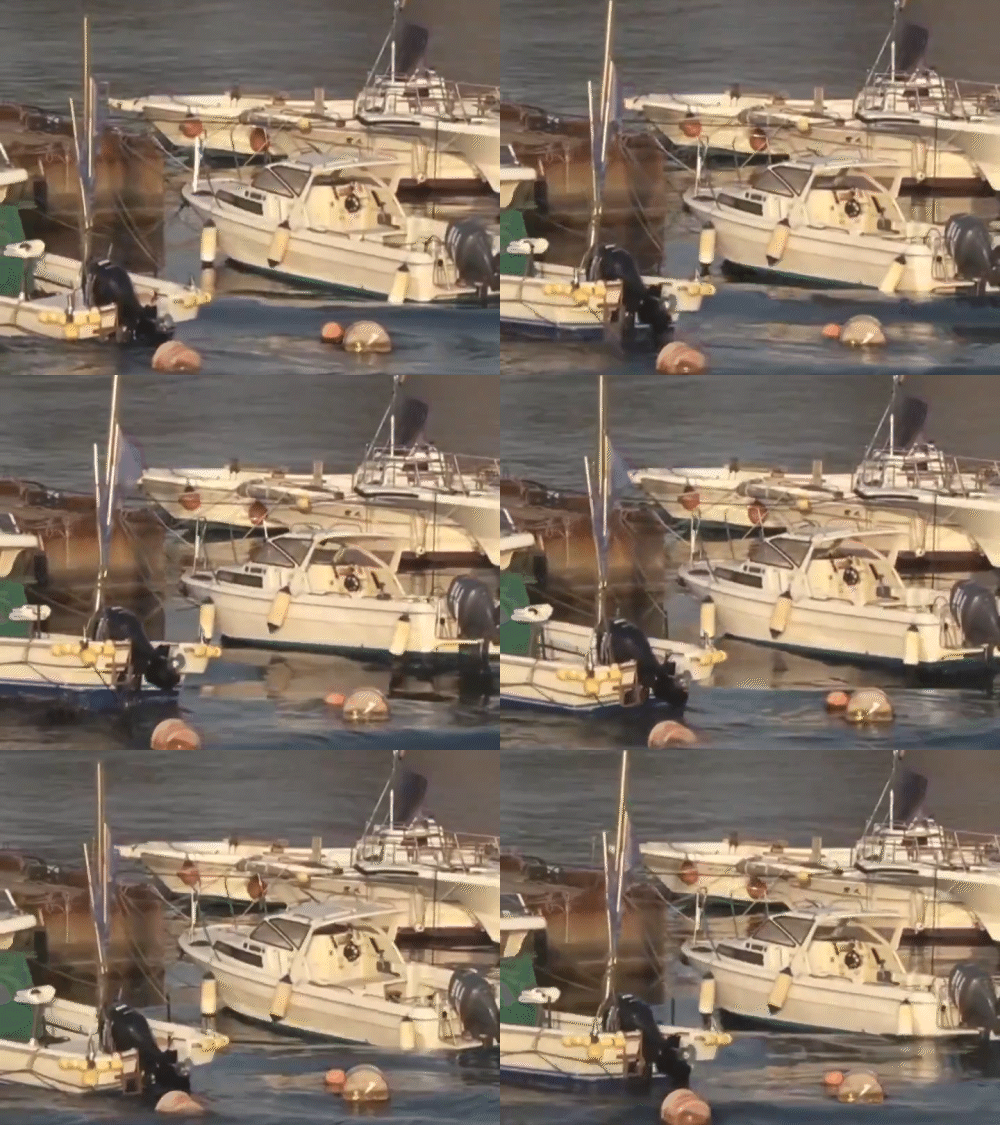
A strong earthquake of 7.7 magnitude occurred in Japan at 1:23 pm (Indian time) on Monday afternoon. The epicenter of the earthquake was at a depth of 20 km in the sea, about 100 km from the coast.
The Japanese Meteorological Agency (JMA) has issued a tsunami warning of up to 3 meters high in coastal areas. Also asked to be prepared for an even bigger earthquake.
After the earthquake, waves of about 3 feet were recorded in Iwate Prefecture, up to one and a half feet in Miyako and Hachinohe. The water level is rising in these areas. Read the full news…

Source link
[ad_3]

