
- Hindi News
- National
- Gangotri Glacier Size Increased By 17%| Satellite Image Shows Large Expansion In Glacial Lakes In Himalayas| ISRO Monitoring|
Dehradun2 minutes agoAuthor: Manmeet
- copy link
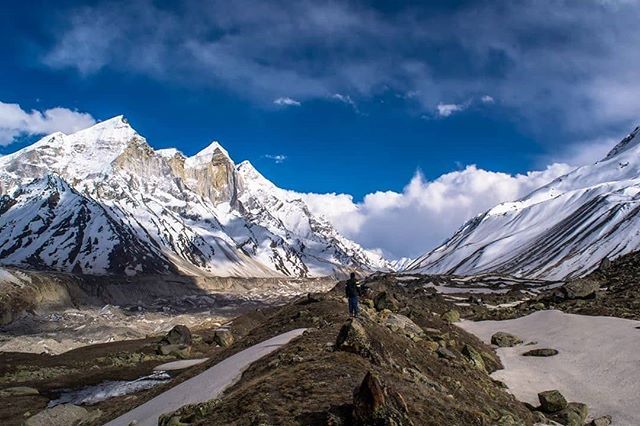
There are 9,575 glaciers in the Himalayas spread over 2400 km. Out of these, 968 are in Uttarakhand. (File photo)
The size of the Gangotri glacier, which is facing the wrath of global warming, has increased by 18% in a year. Scientists estimate that this will ensure that there will be sufficient water in the Ganga this winter. This will ensure that crores of people living in the Ganga basin from Uttarakhand to Bengal will not face water shortage. According to the report of the Wadia Institute, the snow cover in the Gangotri glacier was 83% in May 2023, which was reduced to 69% in June. But there was good snowfall in the high Himalayas, due to which the snow cover on the glacier has reached 86.14% by March 2024. Scientists believe that the health of the glacier will improve.
Scientists are monitoring the Gangotri glacier
To study the impact of global warming on the Gangotri glacier, study centres have been set up in Bhojwasa and Chidbasa, where meteorological, hydrological and seismological observatories have been established. Snowfall, rainfall and temperature in the glacier are being studied through this. Satellite images are also being used.
ISRO claims that the size of glacial lakes identified in the Himalayas has increased.
There are 9,575 glaciers in the Himalayas, out of which 968 are in Uttarakhand alone
There are 9,575 glaciers in the Himalayas spread over 2400 km. Out of these, 968 are in Uttarakhand. Major rivers like Bhagirathi, Mandakini, Pindar, Yamuna, Kali, Kosi originate from these glaciers. The lives of more than 40 crore people depend on these rivers.
Global warming has caused Gangotri glacier to melt 1700 meters in 87 years
Scientific research has proved that the Gangotri glacier has melted by about 1700 meters in 87 years. From 1935 to 2022, the mouth of the Gangotri glacier has continuously moved backwards. Global warming is being said to be the main reason for this.
The Indian Space Research Organization (ISRO) released satellite images in April claiming that Himalayan glaciers are melting rapidly. ISRO claims that the size of glacial lakes identified in the Himalayas has increased.
ISRO had said that satellite images covering the catchment of river valleys in the Indian region of the Himalayas from 1984 to 2023 have indicated changes in glacial lakes. It has been told that out of 2431 lakes, 676 glacial lakes have expanded by more than 10 hectares from 1984 to 2016-17.

601 lakes more than doubled
ISRO said that out of the 676 lakes, 601 lakes have increased more than twofold, while 10 lakes have increased by 1.5 to twofold and 65 lakes by 1.5 times. Out of the 676 lakes, 130 are located in India, including 65 in the Indus, seven in the Ganges and 58 in the Brahmaputra river basins. 314 lakes are at an altitude of 4,000-5,000 metres, while 296 lakes are above 5,000 metres.

Moraine dammed lakes are increasing
Of the 676 lakes that are expanding, 307 are moraine dammed lakes, 265 are fertilizer lakes, 96 are other lakes and 8 are ice dammed glacial lakes.
Satellite images released by ISRO show the Gepang Ghat glacial lake, located at an altitude of 4,068 metres in Himachal Pradesh, has expanded by 178 per cent from 36.49 hectares to 101.30 hectares between 1989 and 2022. That is, there has been an increase of about 1.96 hectares every year.
The South Lhonak glacial lake, located at an altitude of 17,000 feet in north-western Sikkim, burst in October last year. The resulting flood had killed 40 people and left 76 missing.
Source link
[ad_3]

