
- Hindi News
- National
- Indias First Private Orbital Rocket Vikram 1 Launch Skyroot Founder Pawan Kumar Chandana Interview
Hyderabad10 minutes agoAuthor: Sanchit Srivastava
- copy link
Skyroot’s founder Pawan Kumar Chandana has worked as a scientist in ISRO.
India’s first private orbital rocket ‘Vikram-1’ is now ready for launch. Skyroot Aerospace has announced a launch window of July 12 to August 4 for its first test flight. This is the first major test of India’s private space potential. With its success, small satellites can be sent into space more quickly as per the need.
This will further strengthen services like agriculture, communication, navigation and national security. If Vikram-1 is successful, India will join the select few countries to reach orbit on the basis of private sector.
Before the launch of Vikram-1, Skyroot Aerospace founder Pawan Kumar Chandana talked to Bhaskar. Read the full interview in his own words…
But before that see the glimpse of Vikram-1…
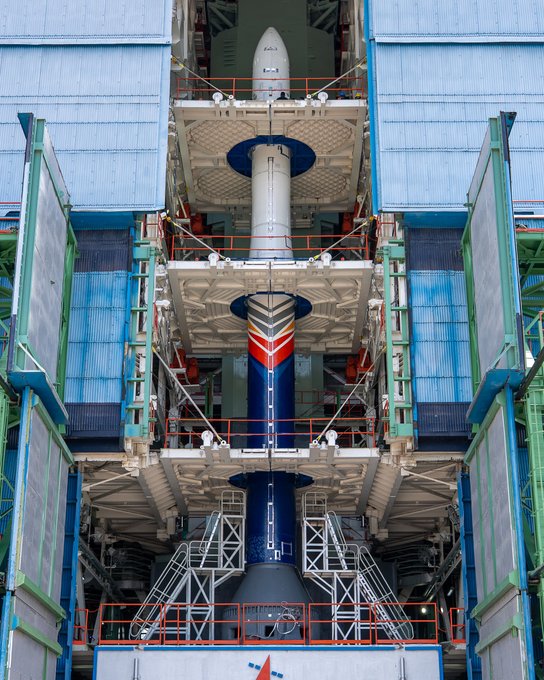
Everyday needs are being fulfilled from space
If you run maps on your phone or make a digital payment, then satellites in space are working behind it. Maps shows your exact location based on navigation signals received from satellite, while services like UPI run on the Internet and communication networks, which are also strengthened by satellite in remote areas.
If satellites increase, facilities will also increase in every area.
With the increasing satellite network in space, the demand for launches will also increase manifold. Currently, ISRO launches most of the satellites in India. But the number of satellites will increase rapidly in the coming years. In such a situation, ISRO will focus on big missions like Chandrayaan, Gaganyaan and space station.
Private companies like Skyroot will work to send small satellites into orbit as frequently and as needed. With this, services like weather, internet, farming, disaster management and communication will be faster and more accurate than before.
Skyroot on ‘cab model’, apart from SpaceX
Skyroot is compared to SpaceX, but both have different models. This can be understood from trains and cabs. The train takes you only to the scheduled station at the scheduled time. But if you want to reach a particular place at a particular time, then cab is a better option. There is the same difference in space also.
SpaceX’s rocket releases satellites in a fixed orbit like a train, while Vikram-1, like a ‘cab’, will be able to deliver satellites to the desired orbit as per the need. Now the demand for such ‘on-demand launches’ will increase rapidly.
India on SpaceX mode, now need to learn fast
India today is in the same phase as America was in about 15-20 years ago. At that time, companies like SpaceX and Rocket Lab had developed their launch capability by continuous testing. The biggest lesson in rocket science is that technology evolves by learning in flight, not just on the ground. Therefore, a series of frequent tests, rapid improvements and then launch is the way forward.
ISRO will do big missions, private companies will increase the speed of launch
India’s space model is now changing. The technical base that ISRO has built over six decades is now helping private companies move forward. In the coming time, ISRO will focus more on big missions like Chandrayaan, Gaganyaan and space station, while private companies like Skyroot will handle the work of launching satellites continuously and at low cost. This model is adopted in the developed space countries of the world.
The problem is not in making the satellite, but in launching it on time.
Small satellites are increasing rapidly in the world, but the capacity to send them to space has not increased that fast. This is why many operators have to wait for months, sometimes years, for launch. Skyroot’s focus is to solve this problem, so that launches can be provided in a timely manner when needed.
Space will become a common feature in the future
In the next 10-15 years, people will see space not as a major scientific achievement, but as a common everyday convenience. Many services like connectivity of fishermen in the sea, timely warning of floods, better weather forecast, data for AI and internet to villages (6G) will be common, but behind them will be satellites working in space.
Small satellites are the new face of changing space technology
- Earlier a big and expensive satellite was made and sent into space. Now the world is preparing a network of hundreds of small satellites.
- Now electronics are much smaller than before. The work which earlier could only be done by big satellites, can now be done by small satellites also. Smaller satellites provide better coverage and more reliable service.
- The third big reason is that their age is 5 to 8 years. After this they have to be changed. This means new satellites will have to be launched continuously.
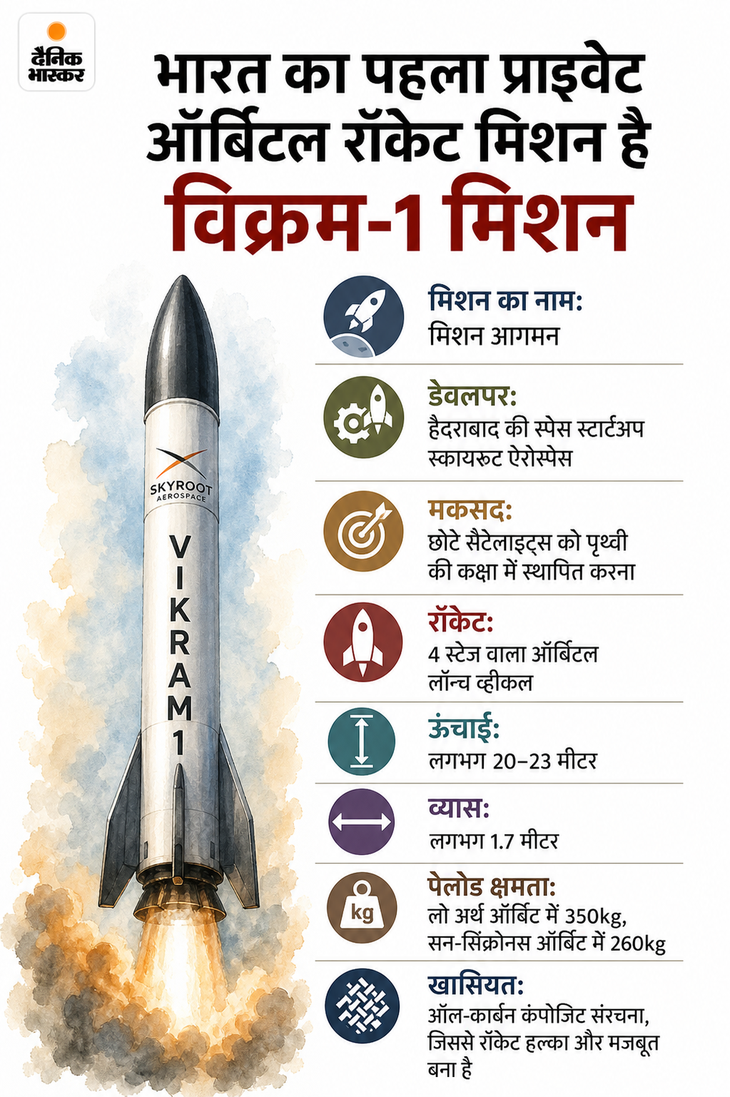
Special things related to Skyroot and Founder…
Skyroot Aerospace is a private space company, which is making rockets to send small satellites into space. It is the first private company in India to successfully launch a rocket into space.
Skyroot was founded in 2018 in Hyderabad. The founders are Pawan Kumar Chandana and Naga Bharat Daka. Both have previously been scientists and engineers in ISRO.
On 18 November 2022, Skyroot successfully launched Vikram-S. The name of the mission was ‘Prarambh’. This was the first successful rocket launch in the history of India’s private space zone.
Apart from Vikram-1, the company is making Vikram-2 and Vikram-3 orbital. They are named in honor of Vikram Sarabhai.
Bhaskar Knowledge…
Companies like Space X gave new heights to the beginning of the private space sector in the world. The space sector in India opened up to private companies after 2020, after which startups like Skyroot, Agnikul Cosmos, Pixel and Bellastrix Aerospace emerged rapidly. With this, India is moving towards creating a strong presence in the global new space economy.

Source link
[ad_3]

