
The Centre seems to be pulling out all the stops to ensure that the NEET-UG re-test passes off without any leaks and lapses. With the Prime Minister’s Office (PMO) now directly monitoring the exam process, the Education Ministry is considering an unprecedented step – rope in the defence forces for logistics and transportation of question papers. It raises a troubling question. Has conducting a fair exam become such a daunting challenge in the country?
The development comes after the May 3 medical entrance exam was cancelled following a paper leak, throwing the future of 23 lakh students in limbo and triggering massive protests. The re-test will be held on June 21. At the centre of all the fire is the National Testing Agency (NTA), which conducts most of the major central exams, including the NEET. A probe so far has revealed multiple points of leakage in the journey of the NEET question paper from the printing press to the exam centres. It is to plug this gap that the defence forces might be roped in.
WHY DEFENCE FORCES MAY BE INVOLVED?
The proposal was discussed at a high-level meeting between Education Minister Dharmendra Pradhan and Defence Minister Rajnath Singh on Thursday, according to a report in PTI. Senior Indian Air Force (IAF) officers were also present.
As per the report, the IAF will be responsible for transporting the NEET-UG question papers from the printing press to exam destinations across the country. Moreover, considering the unpredictable weather in June due to rain, the government believes entrusting the transportation of these sensitive documents to the IAF would be the safest option.
Part of the problem lies in the manner in which NEET is conducted. Unlike JEE, which is computer-based, NEET is a pen-and-paper exam. So far, the question papers have been transported through the postal service. It involved multiple transfers and officials. In simple terms, human intervention.
Experts feel the government’s move to involve the defence forces indicates deep mistrust of the civilian machinery, which involves NTA officials, the police and educational institutions. The probe into the May 3 leak has indicated that postal transportation could be among the vulnerable points.
EXPERTS QUESTION MOVE
“Have all existing systems in the country failed that this has to be resorted to? If culprits are not punished quickly, the system gets used to corruption. This is exactly what is happening with NEET,” Major General Raju Chauhan (retd) tweeted.
Geopolitical expert Rohit Vats said roping in the IAF was nothing but “pure optics” because of the trust factor associated with the services. “Involving the defence forces is a stupid move,” Vats said.
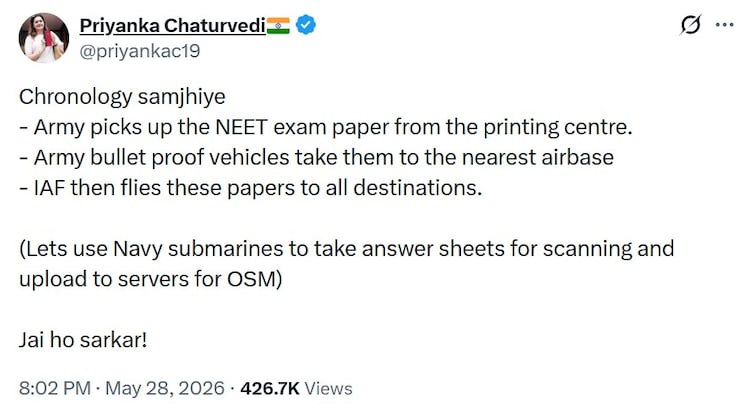
Rajya Sabha MP Priyanka Chaturvedi took a swipe at the government over the possible move. “Army picks up the NEET exam paper from the printing centre. Bullet-proof vehicles take them to the nearest airbase. IAF then flies these papers to all destinations,” Chaturvedi tweeted.
“Let’s use Navy submarines to take answer sheets for scanning and upload to servers for OSM,” the Shiv Sena (UBT) leader further said.
If you have read so far, you would have understood that the keyword here is “trust”. Minister Dharmendra Pradhan, while owning up to the NEET debacle, said the government would follow a “zero-trust, always inspect” policy for the re-test.
THE VULNERABLE EXAM PROCESS
Behind the possible move to involve the defence forces is the trust factor. For this, we need to understand the steps involved in the exam process – from setting the paper to the printing press and the exam centre.
The May 3 leak is believed to have originated directly from the printing press in Nashik, Maharashtra. Shubham Khairnar, the first person to be arrested in the case, allegedly obtained the paper from a person in Pune who got it from an “NTA source”, the CBI told a Delhi court earlier this month.
Now, the NTA, which has restricted manpower, outsources most of the work. This increases the risks of paper leaks.
In fact, according to a reply in Parliament in 2024, the NTA operates with 22 employees on deputation, 38 contractual staffers, and 138 outsourced workers. Such heavy dependence on contractual staff and outsourced systems increases vulnerability. This is where the defence forces plug the gap.
– Ends
Source link
[ad_3]

