
The Beijing E-Town Humanoid Robot Half-Marathon, held on Sunday, witnessed a historic milestone in robotics as several humanoid robots outpaced elite human athletes for the first time in a competitive environment. The event featured a “human-robot joint run” where over 100 humanoid robots raced alongside roughly 12,000 human runners on the same 21.1 km course, separated by barriers for safety.
The winning robot, named ‘Lightning’ and developed by Chinese tech firm Honor, completed the 21.1 km race in an astonishing 50 minutes and 26 seconds. This time is nearly seven minutes faster than the human world record of 57:20 set by Jacob Kiplimo.
Just wrapped up: Beijing Yizhuang Humanoid Robot Half Marathon 2026.
Champion: Honor’s “Lightning” robot finished in 50:26 — smashing the human half-marathon world record by ~17 minutes. pic.twitter.com/3B4XUPrYSS
— Tesla Aaron L (@TeslaAaronL) April 19, 2026
The result also marks a dramatic improvement from last year’s inaugural event, where the fastest robot took over two hours and 40 minutes to finish.
Teams From Honor Took 3 Podium Spots
Notably, teams from Honor secured all three podium positions, with the second- and third-place robots finishing in approximately 51 and 53 minutes, respectively. All the robots utilised advanced liquid cooling technology typically found in smartphones to manage the heat generated during the intense run.
Unlike the inaugural 2025 race, where all machines were remotely controlled, approximately 40% of the robots in this year’s event navigated the course autonomously using on-board sensors and AI.
According to engineer Du Xiaodi, the winning robot had been in development for a year and was designed with extended leg structures, around 90 to 95 cm, to replicate elite human running mechanics. It also incorporated liquid cooling technology adapted from smartphones.
“Running faster may not seem meaningful at first, but it enables technology transfer, for example, into structural reliability and cooling, and eventually industrial applications,” Du said.
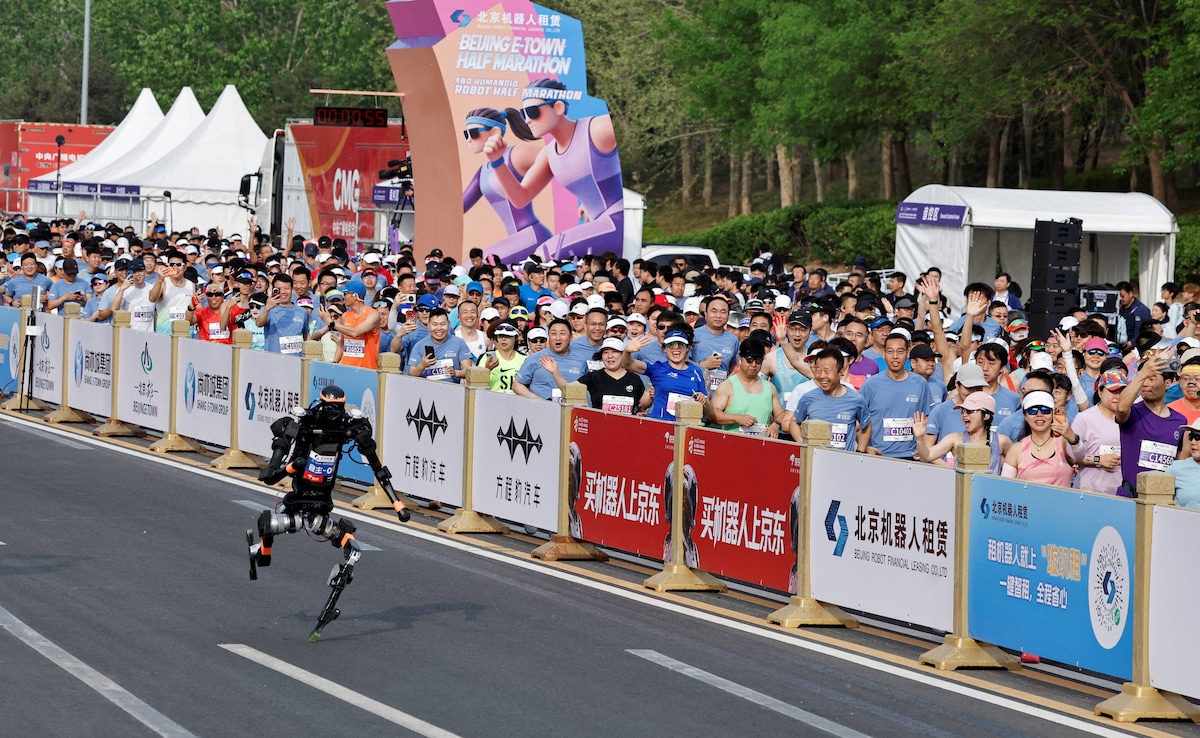
Interestingly, a separately controlled robot from Honor recorded the fastest time overall, 48 minutes and 19 seconds, but did not win, as the competition prioritised autonomous capability under its scoring rules. The event also featured unusual elements, including a robot acting as a traffic marshal, directing runners with gestures and voice commands.
Despite the impressive performance, the race wasn’t without setbacks. Some robots stumbled at the starting line, while others veered off course or collided with barriers.
China’s Prowess in Robotics
For spectators, the race offered a glimpse into the future of robotics. Many were impressed by how quickly the technology has evolved. Some saw it as a sign of an inevitable AI-driven era, while younger attendees said the event inspired them to pursue careers in robotics and programming.
“The humanoid robots’ running posture I saw was really quite impressive… considering that AI has only been developing for a short time, I’m already very impressed that it can achieve this level of performance,” said Chu Tianqi, a 23-year-old engineering student at Beijing University of Posts and Telecommunications.
Even so, experts caution that such performances, while technically impressive, do not yet translate into real-world industrial capability. There are still big problems to solve when it comes to making advanced AI systems that can do complicated tasks that need precision, flexibility, and the ability to make decisions in real time. These are areas where humans are still better than machines.
China, however, is pushing aggressively to lead in this space. The country is putting a lot of money into humanoid robotics as part of its larger technological goals and its strategic competition with the United States. The country’s most-watched TV show, the annual CCTV Spring Festival gala, in February showcased China’s push to dominate humanoid robots and the future of manufacturing.
Omdia’s most recent analysis of the industry found that Chinese companies like Agibot, Unitree Robotics, and UBTech Robotics are the biggest sellers of humanoid robots in the world, each shipping thousands of units in the past year.
Source link
[ad_3]

