
On Tuesday afternoon, Madurai District Collector Nishant Krishna assured the Madras High Court that the Supreme Court’s order would be implemented. By evening, the Karthigai Deepam was burning at Uchipillaiyar and the Deepathoon remained dark. By Wednesday, the district administration explained the intervening hours: the temple trustees had decided to adhere to tradition. Meanwhile, the matter travelled back to the Supreme Court. At Thirupparankundram, the distance between two lampstands has acquired the dimensions of a constitutional dispute.
The collector’s predicament is particularly poignant. Here was an officer appointed by the country’s highest court to coordinate a religious ceremony, reminded by another court of his constitutional obligations and confronted eventually with a resolution by temple trustees that effectively frustrated the exercise. The Supreme Court had spent considerable judicial energy ensuring that the flame would not ignite a communal conflagration. It now finds itself examining why there was no flame at all.
For Tamil Nadu Chief Minister Vijay, the controversy has assumed a complexion quite different from the religious dispute he inherited. The argument over illumination has become an argument over implementation.
BETWEEN PERMIT AND SHALL
Tamil Nadu is no stranger to the constitutional consequences of English grammar. During the parliamentary debate on the Official Languages Bill in 1963, CN Annadurai objected to the Congress government’s provision that English may continue to be used alongside Hindi.
Anna’s argument was simple: may accommodated may not. He wanted shall. A promise with an escape clause was hardly a guarantee. More than six decades later, those two grammatical cousins have returned to haunt Tamil Nadu. This time over the lighting of a lamp rather than the choice of a language.
The Supreme Court’s interim order of November 20 merits meticulous reading, particularly because much of the controversy turns upon ordinary English words with extraordinary legal implications. In paragraph 13, Justices Aravind Kumar and Vipul M Pancholi considered it appropriate “to permit the lighting of the ceremonial lamp” at the Deepathoon on November 24. The operative word was permit.
The court did not pronounce the disputed pillar a customary place of worship, recognise the ceremony as an essential religious practice or confer permanent religious or proprietary rights. It stayed the relevant findings of the Madras High Court and expressly confined the arrangement to this year’s festival.
One can interpret that ‘permit’ therefore had the same connotation as ‘may’. Only that, now the permission was accompanied by prescription.
Paragraph 14 stipulated how the ceremony was to be conducted. The collector, in consultation with the temple executive officer, the Archaeological Survey of India and the police commissioner, would determine the composition of the restricted team authorised by the Devasthanam. Timing, access, security and preservation of the archaeological site received attention. Public participation was excluded, while existing worship at the customary location and lawful activities at the dargah were protected.
Paragraph 18 was more categorical: “The authorities shall make all arrangements” and endeavour to ensure peaceful conduct of the ceremony. Paragraph 20 required a compliance report from the collector within three days of the festival.
The court permitted the flame; it commanded the machinery that would allow it to burn. It advocated no new theology, but it prescribed an administrative procedure. The collector had discretion over the arrangements, not an expressly conferred option to change their destination.
There is an even more significant safeguard in paragraph 16. Cooperation with the court’s arrangement would neither prejudice any party’s legal position nor establish a precedent for future years. The temple could have participated in the ceremony without conceding a permanent right. Tradition, in other words, had been provided judicial insulation.
THE COLLECTOR, THE COURT AND THE COMMAND
Whatever room for interpretation the Supreme Court’s use of permit might have offered, the Madurai Bench considerably narrowed it on Tuesday.
Justices GR Swaminathan and MD Sumathi read the top court’s order as meaning that the “lamp shall be lit today”. The bench summoned the collector, recorded his assurance of compliance and invoked Article 144 of the Constitution, which requires civil and judicial authorities to act in aid of the Supreme Court.
Its instruction to the collector was unusually explicit – “he shall ignore any contra advice given by any other authority”.
The bench also made it clear that the government’s pending review petition furnished no excuse for non-compliance. A review petition questions an order; it does not suspend it.
The proceedings had an extraordinary administrative backdrop.
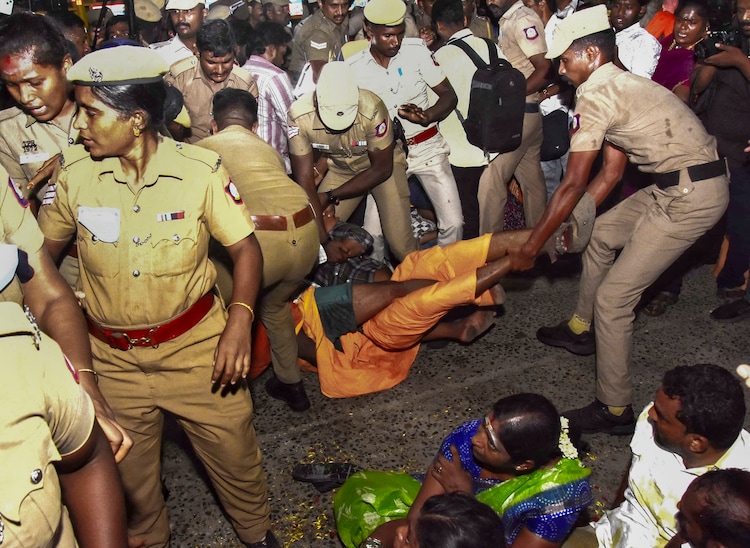
More than 5,600 police personnel had been deployed. Prohibitory orders under Section 163 of the Bharatiya Nagarik Suraksha Sanhita restricted gatherings and unauthorised access. The High Court was informed of 258 detentions and directed that those detained be released. It also restrained public calls for defiance of the Supreme Court’s order, while protecting the freedom to criticise judicial decisions.
Interestingly, the collector’s prohibitory order itself exempted activities connected with implementing the Supreme Court’s directions. The security arrangements were ostensibly designed to facilitate compliance while preventing confrontation. The state had mobilised an impressive machinery of law and order for a ceremony involving a handful of authorised people. Yet the ceremony never materialised.
The Supreme Court said permit, the Madurai Bench said shall, the collector assured compliance and the trustees invoked tradition. The legal vocabulary had expanded considerably; the illumination had not.
THE TRUSTEES’ TRUMP CARD
The temple’s press release on November 24 supplies the most intriguing twist. The Board of Trustees, citing historical documents, Agamic evidence and the views of the Sthanikars, unanimously resolved to light the Deepam at its customary location and subsequently bring the temple’s traditions to the attention of the court. The statement records that the Mahadeepam was lit near Uchipillaiyar at 6 pm.
The district administration’s subsequent explanation rests substantially upon that decision. The collector’s position is that the necessary arrangements had been made, but the trustees chose to adhere to established practice.
There is a genuine legal complication here. The Supreme Court had specifically provided for a team authorised by the Devasthanam. It had not empowered the collector to recruit alternative worshippers or perform the ritual himself. If the requisite authorisation was withheld, the officer could reasonably argue that an indispensable component of the arrangement was missing.
But the trustees’ resolution raises a question of its own. Could the temple administration withhold the very cooperation upon which the court’s arrangement depended, particularly when the court had protected customary worship and expressly preserved the trustees’ legal claims? The trustees’ fidelity to religious precedent has now landed them in a controversy over judicial precedent.
The sequence also matters. When did the trustees pass their resolution? What happened between the collector’s assurance to the Madurai Bench and the lighting of the customary lamp? Was the obstacle communicated to the Supreme Court in time? The administrative explanation illuminates part of the story but leaves these crucial hours in relative darkness.
There is a delicious institutional irony here. Tamil Nadu has long defended extensive government regulation of Hindu temples. Yet at the decisive moment in Thirupparankundram, the administration found itself citing the temple trustees’ decision as the impediment to its own action. Government control and temple autonomy have rarely changed places so conveniently.
COMPLIANCE, CONTEMPT AND CONSEQUENCE
By Wednesday, the controversy was back before the Supreme Court. Counsel appearing for the worshippers sought contempt proceedings, alleging circumvention of the November 20 order. A proposal to carry the flame from the customary mandapam to the Deepathoon was also raised.
The collector’s counsel informed the bench that a status report had been filed. The court invited appropriate applications and indicated that it would examine the contempt plea and the status report. The main appeal is scheduled for final hearing in January.
The state’s legal exposure is substantial, but non-compliance and contempt are not interchangeable expressions. Article 129 empowers the Supreme Court to punish contempt of itself.
Section 2(b) of the Contempt of Courts Act, 1971, defines civil contempt in terms of wilful disobedience of judicial orders or wilful breach of an undertaking given to a court. The critical adjective is wilful.
The government’s apprehension of communal disorder deserves serious consideration. Intelligence inputs, threatened gatherings and the proximity of two places of worship presented genuine administrative difficulties. The Supreme Court, however, had anticipated such difficulties, provided elaborate safeguards and contemplated assistance from the CRPF if required.
The collector’s contention that arrangements had been completed could consequently work both for and against the administration. It could establish his personal efforts towards compliance. It could equally suggest that the decisive obstacle was not a breakdown of security arrangements but a subsequent institutional decision. The explanation for non-compliance may prove to be either an alibi or an exhibit in the ensuing litigation.
For Vijay’s government, there is also an awkward political precedent.
Last year’s controversy occurred under the DMK. This year’s under the TVK. Vijay came to power promising a departure from the practices of his predecessors. On Thirupparankundram, the two administrations appear to have arrived at substantially the same destination. The government has changed. The customary lampstand has not.
THE LAND OF PERIYAR AND PILLAYAR
Tamil Nadu’s response to religious mobilisation makes for a fascinating study.
Here is arguably India’s most conspicuously temple-centred landscape, with its towering gopurams, festivals, pilgrimages and innumerable manifestations of divinity. Yet the political exploitation of religious sentiment has yielded comparatively modest electoral dividends.
In the land of Periyar, Pillayar and family never suffered a shortage of devotees. The rise of rationalism did not empty the temples, just as the swelling temple crowds did not automatically swell the ballot boxes of Hindutva parties. Tamil Nadu’s dominant religious idiom has been one of bhakti rather than belligerence, though its history has certainly not been free of communal bloodshed.
There are historical explanations for this distinction. Tamil Nadu experienced Islamic military incursions, the Khalji campaigns and the Madurai Sultanate, besides the subsequent rule of the Arcot Nawabs. But its experience differed in duration, intensity and historical memory from that of several northern regions. Centuries of conquest and conflict in parts of the north have supplied historical material for modern political mobilisation, notwithstanding the north’s own magnificent traditions of bhakti.
Tamil Nadu’s Nayanmars and Alwars, Murugan worship, village deities and deeply localised religious practices have given its Hinduism a distinctive lexicon.
The Dravidian movement subsequently challenged religious orthodoxy without extinguishing religious observance. The history of mass conversions to Christianity, particularly in the southern coastal districts, and the mass conversion to Islam at Meenakshipuram in 1981 added different dimensions to the State’s religious landscape. The communal clashes at Mandaikadu in 1982 and the Coimbatore bombings of 1998 exposed considerable communal vulnerabilities. Yet religious polarisation has not become the principal framework of electoral politics: Tamil Nadu’s religious tollgate draws a clear, clean line between Hinduism and Hindutva.
Thirupparankundram presents a peculiar test of that inheritance. The BJP and Hindu outfits have found an opportunity to expand the political vocabulary of religious grievance. Their opponents have found an opportunity to proclaim their resistance to communal politics. Vijay’s allies have welcomed the adherence to tradition, while the BJP has denounced the administration’s failure to implement the judicial order. A controversy that could feed several political appetites has acquired an additional ingredient: constitutional confrontation.
The irony is that the Supreme Court’s arrangement had sought to accommodate religious assertion without allowing communal appropriation. The failure of that arrangement has supplied fresh ammunition to precisely the political forces whose confrontation it sought to contain.
THE UNFINISHED ORDER
The Supreme Court had gone to considerable lengths to ensure that lighting the Deepam would confer no permanent religious or proprietary right. It may now have to examine whether not lighting it constituted a violation of a judicial order. The collector’s report, the trustees’ resolution and the new application before the court will help determine where the responsibility lies.
Thirupparankundram’s festival is over, but its legal calendar is far from exhausted. The case began with a question of religious rights: who had the authority to light a lamp? It has arrived at a question of constitutional authority: who had the right to keep it unlit after the country’s highest court had intervened?
– Ends
Source link
[ad_3]

