
Last Updated:
Psychologists explain why people sometimes record emergencies instead of helping, pointing to shock, fear, the bystander effect and social media habits.




The bigger concern, experts say, is not simply that people carry phones or record emergencies (AI-generated image used for representation)
A few days ago, a techie from Haryana, Sambhav Jaindied after jumping from the 43rd floor of an Airbnb apartment at the Supernova Spira building in Sector 94. Videos of the incident later circulated widely on social media, with people heard saying that he was about to jump.
The incident once again raises an uncomfortable question: Why do people reach for their phones and start recording when someone is in danger instead of trying to help?
Psychologists say there is no single answer. Shock, fear, uncertainty, the bystander effect, social media habits and the possibility of getting attention online can all influence how people react in such situations.
According to counselling psychologist Avani Hemant Vira, recording can become a response to shock and uncertainty. “When people witness something unexpected or threatening, they may not immediately know how to respond,” she said, adding that reaching for a phone can offer “a familiar, relatively simple action” when a person is unsure what to do.
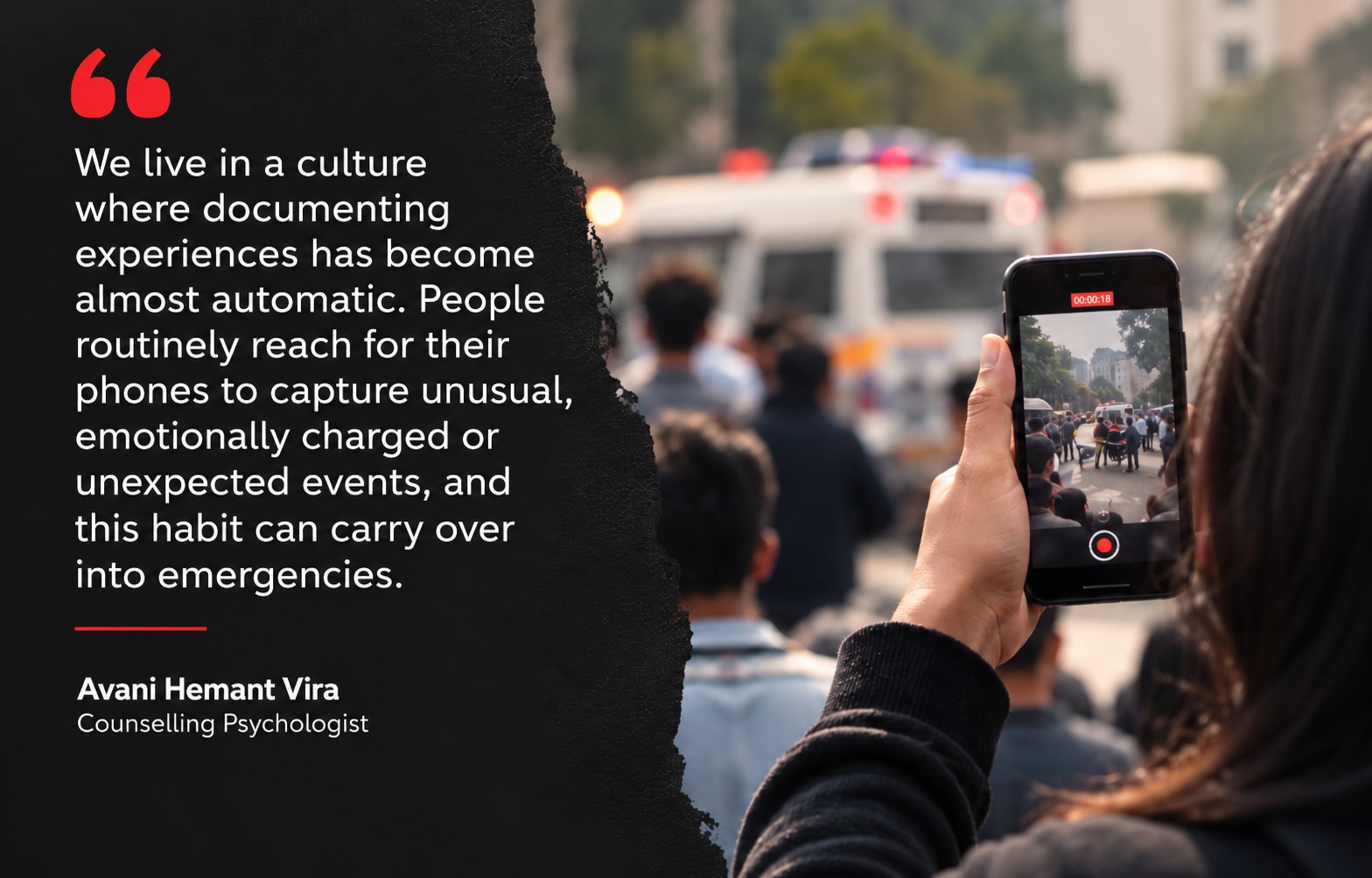
She also pointed to the psychological distance created by recording. Instead of directly engaging with a distressing situation, a person can take on the role of an observer, making the experience feel more manageable.
The behaviour can also be connected to the bystander effect, where people are less likely to intervene when others are present. Vira explained that when several people witness an incident, each person may assume someone else will call for help or take charge.
Counselling psychologist Honey Agarwal said smartphones have added another option to people’s responses during emergencies. “Because recording is quick and familiar, it can become the preset response, even when it is not the most useful one,” she said.
At the same time, Agarwal said the phone itself is not necessarily the problem. It can be used to call emergency services, share a location or document an incident. The concern arises when recording becomes a substitute for helping.
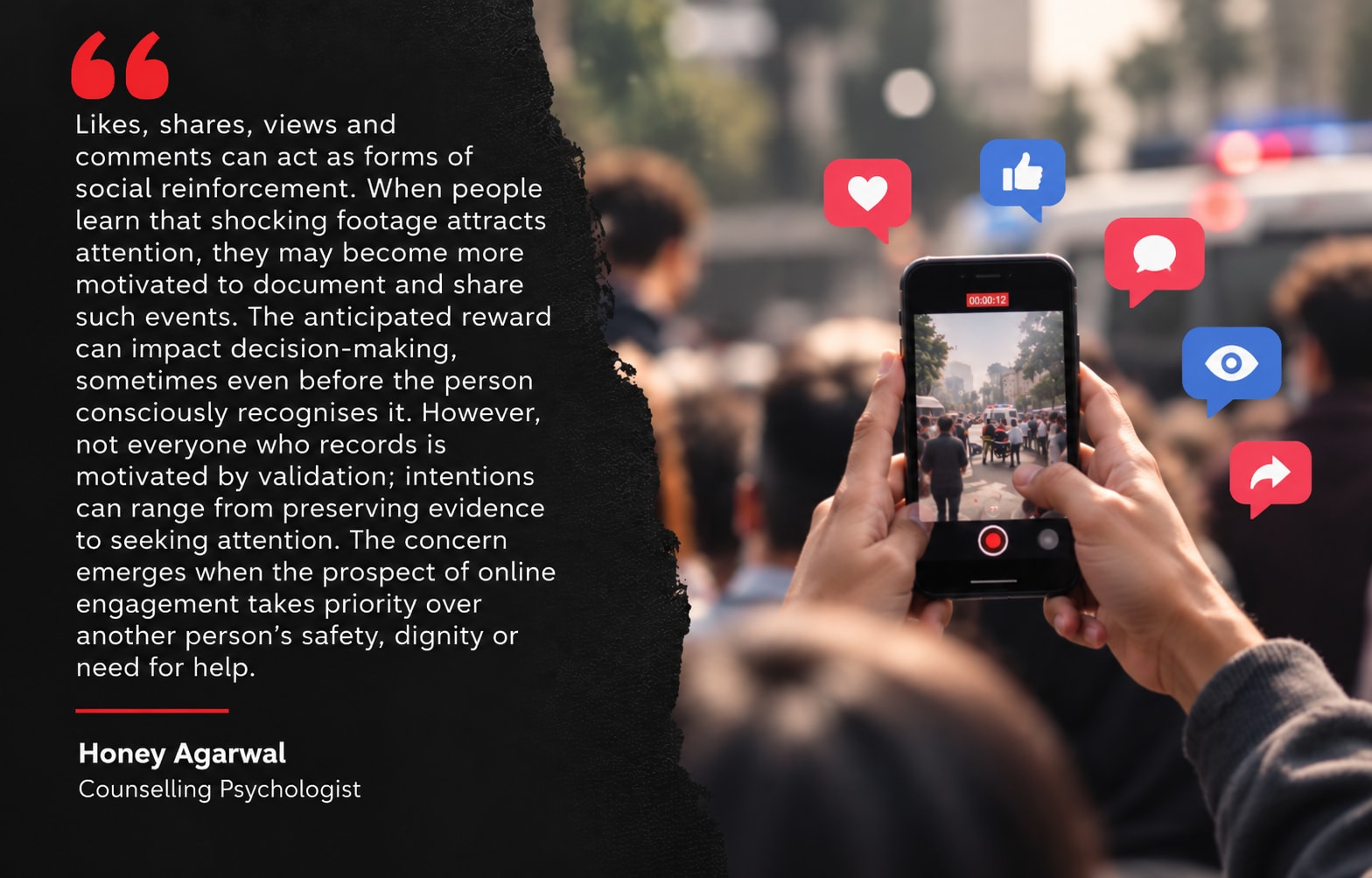
Social media can further complicate the response. Agarwal said the possibility of capturing viral content can influence judgement, particularly because dramatic and shocking footage often attracts attention online.
“Likes, shares, views and comments can act as forms of social reinforcement,” she said, adding that the anticipated reward can sometimes influence a person’s decision to record rather than help.
Counselling psychologist Shilpa Vikram Ghodke also cautioned against assuming that everyone who records an emergency is motivated by attention or a lack of empathy.
“There is no single explanation,” Ghodke said. Some people may be shocked or unsure about how to respond, while others may genuinely believe that footage could preserve evidence.
However, she said the focus should be on what happens after a person starts recording. If the footage helps alert authorities or preserve evidence without delaying assistance, it can be useful. But if a person has a safe opportunity to seek help and continues filming instead, “capturing the event may have taken priority over the person’s immediate welfare.”
The distinction between recording for evidence and recording for entertainment is therefore important. Evidence-focused recording aims to document what happened and assist an investigation, while attention-driven recording can turn another person’s distress into spectacle.
The psychologists also stressed that helping does not necessarily mean physically confronting an aggressor or putting oneself in danger. Calling emergency services, alerting security, directing someone else to help or providing responders with the location can all be meaningful forms of intervention.
As Vira put it, “Safe intervention is still intervention.”
The bigger concern, experts say, is not simply that people carry phones or record emergencies. It is what happens when recording starts replacing responding. A video may preserve evidence, but in a situation where someone needs immediate help, making that call or getting assistance could matter far more than capturing the incident on camera.
Conclusion
The instinct to record rather than respond is not always a sign of cruelty or indifference. Fear, shock, uncertainty and the presence of other people can all affect how someone reacts in an emergency. But psychologists say the line becomes concerning when the camera starts taking priority over the person in distress.
In an increasingly digital world, witnessing an incident can easily turn into documenting it. The real question, experts say, is what comes next: Are we simply capturing someone’s worst moment, or are we doing something that could actually help? Sometimes, putting the phone down, making a call or alerting the right person can make a far greater difference than any viral video.
Quick Answers
 Ask News18
Psychologists note there is no single reason, but factors include shock, uncertainty, and the bystander effect. For many, pulling out a phone provides a familiar action when they do not know how to respond, or creates a psychological distance that makes a distressing event feel manageable.
Ask News18About the Author

Anushka Vats is a Sub-Editor at News18.com with a passion for storytelling and a curiosity that extends beyond the newsroom. She covers both national and international news. For more stories, you can …Read More

October 15, 2026, 4:51 PM IST
Read More
Source link
[ad_3]

