
- Hindi News
- Business
- Supreme Court Grants Relief To Vodafone Idea | Govt Allowed To Review AGR Dues
New Delhi11 minutes ago
- copy link
Telecom company Vodafone Idea (VI), which is facing financial crisis, has got a big relief from the Supreme Court. The court on Monday allowed the Central Government to reconsider the Adjusted Gross Revenue (AGR) dues of VI. The court said that this decision falls within the policy ambit of the Central Government, hence the government cannot be stopped from doing so.
The bench of Chief Justice BR Gavai passed this order after hearing the arguments of Solicitor General Tushar Mehta. Mehta told the court that if Vodafone Idea is closed then consumers will face problems. He argued that customers are also facing problems like duplicate billing or extra billing, due to which it is necessary to re-look at the calculation of AGR dues.
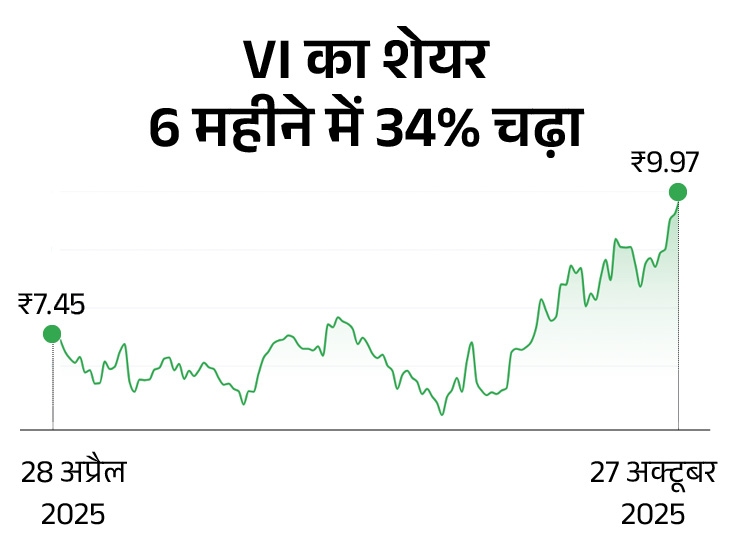
Earlier, the Supreme Court had said that the Department of Telecommunications (DoT)’s calculation of AGR dues will be final and companies cannot dispute it or demand re-investigation. After relief from Supreme Court, Vodafone Idea shares rose by 10%.
The share reached Rs 10.57 at 12 noon. However, by the time the market closed, it closed at Rs 10 with a rise of about 4%.
Why did Vodafone Idea want a re-investigation?
Vodafone Idea had asked the DoT (Department of Telecommunications) to cancel or completely reinvestigate the additional AGR dues of ₹5,606 crore. The company said that there were mathematical mistakes in the assessment of DoT in the year 2016-17.
What is AGR?
AGR (Adjusted Gross Revenue) is the part of telecom companies’ earnings on which the government levies license fee and spectrum usage charge (SUC).
Understand what is the AGR issue in three chapters?
Chapter 1: Beginning of the Case
- The controversy started when the Department of Telecom said that non-telecom revenues (like interest, dividends, sale of assets) would also be included in AGR. But the companies argued that AGR should be just core telecom revenue.
- Regarding this, in 2005 COAI (Cellular Operators Association of India) challenged the definition of AGR in TDSAT (Telecom Disputes Settlement Appeal Tribunal). The case started from here.
Chapter 2- Court’s decision
- Subsequently, in 2015, TDSAT (Telecom Disputes Settlement Appellate Tribunal) ruled that AGR will not include non-telecom revenues (capital receipts, rent, dividends, etc.). Department of Telecom challenged this decision in the Supreme Court.
- In October 2019, the Supreme Court upheld the Department of Telecom’s AGR formula, saying that telecom companies will have to pay the outstanding ADUES of the last 14 years (about ₹1.47 lakh crore).
- In January 2020, the Supreme Court gave 10 years time to pay AGR dues.
Chapter 3- Impact on companies
- The biggest affected companies in paying AGR dues were Vodafone Idea (₹58,254 crore), Bharti Airtel (₹43,980 crore), Tata Telecom (₹16,798 crore).
- Between 2021 and 2024, Vodafone Idea’s financial difficulties increased. VI warned the Department of Telecom that it would not be able to function after FY26 without government help.
- In March 2025, the government converted Vodafone Idea’s spectrum dues worth ₹36,950 crore into equity, giving the government a 49% stake in the company.
- May 2025: Vodafone Idea files petition to waive off outstanding AGR dues. But the petition was rejected.
Source link
[ad_3]

