
Mumbai12 minutes ago
- copy link
The Reserve Bank of India has rejected the application of Tata Sons, the holding company of Tata Group, to voluntarily surrender its NBFC registration as a core investment company.
After this decision of the Reserve Bank, now Tata Sons will have to follow all the strict rules of Upper-Layer Non-Banking Financial Company (NBFC), under which the company will have to list its shares in the stock market.
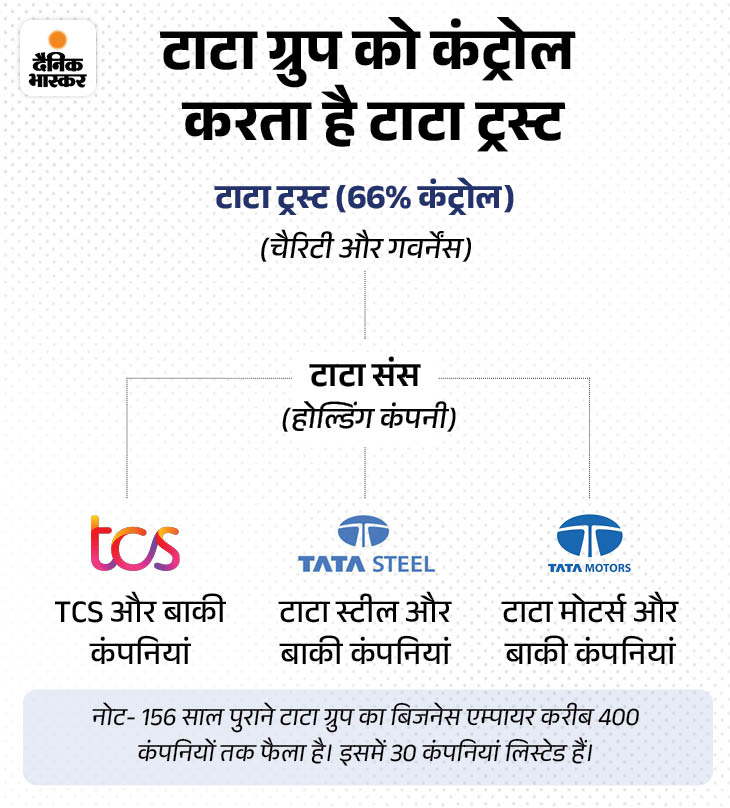
Let us consider the whole matter as question and answer…
Question 1: What major decision has RBI taken regarding Tata Sons? answer: The Reserve Bank of India (RBI) has rejected Tata Sons’ application seeking acceptance of its surrendered registration as a Non-Banking Financial Company (NBFC). After this decision, it will now be mandatory for Tata Sons to follow the ‘upper-layer NBFC’ rules of RBI, under which the company will have to list its shares in the stock market.
Question 2: Why did Tata Sons apply to surrender NBFC registration? answer: Tata Sons had applied to surrender the core investment company (CIC) registration in 2024. The company had repaid its entire debt of ₹21,813 crore in FY2024 and made itself a net cash positive company. Tata Sons’ argument was that after the loan is extinguished, it should now be exempted from the stringent rules of NBFC category and mandatory listing.
Question 3: Why did RBI reject this application? answer: According to the revised framework of the central bank, any NBFC whose standalone asset size is ₹ 1 lakh crore or more, automatically comes under the ‘Upper-Layer’ category. The asset size of Tata Sons is much higher than this limit of ₹1 lakh crore. Even in August 2026, RBI had retained Tata Sons in the updated list of 17 upper-layer NBFCs.
Question 4: When was Tata Sons supposed to be listed in the market? answer: The Reserve Bank had classified Tata Sons as an upper-layer NBFC for the first time in September 2022. According to that rule, it was mandatory for such companies to be listed in the stock market within 3 years i.e. by September 2025. However, Tata Sons remained unlisted till now due to the pending application, but after the application is rejected, now the listing process will have to be completed.
Question 5: How will common (retail) investors benefit from the listing of Tata Sons? answer: If Tata Sons gets listed on the stock exchange, then common investors will get an opportunity to indirectly invest in unlisted companies of the Tata Group, which are not currently present in the stock exchange. This includes big companies like Air India, Tata Electronics, Tata Digital and Tata Advanced Systems.
Question 6: What impact will this have on shareholders and market valuation? answer: The listing of Tata Sons will provide a transparent market-based valuation to the group’s unlisted assets. This could lead to a big jump in the company’s valuation and unlock value for existing shareholders.
Question 7: What does this decision mean for Shapoorji Pallonji? answer: Shapoorji Pallonji Group holds about 18.4% stake in Tata Sons. With the listing of the company in the stock market, it will become easier for SP Group to determine the exact market value of its stake. Additionally, being listed will provide them with considerable liquidity and ease if they wish to raise funds or sell shares against their stake in the future.
Question 8: Does Tata Sons now have any other option to avoid listing? answer: Since the Reserve Bank has made it clear that companies with assets above ₹1 lakh crore cannot be kept out of the upper-layer ambit, it will be difficult for Tata Sons to postpone the listing without legal or regulatory relaxations. However, the company can appeal against this decision to the Central Bank for restructuring or relief in time limit.

Source link
[ad_3]

