
New Delhi3 minutes ago
- copy link
A study by the Automotive Research Association of India (ARAI) has revealed that using E20 fuel in old E10 compliant vehicles can damage the rubber parts of the fuel system. However, this report has not been made public yet.
Understand the whole matter in answers to 10 questions…
Question 1: What is the most important thing that has come out in this report of ARAI?
answer: According to this report of ARAI, using E20 fuel in E10 vehicles can damage the fuel system. This causes damage to the rubber parts of the vehicle such as pipes, gaskets, seals and O-rings. The report states that these rubber parts may need to be replaced.
Question 2: Has the report been released to the general public and what is its significance?
answer: No, this study report has not been made public yet. However, this report remains a key reference point between the government and the country’s major vehicle manufacturers (OEMs) for policy making and technological improvements on this issue.
Question 3: What testing was done regarding the effect of E20 fuel on the engines of four-wheelers?
answer: According to the report, two OEMs had conducted engine durability tests. In this, a manufacturer’s vehicle engine showed no problems after 400 hours of testing and its performance was found to be fine with E20 fuel. But the situation was different in the case of other manufacturers.
Question 4: What technical problem was seen in the vehicles of other four-wheeler manufacturers?
answer: When the engine from another OEM was tested for 809 hours, a ‘thermomechanical failure’ was observed in its exhaust valve. However, experts in this matter say that there could be some other reasons behind the failure of the exhaust valve.
Question 5: What is this ‘thermomechanical failure’ and what harm does it cause to the engine?
answer: Thermomechanical failure occurs when excessive heat and rapid and repetitive movements (mechanical stresses) combine. The combined pressure of these two can cause the engine’s exhaust valve to bend, crack, or break completely.
Question 6: What difference was found in the testing of four-wheelers with BS-IV and BS-VI engines?
answer: Under the 4-wheeler engine durability test, the report states that during testing, the performance of a BS-IV engine was acceptable with E20 fuel. In contrast, a BS-VI turbo charged engine had the problem only after 265 hours of durability testing.
Question 7: What was the result of this testing on two wheelers?
answer: According to the report, engine durability tests were conducted by three two-wheeler manufacturers. No problems were found in the engines in these tests. These have been found to be acceptable with E20 fuel.
Question 8: Does E20 fuel have any adverse effect on metallic parts or emissions of vehicles?
answer: No, the study found that E20 fuel has no adverse effect on metallic components across all tested vehicles. Additionally, silencer emissions were found to be within legal limits even when E10-compliant vehicles were fueled with E20 fuel.
Question 9: What effect did this have on the mileage or fuel consumption of vehicles?
answer: ARAI study has concluded that the fuel consumption of vehicles increases by 2% to 6% when using E20 fuel compared to E10 fuel.
That means the mileage of vehicles reduces. However, this increase in fuel consumption varies according to the model and category of different vehicles.
Question 10: What was the effect on the starting, running and evaporative emissions of the vehicle?
answer: According to the report, evaporative emissions of vehicles with E20 fuel were also found to be completely within the legal limits. Additionally, the startability (easiness of starting) and drivability (driving performance) of the vehicles were also found to be fine with E20 fuel.
The government had said that no evidence of damage to the vehicles was found in the testing.
Recently, in a press conference, experts from the government had said that no evidence of damage to the vehicles has been found in the large-scale testing. Experts had held a press conference amid the ongoing claims on social media about the performance of the vehicle.
Apart from Vartika Shukla, former CMD of Engineers India Limited, Bajaj Auto Circle Head Manpreet Singh and TVS Senior Vice President Prashant Krishnan were present in this press conference.
He was also joined by Toyota Kirloskar Motor Country Head Vikram Gulati, Maruti Suzuki Senior Executive Officer Rahul Bharti, Hyundai India’s Punit Anand and Hero Moto’s Ashutosh Verma.
Government may postpone the decision of blending 25% ethanol in petrol
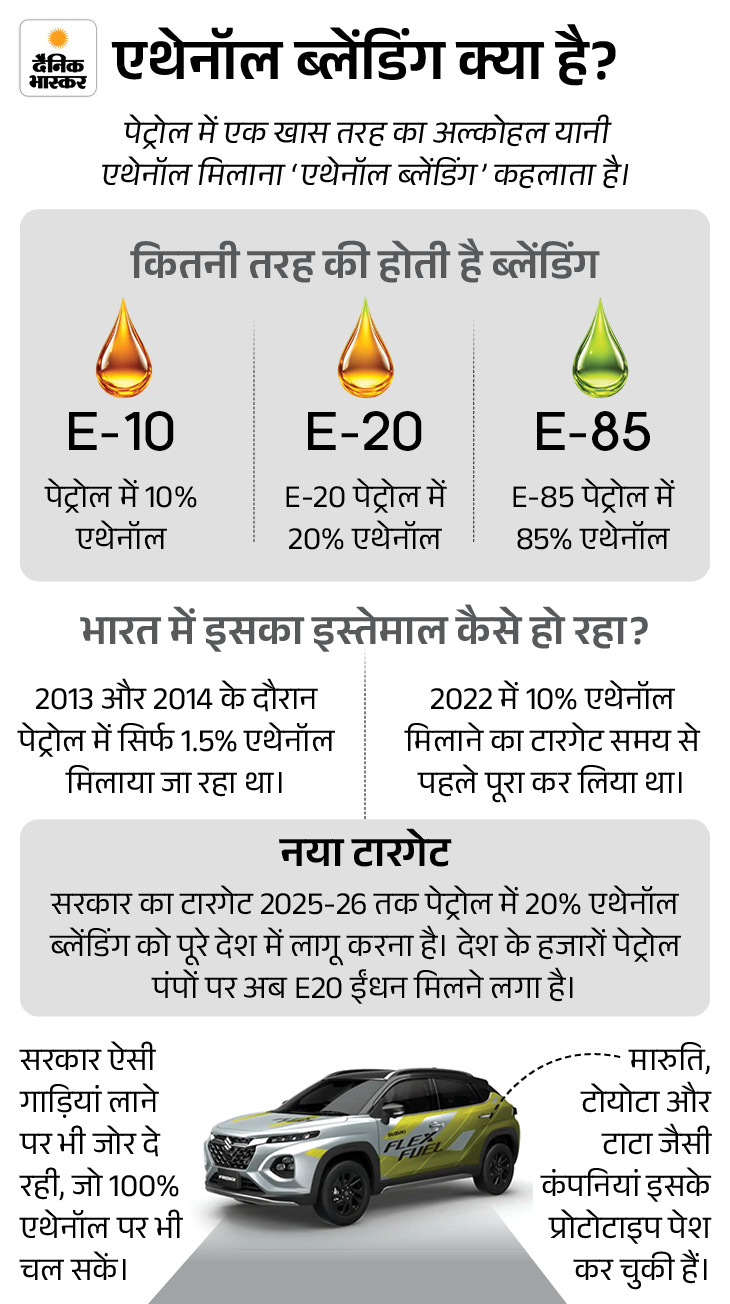
Amidst the opposition to E20 fuel, the government may currently go ahead with the plan to increase the amount of ethanol in petrol to 25%. The government wants to implement this transition gradually and systematically rather than hastily.
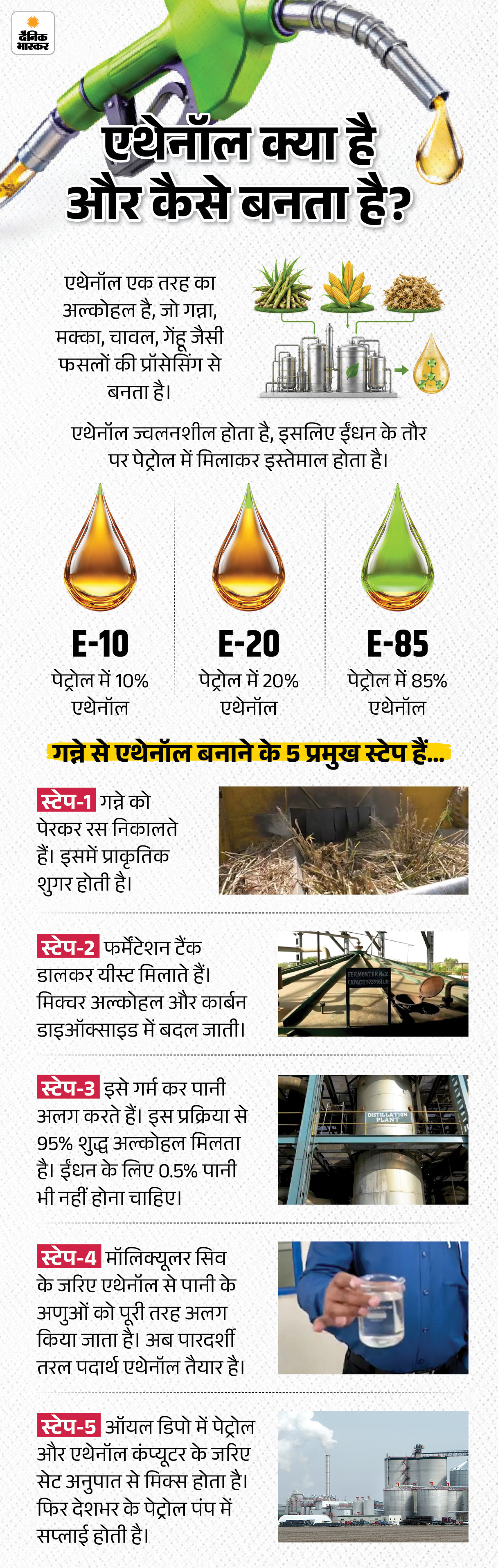
The government had initially planned to mix 20% ethanol in petrol by the year 2030. But long before this target, E20 fuel (80% petrol and 20% ethanol) has been implemented as standard petrol in the entire country and now this petrol is available everywhere.

Source link
[ad_3]

