
Last Updated:
Indian Air Force Day 2026: Share these wishes and greetings as the IAF marks its 94th Raising Day, tracing its journey from 1932 to a modern air power.




October 8, 2026 marks 94th anniversary of Indian Air Force Day. (Image: IAF_MCC/X, formerly Twitter)
Indian Air Force Day 2026 Wishes Greetings History: October 8 marks the 94th Raising Day of the Indian Air Force (IAF), an occasion to honour the air warriors who serve the nation and remember the remarkable journey of India’s air power.
From a small force established in 1932 to a modern and technologically advanced service, the IAF has evolved through decades of war, peace, training, innovation and operational transformation.
On Indian Air Force Day, people across the country extend their wishes and greetings to serving personnel, veterans and the families who stand alongside India’s air warriors.
Indian Air Force Day 2026: Wishes and Greetings
Indian Air Force Day is an occasion to salute the courage, discipline and dedication of the men and women who serve the nation. Here are some wishes and greetings that can be shared on the 94th Raising Day:
- Happy Indian Air Force Day 2026. Salute to the brave air warriors who serve the nation with courage, commitment and distinction. Jai Hind!
- Warm wishes on Indian Air Force Day. May the valour, dedication and spirit of India’s air warriors continue to inspire generations.
- On the 94th Indian Air Force Day, we remember the sacrifices of our air warriors and honour all those who continue to serve the nation with pride.
- Salute to the Indian Air Force on its 94th Raising Day. From the skies of India to missions around the world, the IAF continues its tradition of service and excellence.
- Wishing all air warriors, veterans and their families a proud Indian Air Force Day 2026. Your courage and commitment remain an inspiration to the nation.
- Jai Hind! On Indian Air Force Day, we honour the legacy of India’s air warriors and celebrate the journey of the Indian Air Force across nine decades.
The Story of the Indian Air Force: A Journey Through Time
At A Glance
The Indian Air Force was established on October 8, 1932.
The IAF’s first operational flight occurred on April 1, 1933.
By the end of 1942, the IAF was operating five squadrons.
In March 1945, the IAF was granted the prefix “Royal” for its wartime contribution.
By 1946, the IAF’s personnel strength had grown to around 28,500.
The story of the Indian Air Force began on October 8, 1932, when the force was established during the pre-Independence era. Its formation marked the beginning of India’s organised military aviation capability.
A few months later, on April 1, 1933, the IAF’s first operational flight took to the skies. Six RAF-trained officers and 19 Havai Sepoys operated four Westland Wapiti IIA aircraft, forming the nucleus of “A” Flight at Drigh Road.
This small beginning laid the foundation for what would eventually become one of the world’s major air forces.
The Early Years: 1933 to 1941
The fledgling air force gained operational experience during the 1930s. By 1936, “A” Flight had seen its first action from Miranshah in North Waziristan, supporting Indian Army operations.
The force continued to expand gradually. “B” Flight was established in 1936, while “C” Flight followed in 1938, bringing No. 1 Squadron to full strength.
When the Second World War began, No. 1 Squadron remained the sole IAF formation, although its personnel strength had increased considerably.
The approaching global conflict also prompted a reassessment of India’s air defence requirements. Coastal Defence Flights were established to assist in protecting important ports and coastal areas.
These formations operated from locations including Madras, Bombay, Calcutta, Karachi, Cochin and, later, Visakhapatnam.
The period demonstrated an important characteristic that would define the IAF’s subsequent history: its ability to expand, adapt and absorb new technologies in response to changing operational requirements.
Wartime Expansion and Training: 1941-1946
The Second World War accelerated the development of the Indian Air Force. Training became an important priority as the demand for qualified aircrew increased.
In 1941, flying instructors were assigned to flying clubs across British India to strengthen the training pipeline for IAF Volunteer Reserve cadets. By the end of that year, hundreds of cadets had received elementary flying training on Tiger Moth aircraft.
At the same time, the IAF began upgrading its aircraft. No. 1 Squadron transitioned from the Wapiti to the Westland Lysander, while other squadrons moved to aircraft such as the Audax and subsequently the Hurricane.
The force continued to expand despite the limitations of wartime resources. By the end of 1942, the IAF was operating five squadrons.
No. 7 Squadron later adopted the US-built Vengeance dive bomber, while the number of operational squadrons continued to increase.
By the end of 1944, nine squadrons were active, most equipped with Hurricanes and one with Spitfires.
IAF personnel received numerous decorations for their wartime service, including 22 Distinguished Flying Crosses.
In March 1945, the IAF was granted the prefix “Royal” in recognition of its wartime contribution.
By 1946, personnel strength had grown to around 28,500, including approximately 1,600 officers.
Independence and the Transformation of the IAF
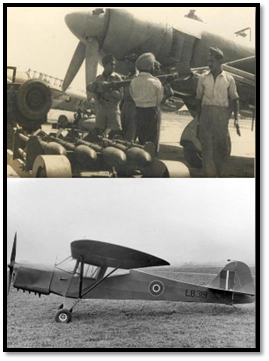
India’s Independence in 1947 brought another major transformation.
Partition resulted in the reorganisation of military assets and personnel, with several units and equipment transferred to the newly established Royal Pakistan Air Force.
The Indian air arm, meanwhile, continued to reorganise and modernise. Air Headquarters was established in New Delhi, while new and re-equipped squadrons strengthened the force during the conflict in Jammu and Kashmir.
The years immediately following Independence were therefore not only a period of transition but also a crucial phase in building an independent Indian air power structure.
From the Royal Indian Air Force to the Indian Air Force
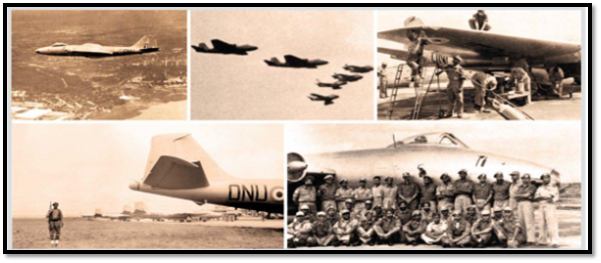
A major constitutional change came in January 1950, when India became a Republic.
With the new constitutional status, the “Royal” prefix was dropped, and the Indian Air Force assumed its present name.
At the beginning of the Republic, the IAF operated a mix of fighter, bomber, transport, observation and communication aircraft. Training institutions also developed, helping establish a stronger and more systematic pipeline for pilots and other personnel.
The 1950s became a decade of expansion and modernisation. The IAF introduced new aircraft, including Vampire night fighters, Dassault Ouragans, Fairchild C-119G Packets, Mystere IVAs, Hawker Hunters and English Electric Canberras.
The force also expanded its training, maintenance and auxiliary structures.
By the late 1950s, the IAF was moving from a relatively small post-Independence force towards a significantly larger and more capable organisation.
The MiG-21 Era and Modernisation
The 1960s brought another decisive phase in the IAF’s development.
The changing security environment and lessons from earlier conflicts underlined the importance of modern aircraft, trained personnel and stronger air-defence systems.
An important milestone came with India’s decision to acquire the MiG-21 from the Soviet Union.
The induction of the MiG-21 marked a significant shift in the IAF’s combat aviation capabilities and had a lasting influence on its fighter fleet.
The IAF also expanded the use of aircraft such as the Gnat and Sukhoi Su-7BM.
The period saw a gradual transition away from older aircraft and towards platforms with improved performance and combat capabilities.
Training infrastructure expanded as well. The establishment of the Air Force Academy at Dundigal in 1971 provided an important institutional foundation for developing future generations of air warriors.
The 1971 War and the Growth of Air Power
The 1971 Indo-Pakistan War became another important chapter in the IAF’s operational history.
The force conducted thousands of sorties during the conflict, employing aircraft including the Gnat and MiG-21.
The experience of the 1971 war further shaped the IAF’s approach to air operations, modernisation and preparedness.
In the decades that followed, newer aircraft and technologies entered service. Platforms such as the Jaguar and Mirage 2000 strengthened the IAF’s capabilities across different operational roles.
The force increasingly combined fighter aviation with improved surveillance, transport, air defence, training and support capabilities.
Kargil War and Operation Safed Sagar
The 1999 Kargil conflict presented a very different operational challenge.
High-altitude terrain demanded careful planning and precision in the employment of air power.
During Operation Safed Sagar, the IAF provided air support in extremely difficult mountainous conditions.
The Mirage 2000 and other aircraft played important roles, while helicopters were also employed for operational support.
The Kargil experience highlighted the importance of precision, technology, intelligence and adaptability in modern air operations.
It also demonstrated how air power could be employed in challenging terrain while operating under complex operational constraints.
From Kargil to a Modern, Technology-Driven Force
The IAF’s transformation continued after Kargil.
Modernisation increasingly focused not just on individual aircraft but on integrating aircraft, sensors, communications, weapons, surveillance and command systems.
A significant milestone in India’s indigenous aerospace journey was the induction of the Tejas Light Combat Aircraft into the IAF.
The aircraft represents India’s effort to strengthen domestic aerospace capabilities while developing a modern multi-role combat platform.
The broader evolution of the IAF has also included advances in airlift, helicopters, air-to-air refuelling, airborne early-warning capabilities, network-centric operations and other areas of military aviation.
This transformation reflects a shift from an air force built around a relatively small number of aircraft types to a complex organisation combining combat aviation, transport, helicopters, surveillance, training and technological systems.
Indian Air Force Day 2026: Celebrating 94 Years of Service
As the Indian Air Force marks its 94th Raising Day on October 8, 2026, the occasion provides an opportunity to look back at the distance travelled since 1932.
The IAF’s history has been shaped by wartime operations, national security challenges, technological change and the continuous development of its personnel and infrastructure.
From the four Wapiti aircraft of its early years to today’s advanced aviation systems, the journey reflects decades of evolution.
The anniversary is also an opportunity to recognise the contribution of air warriors, veterans, civilian personnel and the families who support them.
A Legacy of Courage, Service and Innovation
The Indian Air Force remains an important component of India’s defence architecture.
Its journey over nine decades illustrates how a small aviation force developed into a modern service capable of undertaking a wide range of missions.
Its history is not only a story of aircraft and technology. It is also a story of people — pilots, engineers, technicians, ground personnel, support staff and families — whose collective efforts have sustained the force through changing times.
On Indian Air Force Day 2026, the nation honours that legacy and extends its greetings to all air warriors, veterans and their families.
As the IAF enters its 95th year since its establishment, its journey from 1932 remains a story of adaptation, professionalism, courage and service to the nation.
Quick Answers
 Ask News18
October 8 marks the Raising Day of the Indian Air Force, celebrating its evolution and legacy of service since its establishment.
Ask News18About the Author

Nibandh Vinod is a seasoned journalist with nearly three decades of experience. He specialises in covering events and festivals and in driving SEO-focused content for News18.com. Tech-savvy and collab…Read More
October 08, 2026, 06:30 IST
Source link
[ad_3]

