
- Hindi News
- Business
- HDFC Bank Q2 Results | Profit Grows 4.7% NII Rises Asset Quality Improves
Mumbai23 minutes ago
- copy link
HDFC, the country’s largest private bank, has released the results for the July to September quarter of this year today on October 17. The bank’s standalone net profit has increased by 4.7% year-on-year to ₹19,510 crore.
The bank’s net interest income (NII) increased by 9.7% year-on-year to ₹34,619 crore. The asset quality of the bank has also improved.
Bank results were very close to estimates
CNBC TV18’s poll had predicted a 5% increase in net profit to ₹19,567 crore and a 10% increase in NII to ₹34,861 crore. This means that the bank’s results were very close to estimates.
Margin, provisions and credit cost
HDFC Bank’s net interest margin (NIM) stood at 3.16% on total assets and 3.32% on interest-earning assets in the July-September quarter. The bank’s provisions and contingencies for the quarter stood at ₹3,570 crore, while the total credit cost ratio stood at 0.44%.
Bank’s asset quality improved
By September 30, 2026, the gross non-performing asset (GNPA) ratio of the bank improved to 1.11%. In the last quarter i.e. June 2026 it was 1.17% and a year ago (September 2025) it was 1.24%.
Excluding the NPA of the agriculture segment, the GNPA ratio stood at 0.87%, which was 0.91% in June 2026 and 0.99% in September 2025. Net NPA ratio was recorded at 0.37% at the end of September quarter.
Double digit growth in advances and deposits
The bank’s gross advances grew 16.3% year-on-year to ₹32,19,500 crore as of September 30, 2026, while advances under management grew 15.3%.
- Retail Loan: An increase of 11.7%.
- Small and Mid-Market Enterprise Loan: Growth of 23.5%.
- Corporate and Other Wholesale Loans: Increase of 16.4%.
Total deposits increased by 18.8% year-on-year
Average advances under management during the quarter stood at ₹31,87,200 crore, up 14.1% year-on-year and 4.9% quarter-on-quarter.
Total deposits grew 18.8% year-on-year to reach ₹33,27,400 crore at the end of September. Average deposits increased by 16.8% to ₹31,66,400 crore, showing a quarter-on-quarter growth of 5.1%.
Current Account and Savings Account (CASA) deposits grew 10.8% year-on-year, accounting for 31.6% of total deposits. Whereas time deposits increased by 22.8%.
Capital Adequacy and Operating Performance
HDFC Bank’s capital adequacy ratio under Basel III as of September 30, 2026 stood at 18.9%, much higher than the regulatory requirement of 11.9%, compared to 20% a year ago.
In this, Tier 1 Capital Adequacy Ratio was 17.2% and Common Equity Tier 1 (CET1) ratio was 17.1%.
Net revenue of the bank was ₹48,450 crore.
The net revenue of the bank stood at ₹48,450 crore in this quarter, which was ₹45,900 crore in the same quarter last year. Other income stood at ₹13,830 crore, which included fees and commission of ₹9,690 crore. Treasury trading gains declined to ₹780 crore from ₹2,390 crore in the same quarter last year.
Operating expenses increased to ₹18,970 crore from ₹17,980 crore, while the cost-to-income ratio stood at 39.1%. The bank said that its net profit excluding treasury trading gains has increased by about 12.6% on an annual basis.
HDFC Bank shares fell 26% this year
On Friday, before the results, HDFC Bank shares had closed at ₹ 728.85 with a gain of 0.28%. So far in the year 2026, this stock has declined by 26.5%. The market cap of the bank is approximately ₹11.24 lakh crore.
What is net interest income and net interest margin?
Net Interest Income (NII): The bank mainly performs two functions – accepting deposits and giving loans. The amount left after deducting the interest paid to depositors from the interest received by the bank on giving loan is called net interest income. This is the main income of the bank.
Net Interest Margin (NIM): It is a measure of financial health of a bank. The difference between the amount of interest a bank earns on its total interest earning assets (such as loans) and the interest it pays on deposits, expressed in percentage, is called Net Interest Margin.
What is Non Performing Asset or NPA?
When a person or organization takes a loan from a bank and does not return it, it is called bad loan or non-performing asset or NPA. This means that the chances of recovery of these loans are very less. As a result, banks lose money and go into losses.
According to the rules of the Reserve Bank of India (RBI), if the installment of a bank loan is not repaid for 90 days i.e. three months, then that loan is declared NPA. In case of other financial institutions this limit is 120 days. Banks have to do this to clear the books.
What is GNPA and NNPA?
Gross NPA (GNPA): The total loan of the bank which is stuck or on which installments/interest are not coming on time.
Net NPA (NNPA): When the money kept aside for emergencies (provision) by the bank is subtracted from the total bad loan (GNPA), the real bad loan i.e. Net NPA comes out. The lower the NPA, the better the health of the bank is considered.
Read this news also…
Wipro’s profit declines, 6,716 employees reduced: ₹3,200 crore profit in second quarter; The stock has fallen 35% so far this year
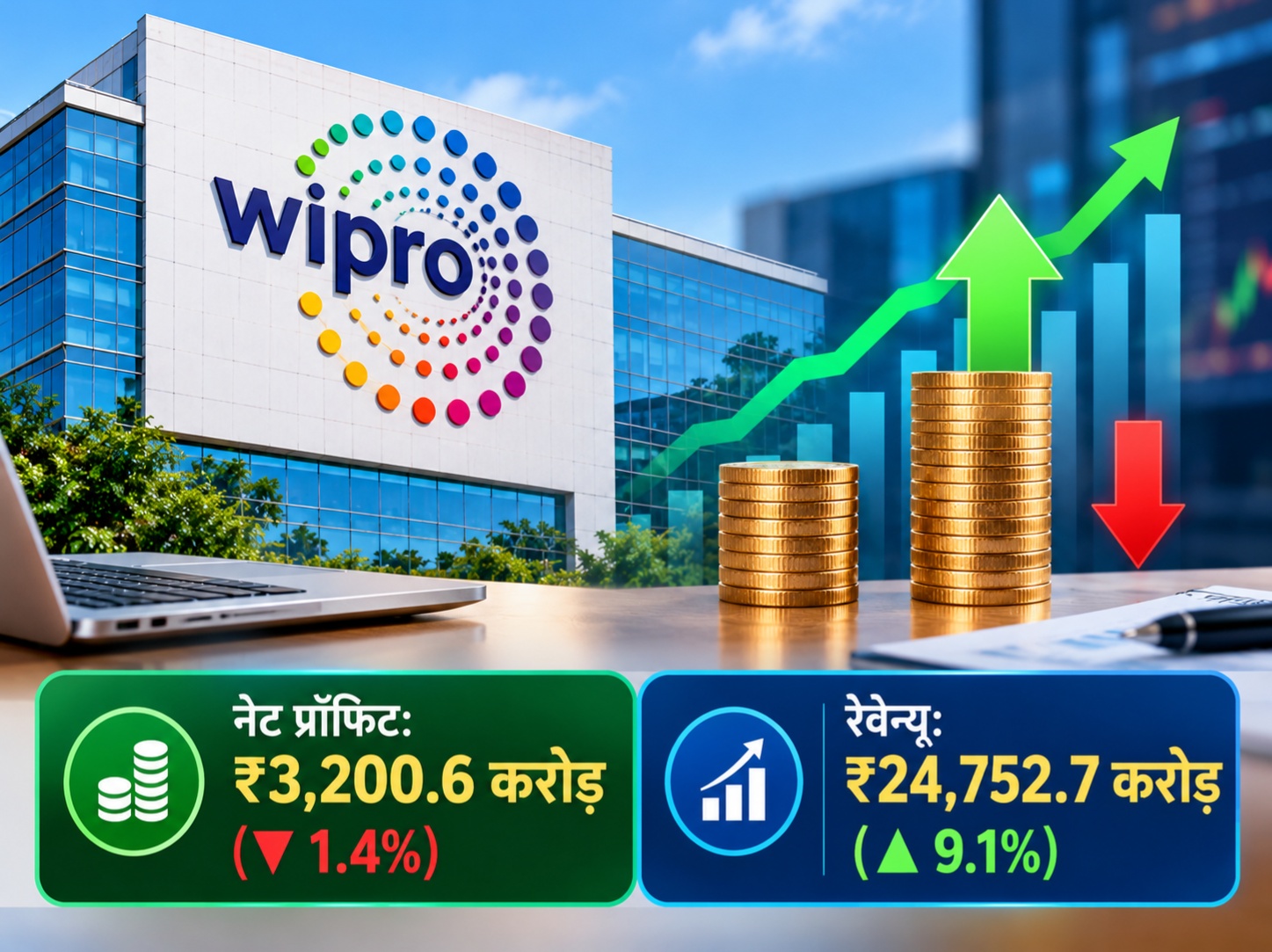
Wipro, one of the country’s largest IT companies, has released the results for the July to September quarter of this year today on October 15. The company has made a revenue of ₹ 24,752.7 crore during this period, which is 9.1% more than the revenue of ₹ 22,697.3 crore made at the same time last year. Read the full news…

Source link
[ad_3]

