
New Delhi49 minutes ago
- copy link
Finance Minister Nirmala Sitharaman has said that the government is ready to listen to the suggestions regarding removal of Long-Term Capital Gains i.e. LTCG tax in the discussions to be held before the budget. The Finance Minister said this in the ‘Bloomberg New Economy Forum’ in New Delhi.
Apart from this, Sitharaman also talked about the country’s economic situation, capital markets, investment in infrastructure and technology sectors.
Question 1. What did the Finance Minister say regarding LTCG tax and STT?
answer: Sitharaman said that both domestic and foreign investors are raising questions regarding LTCG tax and Security Transaction Tax (STT) on equity.
There is a lot of debate in the market on the question of STT and treating different asset classes equally. It is quite healthy to have such a debate and the government is fully ready to listen to suggestions on this in the budget discussion.
Question 2. Is the government considering abolishing or reducing LTCG tax?
answer: According to the statement of the Finance Minister, the government has not taken any final decision, but they have agreed to consider the suggestions of investors and experts in the budget meetings.
Both STT and LTCG are directly linked to stock market investors, so the market is hopeful that there may be relief on this in the budget.
Question 3. In which sectors is private capital and investment increasing rapidly?
answer: Sitharaman informed that domestic and foreign private capital is now rapidly going into new and future sectors.
- Renewable Energy, Green Hydrogen and Green Ammonia.
- Semiconductor Chips: Chip Designing, Manufacturing, and Packaging.
- Data Centers and Transmission Lines.
- MRO (Maintenance, Repair and Overhaul) centers in biosimilars, drug manufacturing and aviation sectors.
Question 4. What is India’s strategy regarding semiconductor chips and AI?
answer: The Finance Minister said that India is not only working on AI but is also strengthening the sectors that enable AI. This includes semiconductor chips, design and packaging.
The government has decided to manufacture advanced, finer-nanometer chips as well as basic chips that are essential for the entire economy and electronics.
Question 5. What is the status of infrastructure development and funding in the country?
answer: On infrastructure funding, the Finance Minister said that the National Infrastructure Pipeline (NIP), launched in late 2019, has now crossed the figure of $4.5 trillion i.e. approximately Rs. lakh crore.
Apart from this, these two institutions – National Bank for Financing Infrastructure and Development (NaBFID) and National Investment and Infrastructure Fund (NIIF) have played an important role in raising funds and accelerating the projects.
Sitharaman said that in the last 10 years, India has performed well in whatever sector required infrastructure and this pace will continue in future also.
Question 6. What is the status of growth in the aviation sector?
answer: According to Sitharaman, India’s civil aviation sector is currently growing at an annual rate of about 16%. As demand from airlines increases, there are huge opportunities for investors to set up maintenance, repair and overhaul (MRO) centers for aircraft in the country.
Question 7. What did the Finance Minister say on the decline of Indian Rupee and Dollar?
answer: The Finance Minister accepted the fluctuations in the rupee against the dollar as a challenge. However, he clarified that the Reserve Bank of India (RBI) is not targeting any fixed exchange rate.
RBI’s entire focus is on preventing rupee volatility in the market. For this, the Reserve Bank is continuously taking steps and will continue taking necessary measures in future also.
Question 8. What was the stance of the Finance Minister on the condition of India’s overall economy?
answer: Finance Minister Sitharaman said that India’s macroeconomic fundamentals are completely strong and secure. The government has strictly followed financial discipline. Despite the ongoing economic turmoil around the world, the Indian economy is moving in the right direction.
Long Term Capital Gains Tax (LTCG): Tax on earnings from shares.
- Applicable if shares are held for more than 1 year: If you sell shares or mutual funds after holding them for more than 1 year, then LTCG tax is levied on the profit made.
- Rebate of Rs 1.25 lakh, 12.5% tax on the rest: There will be no tax on profits up to Rs 1.25 lakh in a year, but 12.5% tax will have to be paid on profits above this.
Short Term Capital Gains Tax (STCG): Tax on short-term earnings.
If you sell shares or equity mutual funds after holding them for less than 12 months, STCG is taxed at 20% (there is no exemption up to ₹1.25 lakh).
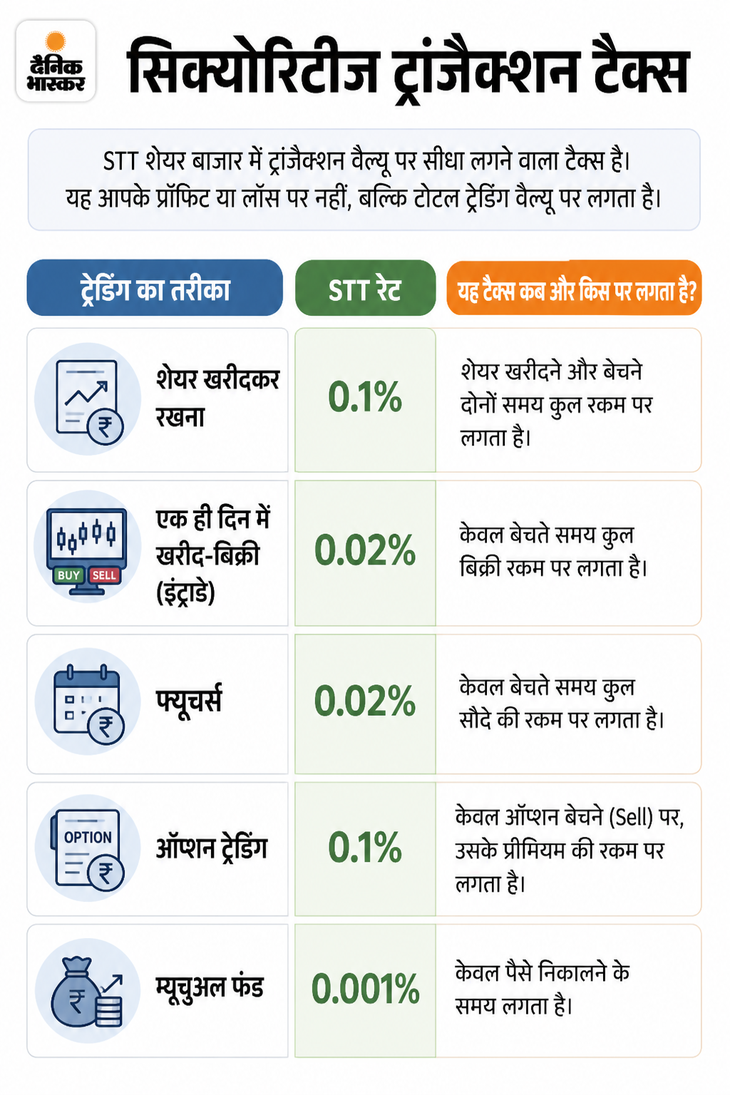
Securities Transaction Tax (STT): Tax on buying and selling shares.
- Be it profit or loss, this tax will be deducted: It is not imposed directly on your earnings, but on the total amount of transactions (trading) in the stock market.
- 0.1% on delivery and 0.025% on intraday: On buying and selling of shares (delivery) 0.1% STT is deducted on both sides and on same day selling (intraday) 0.025% STT is deducted only on the selling amount.

Source link
[ad_3]

