
Two days after the Election Commission of India announced the dates for the West Bengal Assembly polls on March 18, a Trinamool Congress booth president was hacked to death in North 24 Parganas due to intra-party rivalry, according to police reports.
The killing was not an aberration.
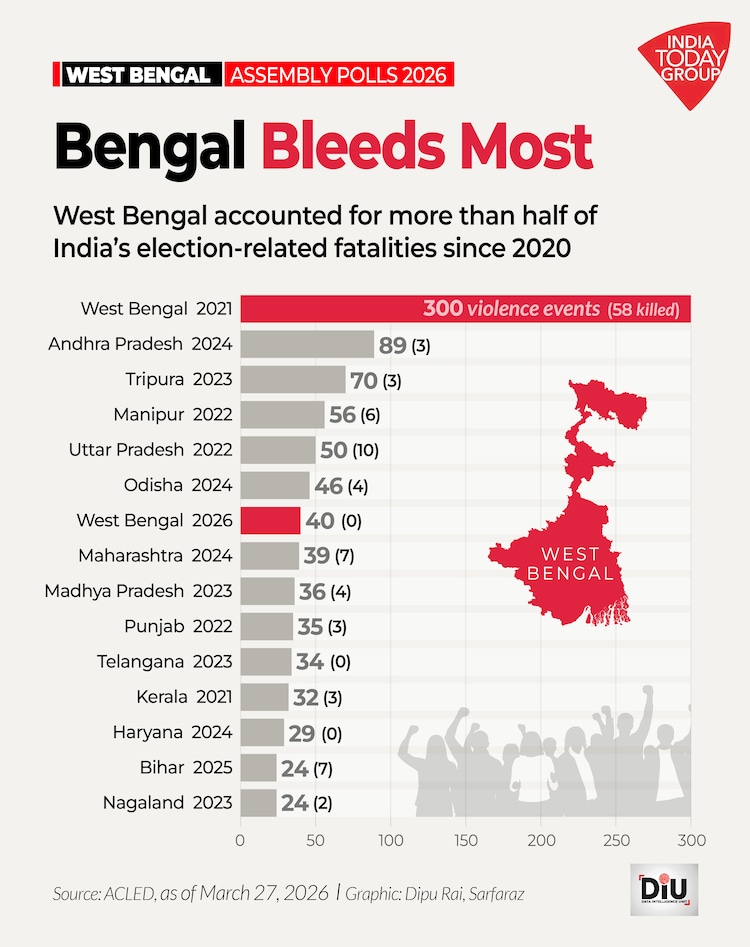
An India Today analysis of data from the Armed Conflict Location and Event Data Project (ACLED), a conflict-monitoring organisation, shows that West Bengal has recorded more election-related violence than any other Indian state over the past six years.
West Bengal’s 2021 Assembly election was the bloodiest in the dataset: 300 violence events and 58 deaths. The next closest was Andhra Pradesh in 2024 with 89 events and three deaths.
Bengal alone accounted for 35 per cent of all election-related violence events in India (904 of 2,593) and 51 per cent of all election-related fatalities (168 of 329) recorded by ACLED since 2020, covering assembly, parliamentary and local elections.
Bengal vs the rest
Among large states with more than 200 Assembly seats, the gap is wide.
Bengal’s 2021 election recorded 1.02 violence events per constituency. In Uttar Pradesh’s 2022 election, the second-most-violent among large states, there were 50 events across 403 seats, 0.12 per constituency. In 2024, Maharashtra had 39 events across 288 seats. Bihar, Madhya Pradesh, Karnataka, Tamil Nadu, and Rajasthan each recorded fewer than 40 events during their most recent elections.
Smaller states trail far behind. Tripura’s 2023 election had 70 violence events; Manipur’s in 2022 had 56.
Bengal’s bloodiest election
The 2021 polls were held in eight phases between March 27 and April 29 with an average turnout of 82 per cent, according to Election Commission data. Violence escalated during the polling period.
April was the worst month: 123 violent events and 19 deaths. In May, when results were announced on May 2, 88 events and 31 deaths were recorded. Much of the violence in May was retaliatory, directed at opposition supporters following the Trinamool Congress’s landslide victory.
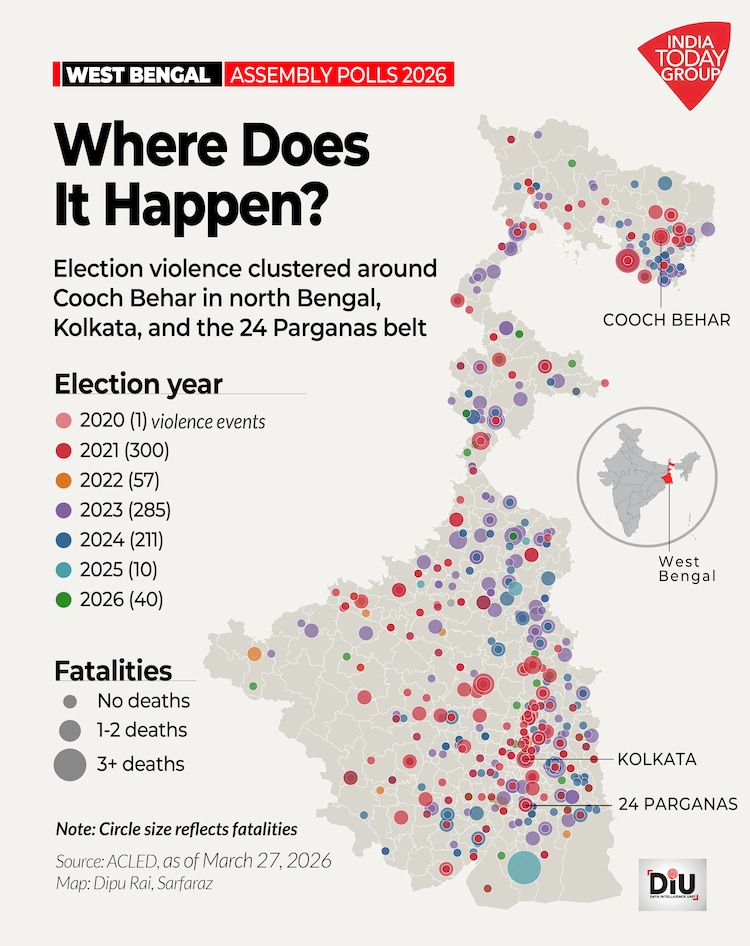
Riots accounted for 260 of the 300 violent events. Attacks on civilians made up 36, and four armed clashes were recorded.
Who are the actors?
ACLED names the primary actor in each event. Across all Bengal election cycles since 2020, the Trinamool Congress was identified as the primary actor in 77 violence events, more than any other named party. The Bharatiya Janata Party was named in 25. Including non-violent incidents such as property destruction, the TMC figure rises to 109 and the BJP to 31.
The bulk of violence events, 682, were attributed to unnamed rioters, a standard ACLED coding for mob violence where no specific organisation is identified.
A pattern for 2026?
The current election cycle has already recorded 40 violent events in Bengal through March 27, according to ACLED data, though no fatalities so far. In the same period before the 2021 election, Bengal had recorded 59 violent events and five deaths.
The 2026 polls will be held in two phases, April 23 (152 seats) and April 29 (142 seats), with counting on May 4. The 2021 election was spread across eight phases, giving more time for violence to build. But even adjusting for that, the early trajectory is lower.
Whether that holds will depend on what happens over the next four weeks.
Note: “Violence events” include riots, violence against civilians, battles and explosions/remote violence, as classified by ACLED. Strategic developments (looting, property destruction) and protests are excluded from the violence count. Events are mapped to state election cycles by calendar year.
– Ends
Source link
[ad_3]

