
Last Updated:
For Trump, the midterms were important enough to ask voters to imagine him on the ballot. In explaining the Republican losses, however, he has returned to the fact that he was not




Trump claimed on Wednesday that Republicans would have won by a landslide had he been a candidate himself. (AFP)
For months, US President Donald Trump wanted Republican voters to treat the 2026 midterm elections as a personal contest, repeatedly urging them to “pretend” he was on the ballot and warning that a Democratic victory would threaten his agenda. But, as Republicans suffered losses and Democrats paved the way to the Senate on Wednesday, Trump has offered a rather different explanation: he was not actually on the ballot.
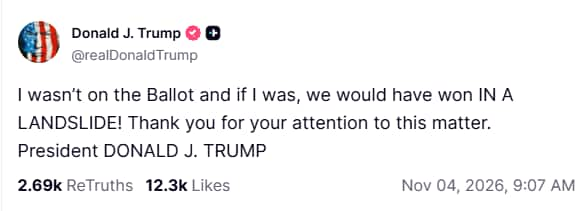
In a post on his social media platform Truth Social following the election results, Trump claimed that Republicans would have won by a landslide had he been a candidate himself.
“I wasn’t on the Ballot and if I was, we would have won IN A LANDSLIDE!” he wrote.
The remark captures a recurring feature of Trump’s political messaging: his tendency to claim personal credit for Republican victories while distancing himself from defeats. During the campaign, he had repeatedly presented the midterms as a test of his popularity and political influence. Now, with Democrats making significant gains, including taking control of the Senate, he has pointed to his absence from the ballot as a reason Republicans did not perform as expected.
When Trump Wanted The Midterms To Be About Him
Trump’s appeal to voters to imagine that he was contesting the elections was not a one-off remark. He made it repeatedly while campaigning for Republican candidates, arguing that his presence on the ballot typically brought out more Republican voters.
In August, while campaigning in South Carolina for Republican Senate candidate Darline Graham, Trump acknowledged that Republicans often struggled to reproduce his turnout numbers in elections where he was not a candidate.
“The problem that we have is they say ‘Trump does great when he’s on the ballot, but when he’s not on the ballot, his people don’t come and they don’t vote for senators, congressmen or other Republicans’,” he told supporters.
His solution was to ask them to treat the midterms as though he were running. “So what I really want you to do is pretend, please, that I’m on the ballot,” he said.
The message continued right up to Election Day. During an appearance on Sean Hannity’s programme on November 2, Trump again urged voters to imagine that they were voting for him. “When I’m on the ballot, as you know, I’ve won every time, and we get 50 per cent more votes than when I’m not on the ballot, so I’m just asking everybody to pretend that I’m on the ballot,” he said.
He also warned that a Democratic victory could undo policies associated with his administration, including tax breaks on tips, Social Security and overtime. The message was clear: a vote for Republican candidates was, in effect, a vote of confidence in Trump.
From Claiming The Credit To Distancing Himself
Trump’s post-election remarks have now shifted the emphasis. Rather than treating the results as a verdict on his presidency, he has argued that the absence of his name from the ballot deprived Republicans of the electoral advantage he believes he brings.
The White House, too, has pointed to the fact that Trump was not personally contesting the elections while responding to questions about Democratic gains. A White House official told Fox News reporter Peter Doocy that the president was not on the ballot, despite his repeated attempts to make the midterms about his political standing.
Trump also told CBS News that Republicans would have won easily had he been contesting the election. He questioned the appeal of some Republican candidates, suggesting that voters did not like them and that some were not his supporters.
This is not the first time Trump has sought to separate himself from Republican setbacks. Ahead of the 2022 midterm elections, he said he deserved “all the credit” if Republicans won but “should not be blamed at all” if they lost.
The latest episode follows a campaign in which Trump was anything but a distant figure. He held 30 rallies across 20 states over 32 days, endorsed candidates and repeatedly asked voters to make the election a referendum on his leadership.
Democrats have now taken control of the Senate and made gains in other contests, putting Trump’s legislative agenda under pressure during the remaining two years of his presidency.
For Trump, the midterms were important enough to ask voters to imagine him on the ballot. In explaining the Republican losses, however, he has returned to the fact that he was not.
Quick Answers
 Ask News18
Following Republican losses and Democratic gains in Congress, Donald Trump posted on Truth Social that Republicans would have won in a landslide if he had personally been on the ballot.
Ask News18United States of America (USA)
November 04, 2026, 11:17 IST
Read More
Source link
[ad_3]

