
New Delhi6 minutes ago
- Copy link
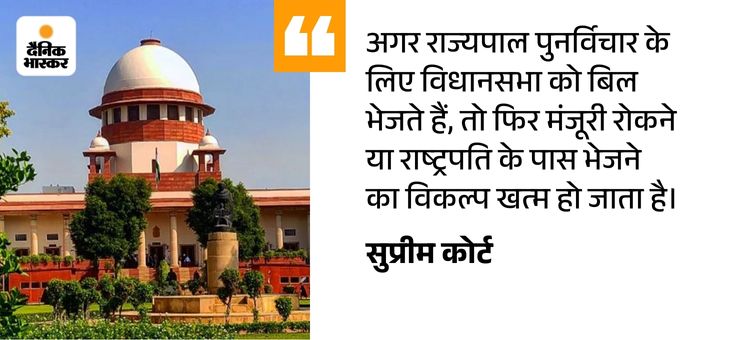
The Supreme Court on Wednesday said that the elected governments cannot run on the will of the governors. If a bill passes from the state assembly and comes to the Governor for the second time, the governor cannot send it to the President.
Under Article 200 of the Constitution, the Governor has four options- approval, preventing approval, sending to the President or returning to the Legislative Assembly for reconsideration. But if the assembly again passes the same bill and sends it, then the Governor will have to approve it.
A five -judge bench headed by CJI BR Gawai said that if the governors stop the approval without reconsideration, then the elected governments will depend on the Governor’s will. The court said that the governor does not have the right to stop the approval indefinitely.
The bench consists of Justices Suryakant, Vikram Nath, PS Narasimha and AS Chandurkar besides CJI. A five -judge bench will continue the hearing of the case on the third consecutive day on the third consecutive day by the ‘Governor of India and the President’s approval, stop or reservation’ case.
The Center said- Governor cannot be made postman During the hearing, Solicitor General Tushar Mehta on behalf of the central government said that the governor cannot be placed only in the role of postman. They have some constitutional rights and are appointed by the President.
He argued that the governor can also send the bill to the President. The right to prevent approval should be used only in extraordinary conditions and limitedly.
Senior advocate Kapil Sibal opposed the arguments of the Center and said that if the Governor has this right, then the President can also stop the approval on the central government bills. On this, the Chief Justice said that the Constitution will not be interpreted by looking at political circumstances.
Justice Narasimha said- Constitution is a lively document Justice Narasimha said that the powers of the Governor cannot be explained in a limited scope. The constitution is a lively document and should be interpreted according to time. He said that the governor can first return the bill for amendment and if the assembly is amended, the governor can also approve later.
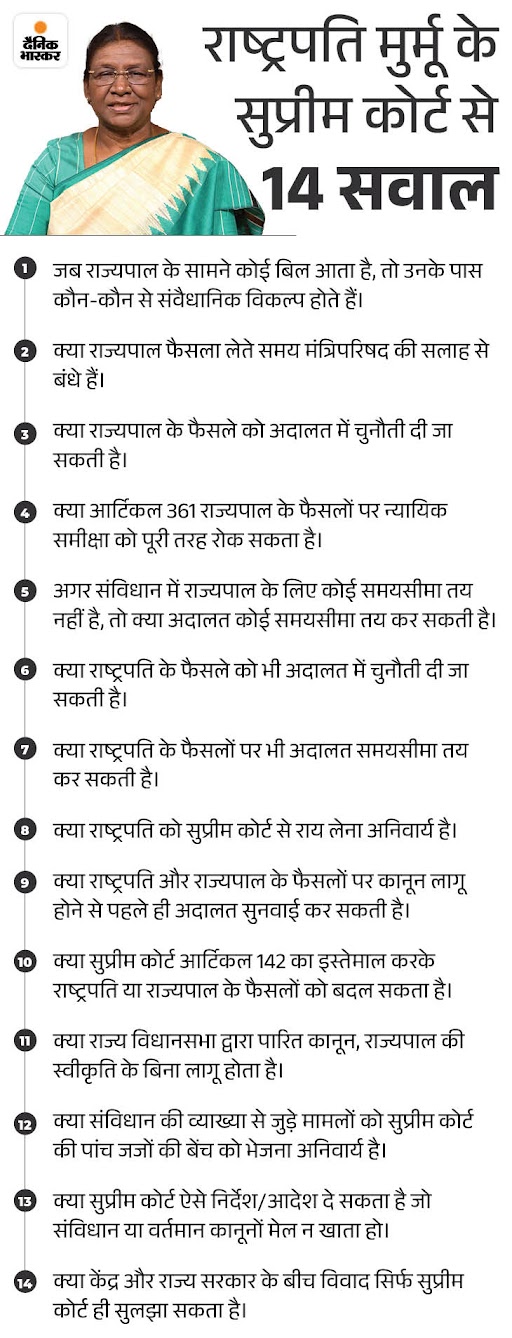
President Murmu From the Supreme Court 14 questions were asked On 15 May, President Draupadi Murmu asked 14 questions about the powers of the President and the Governor under Article 143 (1). The President had sought an opinion from the Supreme Court whether the court could set a deadline for the President to take a decision on the bills passing from the state assembly.
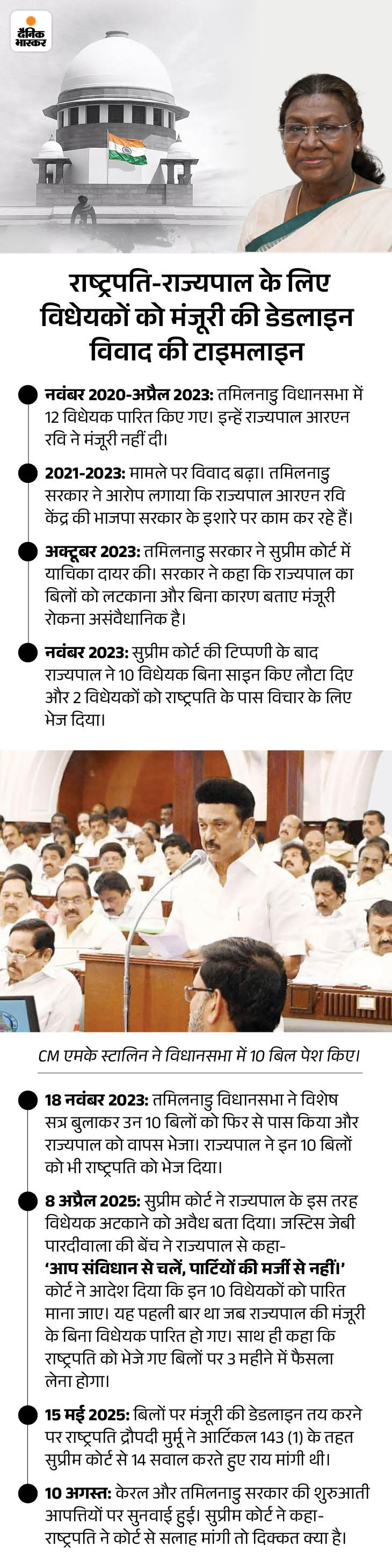
Controversy started from Tamil Nadu The case was raised from the dispute between the Tamil Nadu Governor and the State Government. Where the state government bills were stopped from the governor. The Supreme Court on 8 April ordered that the Governor has no veto power.
It was said in this decision that the President will have to take a decision on the bill sent by the Governor within 3 months. The order came to light on 11 April. The President then sought opinion from the Supreme Court in the case and asked 14 questions.
Source link
[ad_3]

