
2 hours ago
- copy link
From October 1, there will be a charge on the messages sent by companies to customers on the WhatsApp Business platform. Currently, companies can send a free response to a customer’s inquiry message within 24 hours.
Now every service message sent during this period will be charged separately. Messages like order confirmation and delivery updates will also not be free. Every business number will get the first 1,000 service messages free of charge in a month. After this, a fee will be charged for every message sent by an employee or chatbot.
There will be no charge for messages sent by the customer to the company. This rule will not apply to general WhatsApp and free WhatsApp Business app made for small businesses.
Companies will have to add the payment method to their accounts by September 30. Failure to do so will stop the delivery of their service messages from October 1.
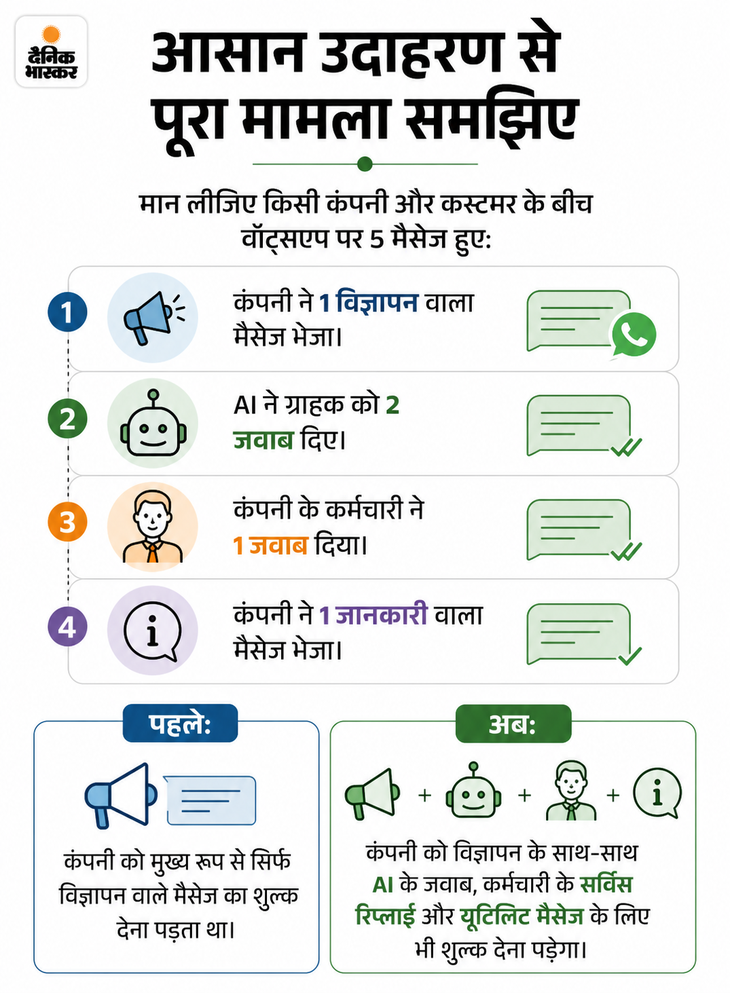
Paid messages of WhatsApp Business: Understand in 15 questions and answers
1. What is changing in WhatsApp from October 1?
From October 1, 2026, some service messages sent by companies on WhatsApp Business will become paid. That means companies will have to pay a fee to WhatsApp’s parent company Meta for sending such messages.
2. What used to happen till now?
Companies were not charged for certain non-template service messages and certain utility messages sent during the 24-hour customer service window. Now this system is changing.
3. What is a service message?
When a customer talks to a company on WhatsApp and a customer service employee or third party AI system responds to it on behalf of the company, it is called a service message.
4. Can the company itself initiate a new conversation by sending a service message?
No. Service messages can be sent only when a 24-hour customer service window is open with the customer.
5. What is the 24-hour customer service window?
When a customer messages the company on WhatsApp, there is a set 24-hour period in which the company can respond to the customer. Some messages sent during this period come under the category of service messages.
7. Are marketing messages also paid?
Yes. Companies are charged an upfront fee for marketing, utility, and authentication template messages. From October 1, service messages will also be added to the paid category.
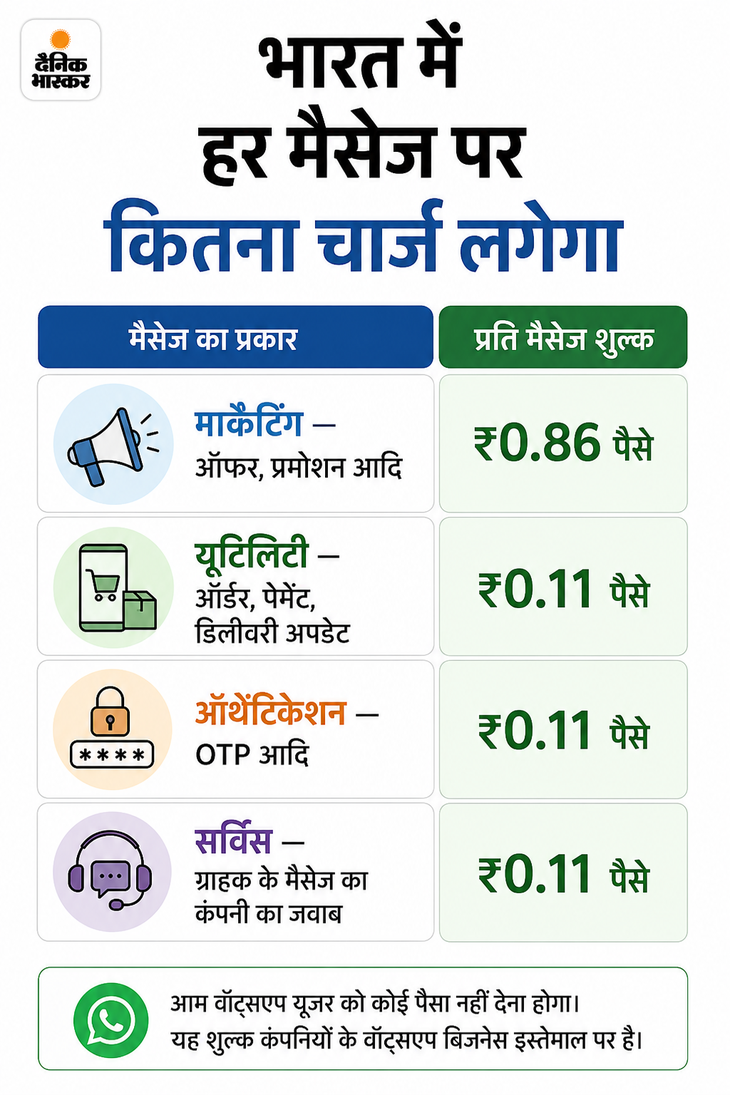
8. What will be the cost of service message in India?
According to Meta, its price will be according to every market. The rate for service messages in India will be equal to the rates for utility and authentication messages.
11. What will companies have to do by September 30?
Companies using WhatsApp Business will have to add a payment method to their account. Failure to do so will stop the delivery of their service messages from October 1.
13. Will every WhatsApp Business message now be paid?
No. There will be no charge for all messages. Meta has not changed the free entry point window.
14. What is free entry point window?
If a customer comes to WhatsApp by clicking on an advertisement that has the option to open a WhatsApp chat, the delivery of messages sent during that entry point window remains free.
15. What impact will this have on companies and customers?
This will be directly charged to the companies, because the companies sending messages through WhatsApp Business will have to pay for the new paid category. The cost of customer service interactions, in particular, may increase for companies.
——————————————–
Read this news also…
Supreme Court refuses to ban UPI charges: 0.4% charge fixed on payments above ₹ 2000
The Supreme Court has refused to stay the Central Government’s decision to impose 0.4% charge on UPI payments. From October 15, this fee will be applicable on merchant payments of more than Rs 2000. However, the court has issued a notice to the Central Government seeking its answer as to what is the basis for implementing this new rule. Read the full news…

Source link
[ad_3]
