
New Delhi3 minutes ago
- copy link
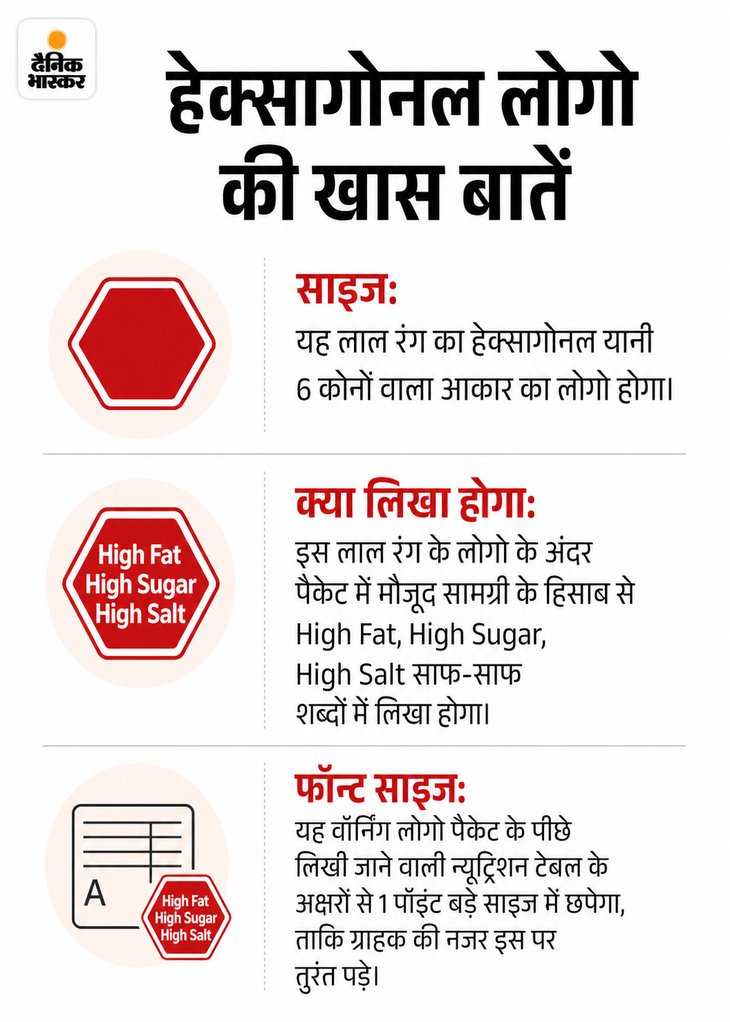
If the amount of salt, sugar or saturated fat in any packaged food item exceeds the limit, then there will be a hexagonal red mark on the packet. A warning would also be written. Food Safety and Standards Authority of India (FSSAI) has presented this proposal in the Supreme Court. Its purpose is to caution people about such food items.
According to the proposal of FSSAI, this warning label will be of red colored hexagon (hexagonal – 6 corners) shape. It will be placed on the front of the packet.
Action on PIL of Charitable Trust
In fact, a public charitable trust named 3S and Our Health Society had filed a petition in the Supreme Court demanding mandatory warning labels on canned or packaged food.
During the last hearing of this case (August 13), a bench of Justice JB Pardiwala and Justice K Vinod Chandran had slammed FSSAI for delaying the rules and asked whether the government does not want its people to remain healthy? After this FSSAI has presented this affidavit.
Proposal to implement in two phases
FSSAI has proposed to implement it in different phases, so that the industry gets a chance to improve its products.
Phase 1: In the first phase, red labels will be imposed on those products in which any ‘two or more’ ingredients like fat, sugar or salt exceed the prescribed limit. This will also include all overly sugary cold drinks.
Phase 2: In the second phase, this rule will also be applicable to those products which contain any one of these things in large quantities.
Through 10 questions and answers, let us understand what the whole matter is and why it was needed…
Question 1: What proposal has FSSAI made in the Supreme Court?
answer: FSSAI has informed the apex court that it proposes to put a red warning label on the front of food packets containing high fat, high sugar and salt content. This label will provide an easily understandable warning to the public.
Question 2: What is the basis or criteria for deciding the rules?
answer: Whether any food product falls in the high fat, high sugar or high salt (HFSS) category will be decided on the basis of the standards of ‘Dietary Guidelines for Indians, 2024’ issued by ICMR-National Institute of Nutrition (ICMR-NIN).
Question 3: Are some food items exempted from this red label?
answer: Yes, there is a proposal to keep some selected categories out of it. Single-ingredient products and foods that are naturally high in fat, sugar or salt will be exempt. For example, pure ghee, edible oil, common salt, sugar, jaggery and honey will be exempted from this front-of-pack warning.
Question 4: According to FSSAI, who will get the biggest benefit from this new rule?
answer: FSSAI has told the court that this consumer-friendly labeling system will enable people to make informed food choices. Its biggest benefit will be to children and sensitive or vulnerable sections of the society, who unknowingly consume extremely unhealthy things.
Question 5: What is ‘Front of Pack Labelling’?
answer- Front-of-pack labeling (FOPL) is a label that appears on the front of a food product’s packaging. In this, information about main ingredients of food like sugar, salt and fat is shown in an easy and quick to understand manner.
Its purpose is that the customer can immediately understand how healthy the food he is buying is. This information is different from the lengthy nutritional facts written on the back of the packet. In this, only the necessary information is shown through simple graphics or colors.
Question 6: Where is the nutritional information related to food written on existing packaged foods?
answer- It is usually written in the form of a table on the back or side of the packaged food. This information tells the nutritional value such as calories, fat, protein, sugar and sodium present in 100 grams, 100 ml or each serving of the product.
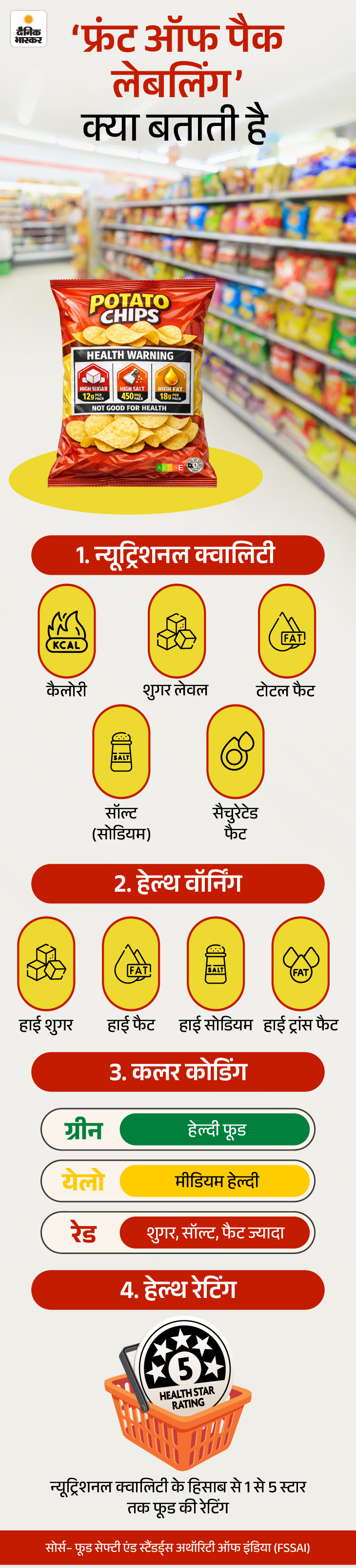
Question 7: What does ‘Front of Pack Labeling’ indicate?
answer- Front of pack labeling shows whether the food is healthy or unhealthy. How many calories, sugar, salt and fat does it contain and whether it can pose a risk to health. See the details in the graphic below –
Question 8: Why is ‘Front of Pack Labelling’ important?
Answer- ‘Front of pack labeling’ is necessary so that people can quickly and clearly understand its health impact while buying packaged food. This will make it easier for them to choose healthy options and prevent excessive consumption of unhealthy food.
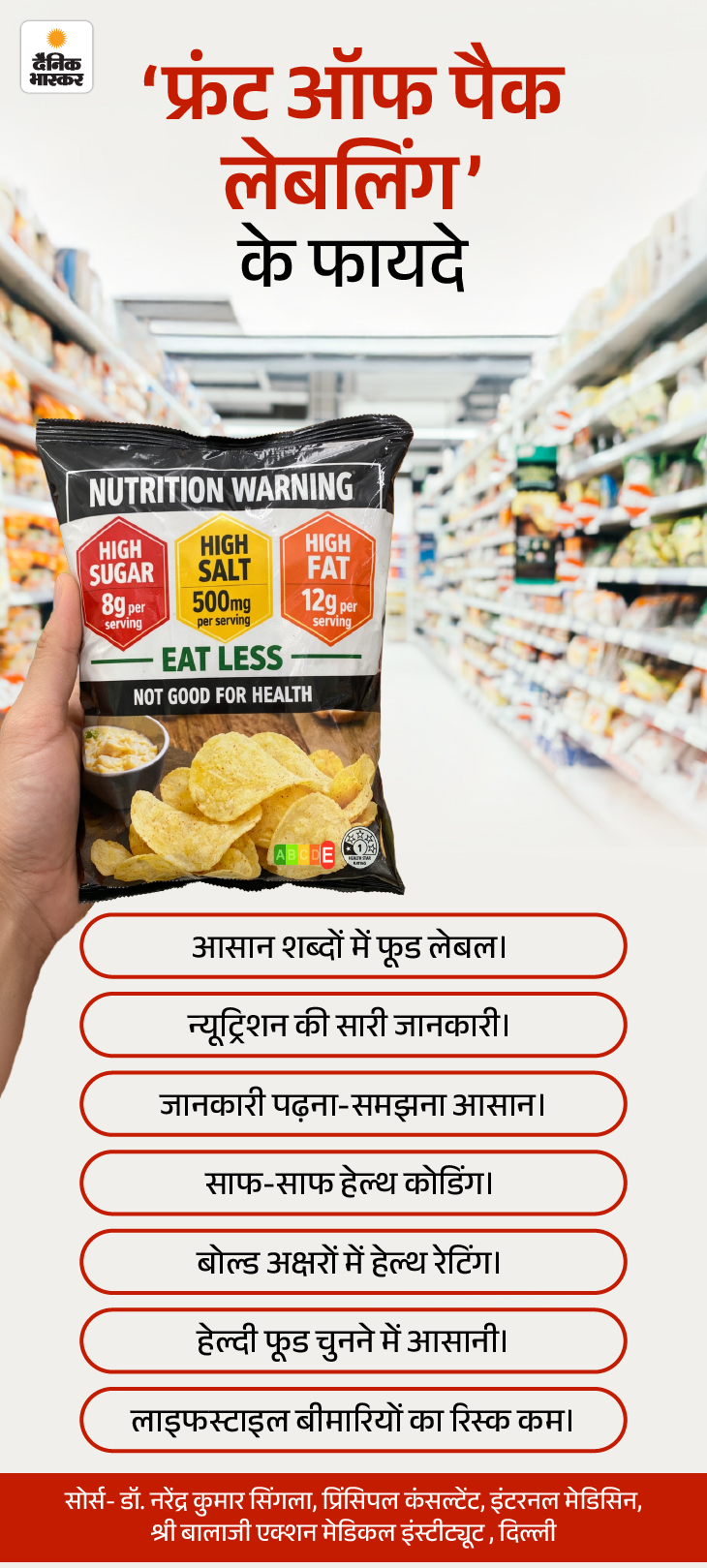
Question 9: How will we benefit from ‘Front of Pack Labelling’?
answer- Front of pack labeling aims to simplify complex nutrition information so consumers can make informed purchasing decisions and avoid unhealthy choices. Understand its benefits from the graphic given below-
Question 10: Why did the Supreme Court give instructions to FSSAI?
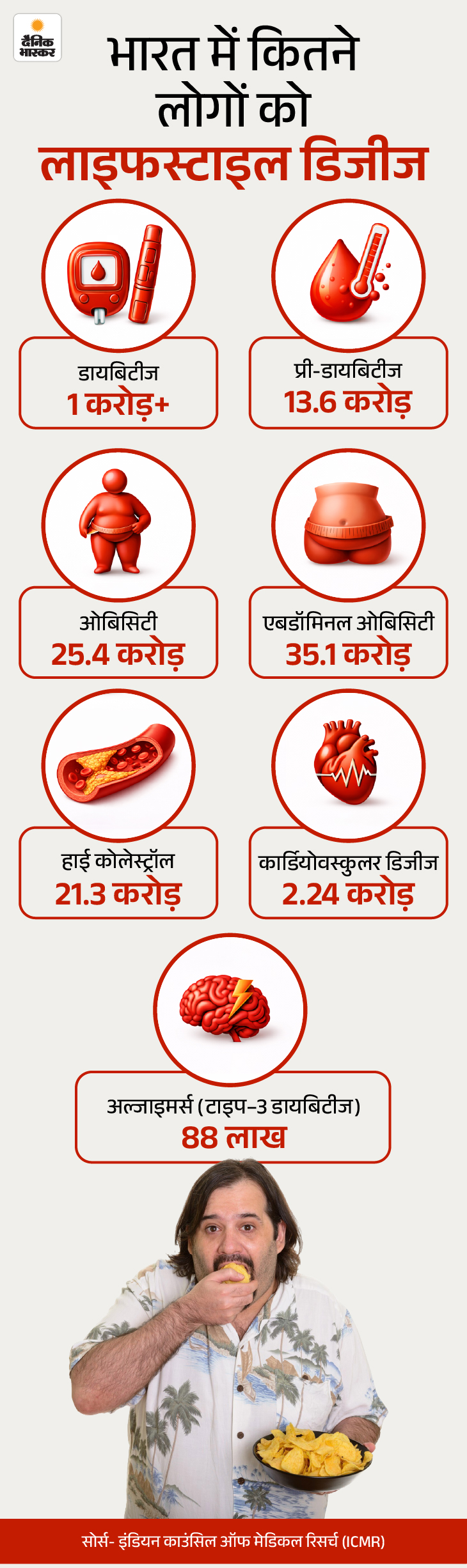
answer- Lifestyle diseases are increasing rapidly in the country. The main reason for this is unhealthy eating habits. The excessive amount of sugar, salt and fat present in packaged and ultraprocessed food is becoming a major cause of these diseases.
In view of this serious situation, the Supreme Court has asked FSSAI to seriously consider implementing ‘Front of Pack Labeling’ on packaged food, so that people can understand the possible health risks while purchasing. Let us understand from the graphic how serious is the situation of lifestyle diseases in India-
Now understand what is saturated and unsaturated fat
- Saturated Fat: It is found in abundance in ghee, butter, cream, cheese, cheese, fatty meat and coconut oil or products made from it. Eating too much of it can increase LDL i.e. bad cholesterol in the blood. This is harmful.
- Unsaturated Fat: It is mainly found in peanuts, almonds, walnuts, sesame, mustard oil, olive oil and fish. Taking it in right quantity is considered beneficial for the heart.
————————
Read this news also…
Silver became cheaper by ₹ 2,738 this week, at ₹ 2.44 lakh: Gold fell by ₹ 1,042 to ₹ 1.60; Know the prices of your city

There was a decline in the prices of gold and silver this week. According to India Bullion and Jewelers Association (IBJA), the price of one kg silver has fallen by Rs 2,738 to Rs 2.44 lakh. Before this, it was at Rs 2.47 lakh last week i.e. on 21st August.
At the same time, the price of 10 grams of 24 carat gold has fallen from Rs 1,60,620 to Rs 1,59,578 lakh. That means its price decreased by Rs 1,042. Read the full news…

Source link
[ad_3]

