
New Delhi37 minutes ago
- copy link
The Supreme Court on Thursday raised questions on many aspects related to the three language policy of CBSE. The court also sought answers on the shortage of books and teachers, the burden on children and the way the policy was implemented in different schools.
During the hearing, the bench of CJI Surya Kant, Justice Joymalya Bagchi and Justice V. Mohana said – “Wouldn’t it be good for the country if North Indian students learn South Indian languages and South Indian students learn North Indian languages?”
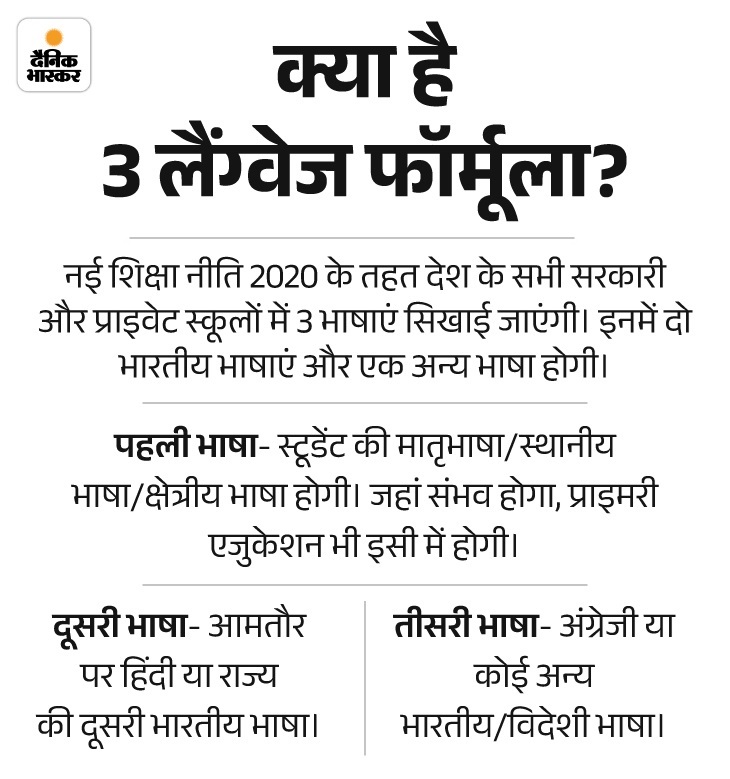
The bench was hearing petitions challenging the three language policy implemented under NEP 2020 for Class 9 children of CBSE.
The petitioners said that under the policy, children will have to study two Indian ‘native’ languages, while many schools do not have the necessary books, teachers and basic facilities for this.
The court was told that even after 4 months of the start of the school, there are no books in some schools. This is affecting lakhs of students appearing for the exam.
The issue of shortage of books was raised in the petition
During the debate, petitioner’s lawyer Anand Grover asked, “How will a child suddenly learn Punjabi, Tamil? He will have to start with the alphabet. But look at the books, they start with sentences. Therefore, students learning French should be allowed to continue it.”
Asking a student from one state to learn the language of another state can become an additional burden and will not be easy to implement everywhere. If children are asked to score passing marks in new languages, the pressure on them will increase.
CJI Surya Kant’s comments during the hearing…
- There is no talk of abandoning the languages already being learned in the policy. There is no question of boycotting the languages being taught earlier. Children can continue them.
- Would it not be good for the country if students of North India learn the languages of South India and students of South India learn the languages of North India?
- There should be no inferiority complex regarding regional languages. We should respect all languages. Internal assessment has been left to the schools so that there is no unnecessary pressure on the students.
Government said- 2 Indian languages are being taught in 99.19% schools
After this, the court raised the issue of teachers and necessary faculty in schools to implement the policy. ASG Bhati, citing CBSE data, said that 99.19% schools are already fulfilling the condition of teaching two Indian languages. About 235 schools are not fulfilling this condition.
He said that the change process will be flexible for students of class 7th to 9th. Initially it will be implemented at the basic level, so that more equality can be brought.
Different parts of NEP 2020 are being implemented at different times. The mother tongue portion is being implemented through the existing process. Five years from 5th to 10th will be enough time for students to learn languages.
Question on qualification of Sanskrit teachers
The court also asked questions from the board on the presence of teachers for languages like Sanskrit. Justice Bagchi asked, “How many Sanskrit teachers in our schools have B.Ed qualification?”
He also raised questions over the comprehensive way the policy was implemented. This includes implementing policies on different types of schools and completing the necessary administrative procedures for them.
Justice Bagchi said that the policy can be implemented from a smaller class than this. This may give parents more opportunities to choose languages for their children.
Constitutional question regarding the word ‘native’ and English
Justice Bagchi said, “I have reservations about the word ‘native’ because it has colonial roots. It should be ‘indigenous’. The makers of NEP 2020 should have been careful about the use of the word ‘native’.”
Justice Bagchi said, “Whether English can be called indigenous or non-indigenous, we have to see its constitutionality.”
Implement policy first, discuss problems later
The bench also asked whether the problems that arise after the implementation of the policy can be resolved later. CJI Surya Kant said that first the policy should be allowed to be implemented, after that the problems faced by schools and children should be assessed.
He said, “Whatever has been implemented, let it be experienced. After the experience, some problems will arise, then we will investigate them. Experts can investigate the unseen problems that come up. Then they can recommend changes in the policy.
CJI Surya Kant asked CBSE to streamline the policy in view of the concerns raised by the petitioners. He said, “You can reconsider these doubts. How to organize the policy?”

Source link
[ad_3]

