
New Delhi2 minutes ago
- copy link
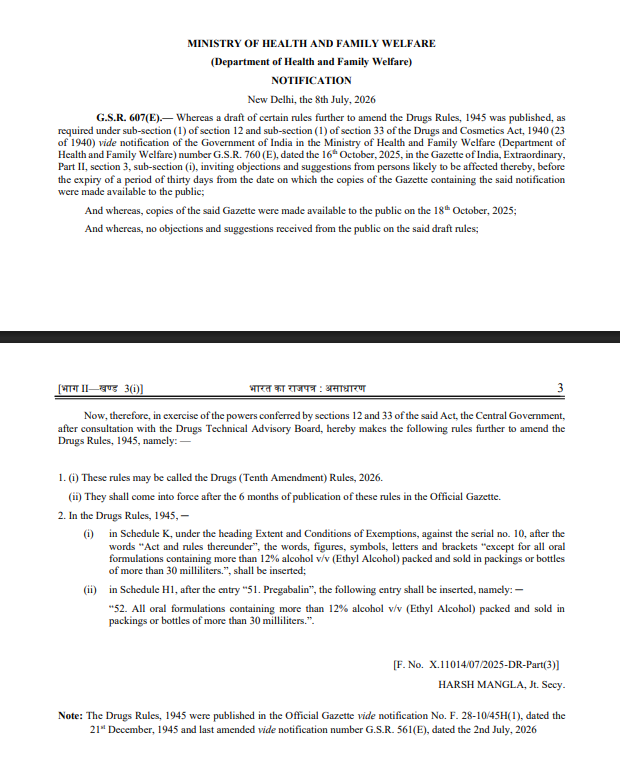
The Central Government has stopped the open sale of medicines containing more than 12% alcohol mix. Now these medicines cannot be sold without a valid doctor’s prescription. To prevent misuse of medicines, the government has made this change in the Drugs Rules, 1945.
Under the new rule, all those drinkable medicines have been included in the ‘Schedule H1’ category, whose ethyl alcohol content is more than 12% and which are sold in bottles larger than 30 ml.
After this change, these medicines will no longer be sold openly and the rules for selling them will become very strict for medical stores. What impact will this decision have on common patients, medical stores and public health? Understand in easy questions and answers…
what are the new rules
Question-1: What new rules has the government made regarding medicines?
answer: The Central Government has issued a notification in the Gazette of India. According to this, all such drinkable medicines—such as cough syrups or tonics—which have ethyl alcohol content more than 12% and come in bottles larger than 30 ml, have now been put in the ‘Schedule H1’ category.
Question-2: What will change now after this change?
answer: Now these medicines will not be sold at medical stores without a valid doctor’s prescription. Apart from this, drug shopkeepers will have to keep complete records of the sale of these medicines in a separate register.
Reason and background of the decision
Question: Why did the government suddenly have to take this strict step?
answer: Actually, many cough syrups and tonics available in the market contain very high amount of alcohol. Due to their availability over-the-counter (OTC) without any restrictions or prescription, many people started using them for intoxication or wrongdoing. The government has taken this step to prevent this misuse and strictly monitor the sale of medicines.
Question: This decision has been taken on the recommendation of which committee?
answer: The drug was reviewed by the government’s regulatory committees—Drugs Consultative Committee (DCC) and Drugs Technical Advisory Board (DTAB)—in response to growing concerns over misuse of the drug. The government has implemented this amendment in the law only after the recommendations of these committees.
Impact on medical stores and patients
Question: What rules will those running medical stores now have to follow?
answer: After coming under Schedule H1, now the pharmacy or medical stores will have to do these three main things:
The medicine will be given only on the valid prescription of a registered doctor.
Details of each sale (name of patient, quantity of medicine, name of doctor) will have to be entered in a separate register.
These prescriptions and sales records will have to be kept safe for at least 3 years, so that drug regulators can investigate it at any time.
Question: Have these medicines become banned or unsafe for me as a patient?
answer: no way. For patients, this does not at all mean that these medicines are unsafe or they have been banned. This is just a safety standard. If your doctor has prescribed this medicine to you, you will get it from the medical store as before, you just have to show the doctor’s prescription.
Medical facts and health impact
Question: Why is alcohol used in medicines, is it dangerous?
answer: Ethyl alcohol is used in limited quantities in medicines as a solvent or preservative, which is clinically necessary. It is not harmful in every situation. However, according to a 2024 report in the Journal of Medical Toxicology, if such drugs are consumed without medical advice or in excess, it can cause serious side effects for children, the elderly and liver patients.
Question: What is the guideline of the World Health Organization (WHO) in this matter?
answer: The World Health Organization (WHO) also always emphasizes on rational and limited use of medicines. Under this, medicines should be prescribed and sold only when there is genuine clinical need.
Schedule H1 and Future Impact
Question: What is this ‘Schedule H1’ and which medicines come in it?
answer: ‘Schedule H1’ was introduced in the year 2013 under the Drugs and Cosmetics Rules. Its purpose was to strictly monitor those medicines which have a high potential for abuse. Initially it included third and fourth generation antibiotics, anti-TB medicines and habit-forming medicines. Now the scope of this list is being expanded.
Question: How will this decision benefit the public health sector in the long run?
answer: This step will further strengthen the drug regulatory system in India. Traceability of medicines will increase, that is, it will be easy to find out which medicine was sold where and to whom. This will prevent misuse of medicines and ensure the safety of patients.

Source link
[ad_3]

