
In India, the South-West Monsoon 2026 reached Kerala in early June, but a little late than usual. The initial rains have been weak at many places. Meteorologists are warning that the full effect of El Nino has not been seen yet, but the coming months from July to November can prove to be very challenging for the country.
Indian Season The Science Department (IMD) has predicted below average rainfall for the entire monsoon season this year – around 90-92 per cent of the Long Period Average (LPA). This means that drought-like conditions may arise in many parts of the country, especially after June.
El Nino What is it and how does it affect India?
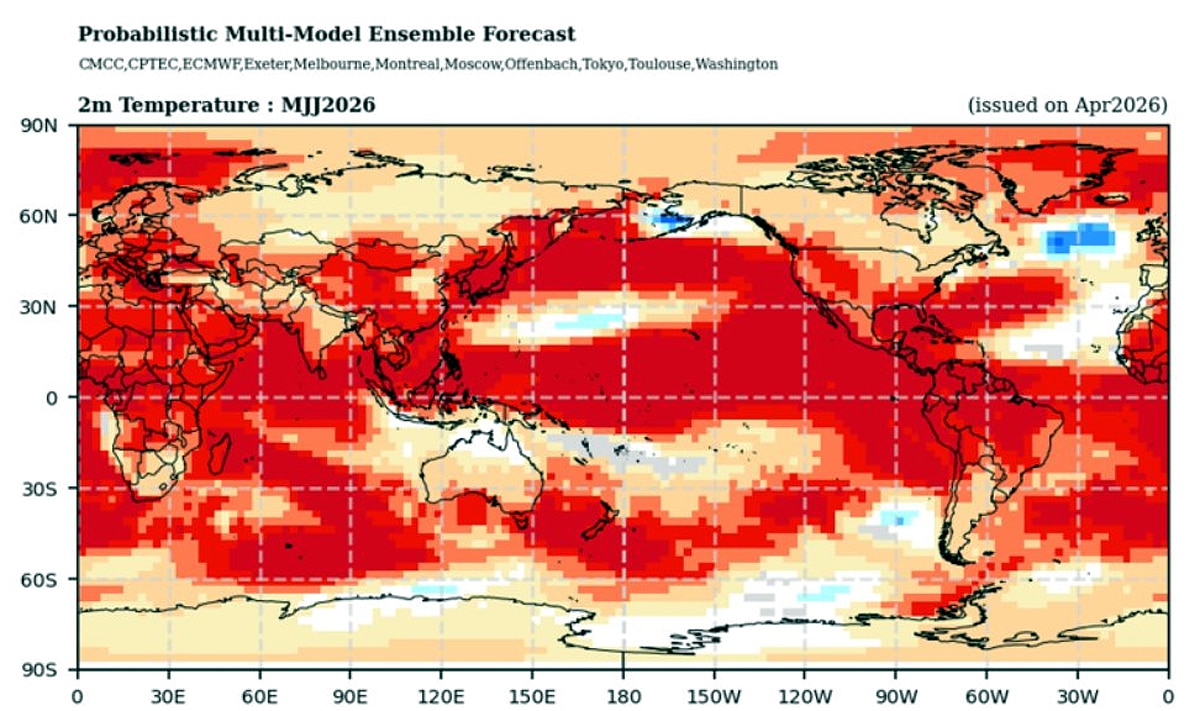
El Nino is a climate phenomenon in which the waters of the central and eastern Pacific Ocean become unusually warm. Under normal conditions the eastern Pacific remains cold. Trade winds blow from east to west. But in El Nino, these winds become weak or start moving in the opposite direction. This affects the moist winds coming towards India.
Also read: Earth shook due to powerful earthquake in Japan and China, alert of aftershocks
The south-west monsoon weakens. Monsoon in India brings about 70 percent of the total annual rainfall of the country. If it decreases, agriculture, water resources, power generation and the overall economy are affected. In 2026, scientists say that El Nino will be weak in June, but may become moderate in July-August and strong by September. According to organizations like NOAA and IMD, the probability of El Nino developing in July-August is more than 80-90 percent.
Records over the past several decades show that India has received below average rainfall in most El Nino years. In 2009, despite a weak El Nino, rainfall was only 78 percent, which was the lowest level in 37 years. The strong El Nino of 2015–16 also resulted in drought conditions.
Although in some years the positive Indian Ocean Dipole (Positive IOD) reduced the negative impact of El Nino to some extent, but in 2026 the IOD is still neutral. It is expected to be positive later, which may provide some relief but not complete protection.
Monsoon starts weak
In the first two weeks of June 2026, rainfall in many states was much less than normal. In states like Maharashtra, a reduction of 70-80 percent was recorded. There is also a shortage in central India and some northern parts. According to IMD, there is a possibility of below average rainfall in the month of June also. The delay and weak start of monsoon has increased the worries of farmers. Sowing of Kharif crops is being affected.
Also read: Indian Air Force will make long-range deadly ‘Kamikaze drone’ with its own design and technology
The full havoc of El Nino is not visible yet because it is still developing. The real impact will be visible between July and September, when the monsoon is at its peak. If El Nino becomes stronger then rainfall in August-September may be even less. This will increase problems like lack of water in reservoirs, drying up of rivers and falling groundwater level.
Potential impact on agriculture and farmers
India’s economy is still largely dependent on agriculture. About 50-60 percent of the population is directly or indirectly associated with farming. In Kharif season (June-September), crops like paddy, maize, soybean, cotton, pulses etc. are sown. The yield of these crops may decrease due to less rain.
In the last El Nino years, due to drought, farmers’ income decreased, debt increased and incidents of suicide also increased. If the rainfall in 2026 is 90 percent or less, then food grain production may decrease by 10-15 percent. This will create a food security challenge. The government may have to increase imports, which will put pressure on foreign exchange reserves.
States like Madhya Pradesh, Maharashtra, Rajasthan, Karnataka, Andhra Pradesh and Telangana may be most affected. Rain-fed farming is more prevalent in these areas. Small farmers who do not have irrigation facilities will be the most troubled. Animal husbandry will also be affected as there may be shortage of fodder.
Water crisis and impact on other areas
Less rain means deepening water crisis. There is already a water problem in many cities and villages. If the monsoon remains weak, the shortage of drinking water, irrigation and water for industries will increase. Electricity production will also be affected because hydro power plants are dependent on water.
The heat is already breaking records. from El Nino temperature It may increase further. Heat waves can become long and intense, which will increase health problems. The elderly, children and laborers will be affected the most.
inflation and growth rate
Due to decrease in agricultural production, prices of vegetables, grains and pulses may increase. RBI’s monetary policy will be affected by increasing food inflation. There will also be pressure on the growth rate. If GDP growth goes below the target of 7 percent then jobs will be reduced. The rural economy may become a victim of recession.
The government is already preparing. Contingency plans are being made. There are plans for drought relief works in more than 200 districts. Crop Insurance Scheme (PMFBY) is being strengthened. But the challenge is big.
Also read: China’s ‘Mosquito Drone’: A new threat of spying and surveillance?
Historical examples and lessons
There have been many El Nino years since 1950. The Super El Nino of 1997–98 was the strongest, but in some cases India received unexpectedly good rainfall. There was a severe drought in 2015. These experiences show that El Nino determines but IOD, Himalayan snow, local weather systems etc. also play a role.
There is a possibility of Super El Nino in 2026, which may remain strong till October-February. Apart from the monsoon of 2026, its effect may also last till the beginning of 2027.
Not all expectations are hopeless. If a positive IOD develops, it may reduce some of the effects of El Nino. Losses can be reduced through better weather forecasting, satellite monitoring and timely advice to farmers.
Scientists say that such fluctuations are increasing due to climate change. In the long run, we will have to emphasize on water conservation, drought resistant crops and micro irrigation.
The havoc of El Nino has not been fully seen yet, but the coming five months can be really difficult. By taking proper preparation and timely action, we can reduce the loss to a great extent. India has faced such challenging weather before and will face such challenging weather in future too.
It is time that we move rapidly towards climate change friendly development. Farmers, government, scientists and common citizens – everyone will have to work together. Hopefully nature provides some relief and our preparations prove successful.
—- End —-
Source link
[ad_3]

