
On YouTube, a Nobel Prize-winning doctor appears to offer a miracle: a simple way to make “cancer cells die”. It feels like finding a diamond in the dust of the internet.
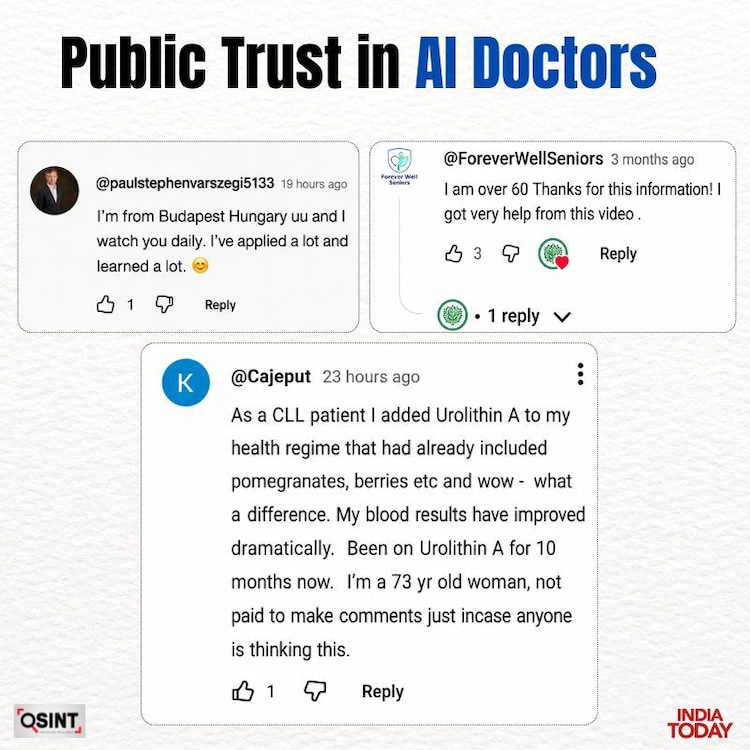
The comment section is filled with gratitude. People thank the “doctor”, tag relatives, and say they are trying the tips on loved ones suffering with cancer.
Except, the doctor is not REAL. The video is a fabrication, using the borrowed authority of a white coat to dress up vague commentary as medical truth. In health care, that kind of AI deception is not just irresponsible. It can be deadly.
Welcome to the AI infocalypse.
The man on screen is Dr William Li, a real physician, author and trusted online health voice. However, across social media, AI-generated versions of Dr Li are being used to borrow his credibility and make false medical claims. He has not won a Nobel Prize, yet video captions mention that he has. In many of the clips, he never said the words attributed to him. Yet the packaging of the videos is convincing enough to travel fast: millions watch, many believe, and some are quietly nudged towards products through promotional links.
India Today’s Open-Source Intelligence (OSINT) team found at least seven other YouTube channels that appeared to use AI-generated versions of Dr Li. Most of the sampled videos were flagged as synthetic after checks across at least four AI-detection tools using a frame-level review of visual and audio anomalies.
The danger is closer than it seems. Dr William Li’s case is not isolated. India Today’s OSINT team found more than two dozen AI-generated doctors and health influencers who do not appear to exist, but present themselves with the authority of medical practitioners while dispensing health advice online. Together, they have more than a million followers on Instagram.
White coats, stethoscopes and emergency rooms – the props are familiar. The people are not. Across Instagram, synthetic characters are being presented as real doctors. These accounts are not only misleading people but undermining trust in a profession where credibility can be the difference between life and death.
An analysis of the reels shows many of these synthetic characters of ‘doctors’ are becoming increasingly realistic. Take, for instance, the Instagram profile yours_medico, which has roughly 2,000 followers.
One of its videos is strikingly convincing. A young man in a white coat stands inside what appears to be an ICU, while other “doctors” move in the background, checking patients. He offers life-saving tips on the early signs of a heart attack. His coat even carries a name: Dr Sharma.
But taking a closer look, the video is geotagged to KD Super Speciality Hospital in Mathura. In one quiet corner, a watermark reads “Grok” sign. The account does not explicitly promote the hospital across its 500-plus posts. But many of its videos dispense medical guidance, including the names of medicines for common health problems. And beneath it all, the geotag keeps doing what the videos do not say out loud. The biggest concern is that in most cases, there is a lack of clarity on who’s responsible for the medical advice being prescribed by the AI doctors.
Some accounts go further, describing themselves as “Board-certified MD” in their bios, a phrase that gives the profile an added layer of legitimacy.
There is an apparent regulatory gap among global advisory bodies such as the World Health Organisation (WHO), government regulators, and Big Tech platforms. The WHO’s latest policy advisory on the use of Artificial Intelligence, its guidance on large multimodal models, does raise concerns about AI mimicking human communication. “Because the responses they provide appear to be authoritative, many users uncritically accept them as correct, even if an LMM cannot guarantee a correct response and cannot integrate ethical norms or moral reasoning into the responses it generates,” notes the WHO document, Ethics and Governance of Artificial Intelligence for Health. However, it largely addresses concerns around AI chatbots, not AI-generated doctor avatars or fabricated clinical case studies.
AI Health Creators

But the story does not end with fake doctors. In the wider AI infocalypse, another class of health creators is emerging as a safety concern. These synthetic wellness influencers speak in Indian languages and local dialects, use familiar cultural cues, and present themselves as “holistic healing experts” or lifelong followers of Ayurveda. With claims such as “For over 30 years, I have followed Ayurveda,” they appear less like random pages and more like trusted healers. Many also have a far wider audience than the fake doctor profiles themselves.
One account features a “desi dadi” or Indian grandmother who claims to be 80 years old and to have lived her entire life without any medicines. The claim is outrageous, and the persona is presented as an all-knowing guide to almost every health concern. From menopause to cellulite, there is a tip for everything. The account is not just dispensing advice. It also promotes paid sponsorships and sells products, ranging from gummies to superfoods.
Another video, posted by an “Indian Ayurvedic Healer”, shows a packet of baking soda being poured onto a young woman’s head as a remedy for dandruff. The reel has more than 50 lakh views.
But dermatologists warn that the advice is far from harmless. India Today showed the video to Dr Charu Nagar, a dermatologist based in Greater Noida. She called such claims “misleading and disturbing”, warning that in some cases they could cause serious scalp damage.
Many of these synthetic influencer accounts are not merely posting health tips. They are open for business. Some list email addresses for brand collaborations in their bios. Others send product links over direct messages, turning AI-made trust into a marketing funnel.
– Ends
Source link
[ad_3]

