
- Hindi News
- National
- SC: Religion Choice Right From Birth, Not By Marriage; Says Exclusion Discriminatory
New Delhi25 minutes ago
- copy link
The Sabarimala case was heard in the Supreme Court on Wednesday. The court raised questions on the validity of the 40 year old Public Interest Litigation (PIL). This petition is related to the right of excommunication and its constitutional protection in the Dawoodi Bohra community. The court said that it has to live with the old decision and cannot change its stand suddenly.
A Constitution bench of nine judges is conducting this hearing. In this, women’s entry into religious places, such as Sabarimala temple, and the scope of religious freedom in different religions are also being considered.
7 questions which are being debated…
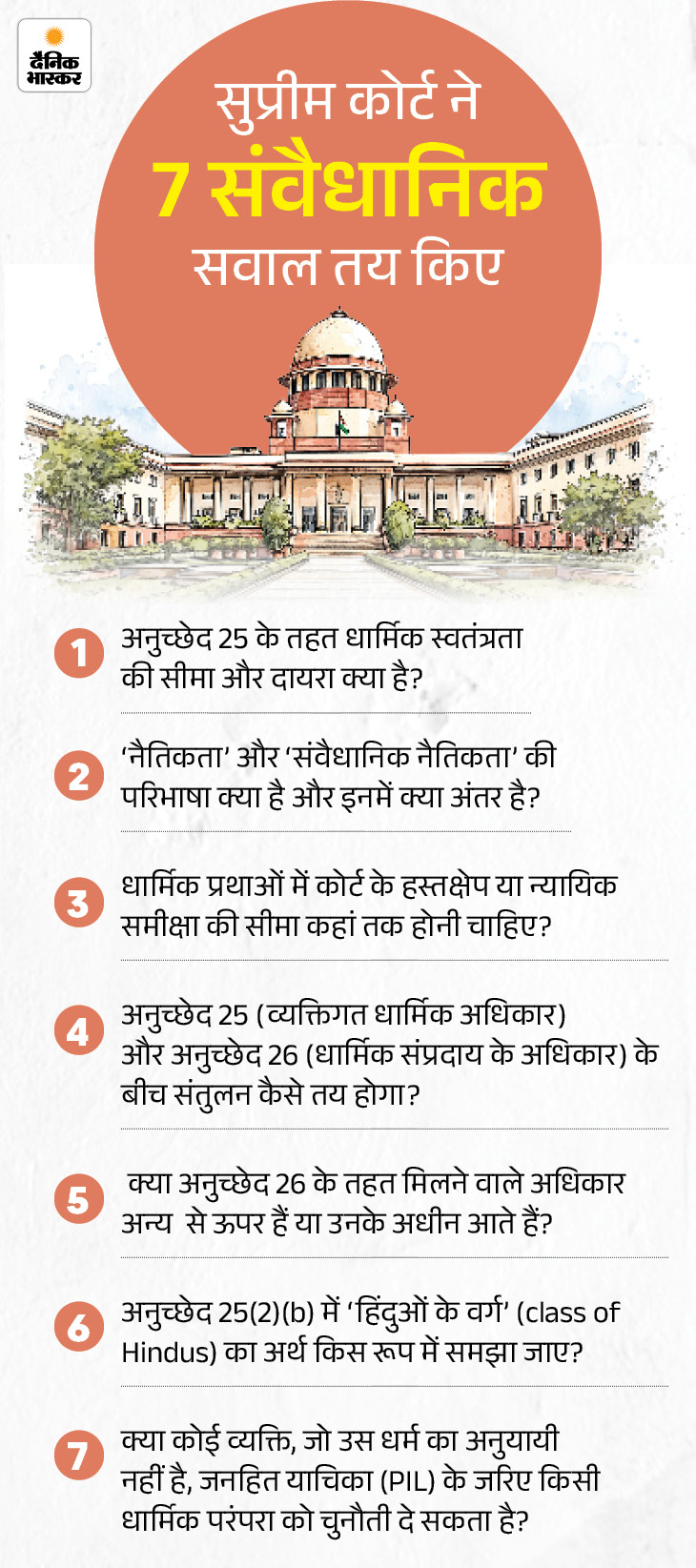
What is the matter?
This case is related to the 1986 PIL of the Central Board of Dawoodi Bohra Community. It demanded the repeal of the 1962 decision which had repealed the Bombay Prevention of Excommunication Act, 1949. Under that law it was illegal to excommunicate a member.
The 1962 decision stated that the right to boycott on religious grounds is part of the management of the religious affairs of the community. Therefore, the 1949 law violates the rights granted under Article 26(b) of the Constitution.
During the hearing, senior lawyer Raju Ramachandran argued on behalf of the reformist Bohras. He said that boycott directly affects human dignity. He also told that his client’s father Asghar Ali Engineer had himself been a victim of boycott.
Ramachandran said that in the Dawoodi Bohra community the religious head is called “Dai”, who enjoys supreme authority. He told that when children become adults, they take an oath of complete loyalty to their babysitter.
He also said that every religion has some rules to maintain discipline. But the real question is the extent of punishment and its impact on human dignity.
During this, Justice Nagarathna asked whether the petition was demanding to cancel the decision of the Constitution Bench of 1962 under Article 32. He said how can the court ignore its own old decision like this.
If the decision of Constitution Bench is changed then it will be a serious issue
He said, “We are also bound by strict rules. If the decision of the Constitution Bench will be changed on every Article 32 petition, then it is a serious issue.”
Justice Nagarathna also said that the court was yesterday raising questions on similar petitions in the Sabarimala case. In such a situation, a different stand cannot be adopted now.
Earlier on Tuesday, the court had also asked questions to the Indian Young Lawyers Association. On the petition of this NGO, entry of women of all ages was allowed in Sabarimala temple.
Meanwhile, senior lawyer Darius Khambatta argued on behalf of the Parsi woman. He said that if Article 26(b) is given more importance then it can eliminate individual religious rights.
According to Khambatta, the purpose of Article 26(b) is to protect religious institutions from government interference, not to suppress the rights of individuals.
Let us tell you that this case is related to challenging the 1962 decision, which was also upheld by the Bombay High Court. The hearing will continue on Thursday also.
The Supreme Court on Tuesday said that if a Parsi woman marries another religion and is thrown out of the community, it prima facie amounts to discrimination. The hearing will continue on Thursday also.
Hearing on Sabarimala case started from April 7
The hearing on the Sabarimala temple case started from April 7. During this, the central government presented arguments against the entry of women. The government had said that entry of men is also banned in many goddess temples of the country, hence religious traditions should be respected.
Read what happened in the last 9 hearings…
April 7: Centre’s argument – the decision of women’s entry into the temple is wrong
April 8- How is someone who is not a devotee challenging the religious tradition?
9 April- Supreme Court said- Stopping entry into temples will divide the society.
15 April- Sabarimala management said- Ayyappa temple is not a restaurant, celibate deity is here.
21 April- Supreme Court asked – How do gods become impure by touching?
22 April- Supreme Court said- Hindus should remain united, not divided into sects.
23 April- There is no ban on women coming to the mosque in Islam.
April 28- Roads cannot be blocked in the name of religious practices.
April 29 – Supreme Court said – will not be a part of the destruction of religion
May 5- Lawyers filed petition in Sabarimala case; The judge said- work for your people

Source link
[ad_3]

