
Dhaka13 minutes ago
- copy link
A major political upheaval may be seen in the general elections to be held in Bangladesh next month. The pro-Pakistan fundamentalist party Jamaat-e-Islami, which was out of politics for a long time, seems to be coming very close to forming the government for the first time.
According to news agency Reuters, in two separate surveys conducted recently, Jamaat has emerged as the second largest party in the country. She is giving a tough competition to former Prime Minister Khaleda Zia’s Bangladesh Nationalist Party (BNP). General elections will be held in Bangladesh on 12 February for 300 parliamentary seats.
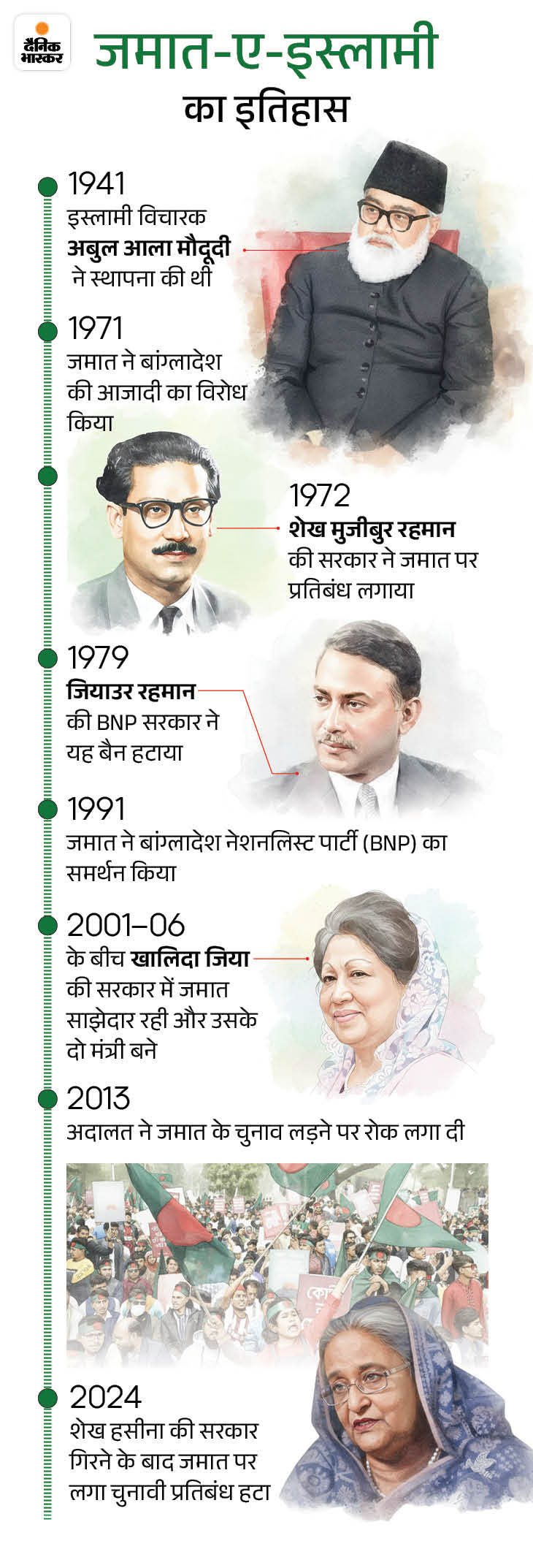
Jamaat-e-Islami is the same party which opposed the independence of Bangladesh in 1971 and supported the Pakistani Army. After the independence of the country, it was banned in 1972. This ban was lifted in 1975 and in 1979, under the rule of Ziaur Rahman, the party was allowed to participate in elections.

This picture is of 18 December 1971. Bangladeshi guerrilla fighters had beaten some people to death in Dhaka. These people were accused of supporting the Pakistani Army.
Slight difference between Jamaat and BNP in survey
The American organization International Republican Institute (IRI) had said in a survey conducted in December that BNP had got the support of 33% people and Jamaat had got the support of 29% people.
In a joint survey conducted in January, BNP got 34.7% support and Jamaat got 33.6% support. The survey was conducted jointly by Narrative, Projection BD, International Institute of Law and Diplomacy (IILD) and Jagoran Foundation.
Jamaat leader said- We are not doing confrontational politics
Jamaat chief Shafiqur Rehman says that his party is no longer doing politics of protest and confrontation but politics of people’s interests. He talked about setting up medical camps, helping flood victims and providing assistance to the families of those killed in the movement.
Experts believe that there is anger among the people regarding the policies of the previous government, which benefited the Jamaat. The party is now presenting itself as a moral alternative by giving the slogan ‘Islam is the solution’.
Mohammad Jalal, a coconut water seller in Dhaka, told the media that people are now tired of old parties and they find Jamaat a new and clean alternative.
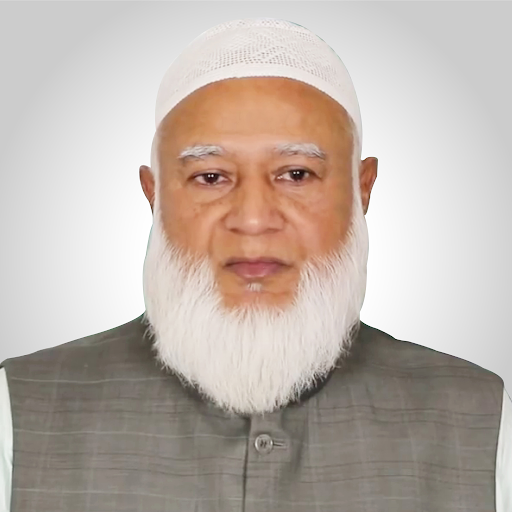
Jamaat-e-Islami leader Shafiqur Rehman says that his party is now emphasizing on public welfare instead of confrontation.
Jamaat may benefit from ban on Awami League
The government of then Prime Minister Sheikh Hasina fell after the student movement in August 2024, after which her party Awami League was banned. Since then, Nobel laureate Mohammad Yunus is running the interim government of the country.
According to Reuters, after the ban on Awami League, a void was created in the politics of Bangladesh, which Jamaat-e-Islami benefited from. This party, which was marginalized for a long time, now seems to be close to power. Jamaat has announced that it will contest elections on 179 seats.
On the other hand, the command of BNP is now in the hands of Khaleda Zia’s son Tariq Rehman. Khaleda Zia has died recently.
Election process in Bangladesh is similar to Lok Sabha elections in India.
Bangladesh also has the same electoral process as India’s Lok Sabha elections. Here, members of Parliament are elected through the first-past-the-post system, just like in India. That means the candidate who gets even one more vote will win.
After the election results are declared, the MPs of the largest party or alliance elect their leader and he becomes the Prime Minister. The President administers the oath of office as the Prime Minister of the country.
There are a total of 350 seats in the Parliament here. Of these, 50 seats are reserved for women. There are no elections for reserved seats, while general elections are held every five years for 300 seats. Apart from the Lok Sabha, there is also the Rajya Sabha in the Parliament of India, but there is only one house in the Parliament of Bangladesh.
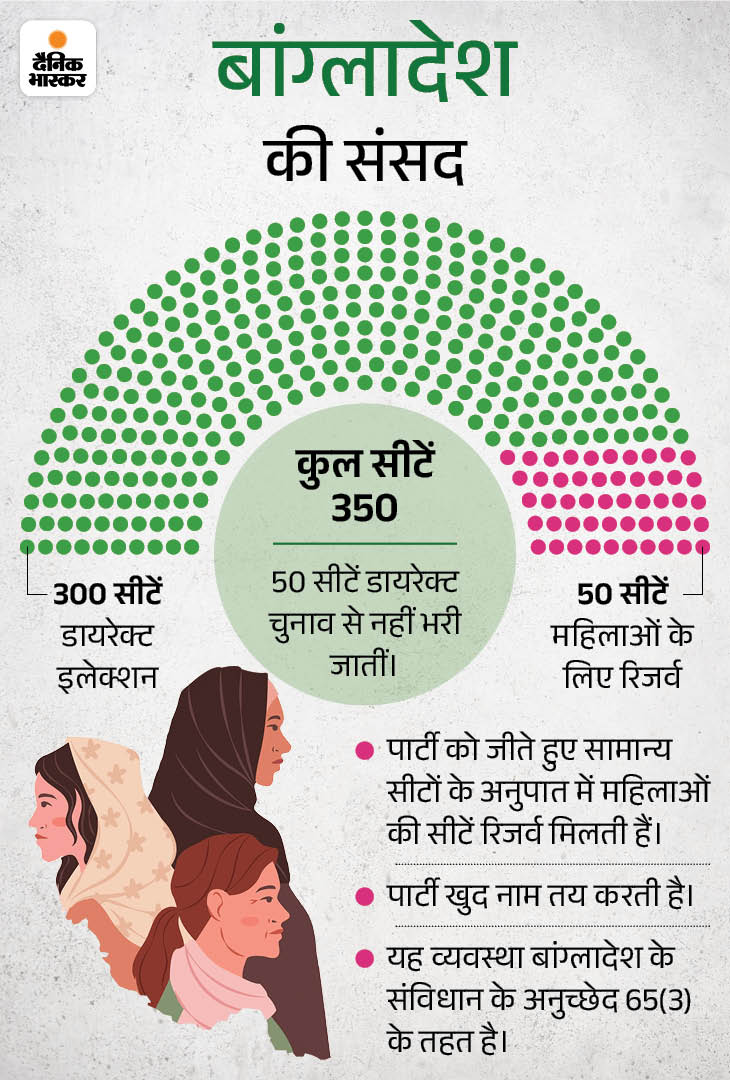
Who is the head of government in Bangladesh?
Like India, in Bangladesh also the Prime Minister is the head of the government. The President is the head of state, elected by the national parliament. In Bangladesh the President is only a ceremonial post and has no real control over the government.
Till 1991, the President was directly elected by the people here too, but later constitutional changes were made. Through this, the President started being elected by the Parliament. Sheikh Hasina was the Prime Minister of Bangladesh for 20 years.
Jamaat’s past became its biggest weakness
The history of Jamaat-e-Islami is considered its biggest weakness. The party had opposed the independence of Bangladesh from Pakistan in 1971. At that time, many of its leaders were accused of being involved in the killing of independence supporters in collaboration with the Pakistani Army.
For this reason, even today there is resentment against the Jamaat among a large section of Bangladesh. However, the party claims that it has around 2 crore supporters and 2.5 lakh registered members.
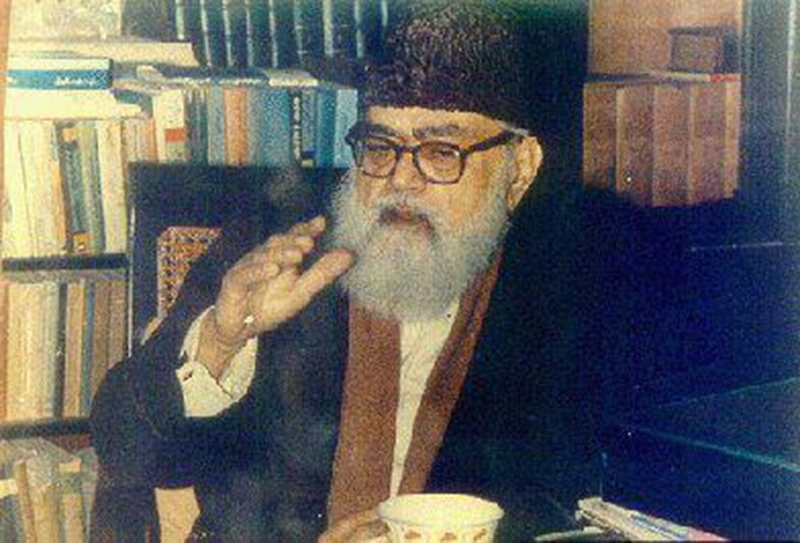
Islamic scholar Syed Abul Ala Maududi founded Jamaat-e-Islami in undivided India in 1941.
Jamaat trying to improve image by forming alliance
Jamaat has formed an alliance with NCP and other Islamic parties. According to Al Jazeera, this may weaken the strict fundamentalist image of Jamaat and it may reach out to the youth. Now the party is presenting itself as an anti-corruption and social service party.
Radical attacks have increased after Sheikh Hasina’s departure. In the last one month, 9 Hindus have been killed and temples and Sufi shrines have been attacked. Jamaat says that it has not been involved in these religious violence and for the first time it has given ticket to a Hindu candidate Krishna Nandi.
Jamaat has not fielded a single woman candidate on 300 seats, although it says that women can be given representation on the reserved 50 seats. Women’s rights organizations fear that after coming to power, Jamaat may impose restrictions on women’s rights.
Sheikh Hasina’s government took many actions against Jamaat
Sheikh Hasina had taken strict action against Jamaat after forming the government in 2009. The International Crimes Tribunal was created in 2010 to adjudicate the 1971 war crimes.
This tribunal had sentenced many leaders to death, including the then Jamaat chief Matiur Rehman Nizami and general secretary Ali Ahsan Mohammad Mujahid. However, international human rights organizations had raised questions on these trials.
A Bangladesh court had said in 2013 that the ideology of Jamaat does not match the country’s secular constitution. After this the party was banned from contesting elections and it remained out of politics for about 15 years.
After the fall of Sheikh Hasina’s government in August 2024, the interim government of Mohammad Yunus lifted the ban on Jamaat. After this the organization of the party strengthened rapidly.
What impact will it have on India?
Political experts believe that if Jamaat comes to power, Bangladesh may move closer to Pakistan, which may increase India’s concerns. However, Jamaat claims that it wants balanced relations with all countries.
BNP chief Tariq Rahman has returned to Bangladesh after 17 years and is contesting elections. BNP is still slightly ahead in the survey, but the difference between the two is only 2-4%. For this reason, it is believed that this time’s election could be the most interesting and decisive contest in the history of Bangladesh.
India-Bangladesh relations are in the most tense phase
Former Bangladesh PM Sheikh Hasina came to India in August 2024, since then the tension in the relations between the two countries is continuously increasing. Recently, relations between the two countries have reached their most tense period.
The Indian government on Sunday considered Bangladesh a country where officers cannot live with their families. According to BBC, this simply means that Indian officers or diplomats working in Bangladesh will no longer be able to take their husbands, wives and children there.
Earlier this rule was applicable only in a few countries like Pakistan, Iraq, Afghanistan and South Sudan. Now Bangladesh’s name has also been included in this list and this decision has come into effect from January 1.
The officers already posted in Bangladesh were told that their families had to return to India by January 8. Those whose children were studying in school were given another 7 days’ time.
After this decision, the families of Indian officers living in Dhaka, Chittagong, Khulna, Sylhet and Rajshahi had to return to India in a hurry.
—————–
Read this news also…
Hindu businessman beaten to death in Bangladesh: Three people attacked the employee after saving him; 9 Hindus killed in one month
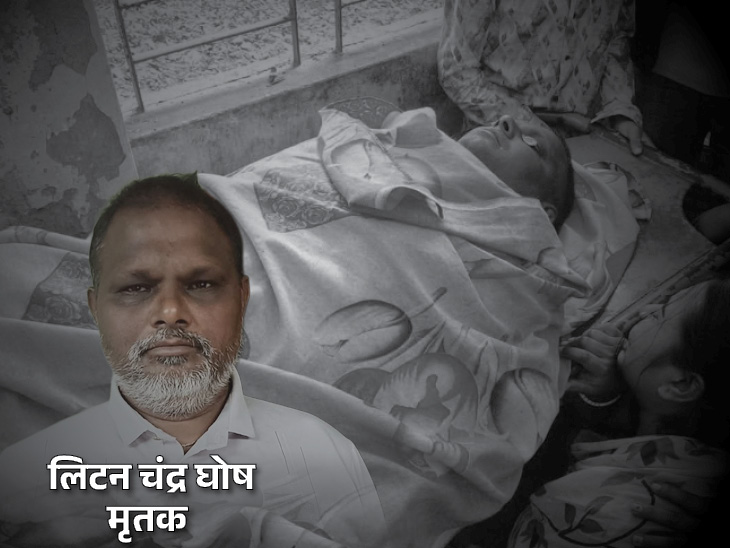
A Hindu businessman was beaten to death in Ghazipur district of Bangladesh on Saturday. He was trying to save a minor employee working in his sweet shop. Police have detained three people in the case. Read the full news…
Source link
[ad_3]

