
- Hindi News
- National
- SC Asks Centre, States For Reply On Transgender Act Amendment In 6 Weeks
New Delhi16 minutes ago
- copy link
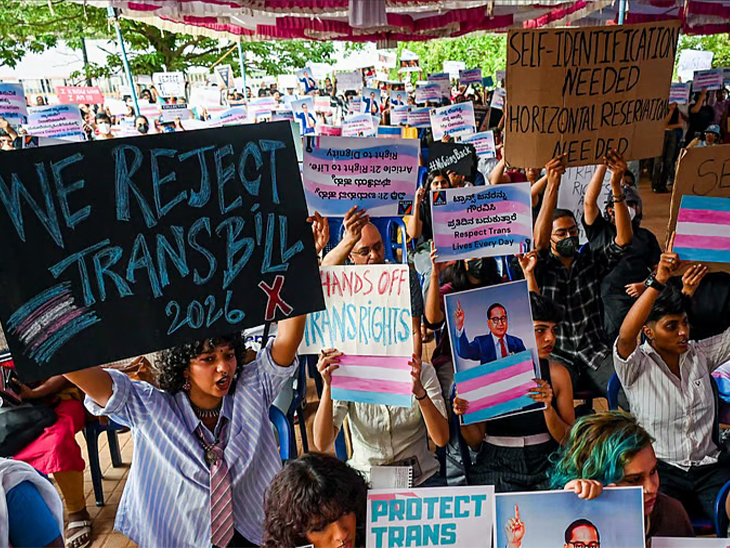
The Supreme Court has issued notices to the Central Government and all States/Union Territories on petitions challenging the constitutional validity of the Transgender Persons (Protection of Rights) Amendment Act, 2026.
The bench of Chief Justice Surya Kant and Justice Joymalya Bagchi has sought a reply on this matter within 6 weeks. Now this case will be heard by a bench of three judges.
Singhvi said- New amendment is against NALSA judgment
Senior advocate Abhishek Manu Singhvi, appearing for the petitioners, expressed strong objection to the amendment. He said that this amendment takes away the right of ‘self-identification’ (to decide one’s own identity) from transgender persons. This goes against the landmark NALSA judgment of 2014, in which the Supreme Court had declared it a fundamental right to choose one’s gender identity.
CJI asked- Will people not take advantage by creating fake identities?
During the hearing, Chief Justice Surya Kant expressed some concerns regarding the right to self-identification. He asked, ‘Doesn’t this pose any danger? Can’t there be people who pretend to be transgender so that they can benefit from the reservations or privileges meant for this community?’
To this, Singhvi replied that as per his knowledge, no reservation is currently applicable for transgender persons, hence there is no possibility of misuse. He further said that even if there is scope for misuse in 0.01% cases, the rights of Article 21 (right to life and dignity) of the majority community cannot be suspended on its basis.
Medical board’s recommendation will now be necessary
Justice Bagchi remarked during this time that the legislature can change the basis of any decision. After the new amendment, now ‘medical evaluation’ i.e. medical examination has been made the basis for transgender identity instead of the individual’s own wish. The petitioners say that the District Magistrate will now issue identity cards only after the recommendation of the Medical Board, which is a violation of the right to privacy and dignity.
Hormonal therapy stopped, lawyer said – this is like criminalization
Senior lawyer Arundhati Katju told the court that hormonal therapy of many people has been suddenly stopped due to fear of amendment. Singhvi said that if a person is taking therapy, then through this amendment an attempt is being made to make him a criminal.
However, Solicitor General Tushar Mehta intervened, saying that the government was only criminalizing forced sex change or coercion of children (such as forced castration). He made it clear that no person, male or female, is being excluded.
Act has not been implemented yet, petitions are premature: Caveator
One party, Harsh Asad, told the bench that this Act has not yet come into force because the Center has not notified it. He argued that the petitions had been filed prematurely. He also said that some people in the community are in talks with the government so that this amendment is not implemented, and the court notice could hinder that process.
The court refused to give any kind of interim order at present because the law has not yet come into effect.
What was the NALSA Judgment of 2014
The Supreme Court for the first time officially recognized that transgender people are neither strictly male nor female. They were given the legal right to identify themselves as ‘third gender’ under the Constitution. Gender should not be determined only by body parts, but by the person’s mind and his emotions (Self-identification).
The court clarified that any person has the right to choose in which gender he sees himself. For this, the legal requirement of any medical certificate or surgery (such as sex change surgery) was said to be wrong. This was considered part of Article 21 (right to live with dignity).
What has changed in the new amendment of 2026?
- Definition changed: Earlier the definition of transgender was based on the personal experience of the person. Now medical and biological grounds have been added to it.
- Mandatory Certificate: If a person undergoes surgery (gender affirming surgery), it will now be mandatory for him to obtain the revised certificate. Earlier it was optional.
- Difference in punishment: The petitioners claim that the punishment for sexual exploitation of transgender persons has been kept low, while the punishment in cases like trafficking is high, which is discriminatory.

Source link
[ad_3]

