
antalya7 minutes ago
- copy link
Chris Bowen, the chairman of the talks during the United Nations Climate Conference (COP31), looked quite disappointed on Sunday.
The United Nations Climate Conference (COP31) held in Antalya, Turkey ended without any major agreement. Representatives of about 200 countries kept discussing for two weeks how to stop the earth’s temperature from rising, but no consensus could be reached on the issue of reducing the use of coal, oil and gas.
There was not even the name of fossil fuels i.e. coal, oil and gas in the last resolution of the conference. The European Union and many small countries expressed strong objection to this. On the other hand, oil-gas producing countries like Saudi Arabia and Russia were against any proposal that clearly talks about reducing the use of fossil fuels.
Ultimately the countries could not reach any common decision. This is the first time since 2009 that the UN climate conference ended without a major political agreement.

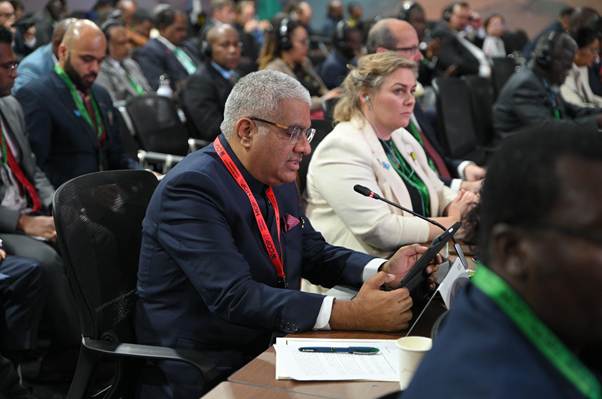
Picture taken during the meeting of the United Nations Climate Conference (COP31) in Antalya, Turkey on Sunday.
Saudi- Russia protested the most
The biggest controversy at the conference was over whether the final agreement should set a deadline for gradually reducing the use of coal, oil and gas.
Saudi Arabia was opposing this demand. Negotiators from many countries alleged that Saudi Arabia exerted a lot of pressure to get decisions in its favor in the conference. It also opposed the inclusion of coal, oil and gas in the final agreement. Instead he was in favor of promoting carbon capture technology.
Carbon capture is a technology in which carbon dioxide gas emitted from factories and power plants is captured and stored before it spreads into the air.
Saudi Arabia said that to deal with climate change, one should not depend on any one method. All types of techniques should be used for this. His argument was that if the supply of oil and gas was reduced rapidly, their prices could increase. This will cause more trouble to poor countries.
Russia also opposed the language related to reducing fossil fuel use. His argument was that sharply reducing the supply of oil and gas could lead to energy shortages and rising prices.
EU and smaller countries blocked the proposal
On the other hand, countries like the European Union, Britain, Panama, Belize, Vanuatu, Marshall Islands and Norway objected to the final proposal. These countries said that the biggest reasons for climate change are coal, oil and gas. In such a situation, how can there be any climate agreement without talking about reducing their use?
On behalf of the EU, Ireland’s Climate Minister Darragh O’Brien said that the agreement, which does not even mention fossil fuels, cannot be accepted.
Panama also opposed the proposal. He said that the world now needs to take concrete steps instead of just talking. The Marshall Islands said the proposal does not meet the needs of countries most affected by climate change.
In fact, about 130 countries had sent a letter to the countries presiding over the conference demanding that the final agreement should include the move away from fossil fuels. Despite this, it was not mentioned in the new draft.

India, China oppose hasty move on fossil fuels
The role of India and China was also important in this dispute. Both are the world’s largest energy consumers. Their economies are still largely dependent on fuels such as coal, oil and gas.
India did not formally oppose the final resolution of the conference, but did express its objection to some parts of it. Union Environment Minister Bhupendra Yadav said that failure to reach a major agreement does not mean that efforts to combat climate change will stop. He said that India is committed to the process of dialogue and consensus building among all countries.
China also accepted the final proposal, although it expressed concerns over some issues. China appealed to all countries to understand each other’s views and show flexibility as needed to reach an agreement.
India was represented by Union Environment Minister Bhupendra Yadav at the COP31 conference.
There was no discussion even on giving money for climate
Another major controversy at the conference was regarding financial help to deal with climate damage. Developing countries wanted rich countries to give more money to deal with floods, droughts, sea level rise and other disasters.
The initial proposal called for tripling the financial assistance provided to deal with climate impacts by 2035 to $120 billion. But this fixed amount was removed from the later draft. Developed countries were not ready to give any specific amount separately under the already decided responsibility of climate finance.
This increased the resentment of developing countries. He said that poor countries suffering the effects of climate change are not getting adequate financial assistance.
Questions on the way the United Nations takes decisions
After this conference remained inconclusive, questions have also started being raised on the method of taking decisions in the UN climate conferences. Here decisions are not taken on the basis of majority, but with the consent of all the countries. This means that if some countries also oppose any proposal then the agreement may get stuck.
Former US Vice President Al Gore called this result disappointing. He said that the world should take concrete steps to move away from fossil fuels and provide economic help to the affected countries. Australia’s Climate Minister Chris Bowen also admitted that the current method of taking decisions by consensus is becoming a big problem.
However, UN climate chief Simon Steel defended the arrangement. He said that through this process, the Paris Climate Agreement was reached in 2015, which gave the world a common goal to deal with the climate crisis.
America stayed away from the summit for the second consecutive year
America’s stay out of the conference also had an impact on the talks. European diplomats believed that if America had been present, it would have been easier to stop Saudi Arabia’s opposition.
The biggest reason for America staying out of the COP31 conference is President Donald Trump’s climate policy. Trump has been critical of international agreements and regulations designed to combat climate change. He believes that such agreements burden the American economy and industries.

Source link
[ad_3]

