
In the ancient texts written in North India, the southern plains are mentioned only by the name Dravida. In the Sankalp Mantra included in our worship method, there is mention of Mero Dakshina Parshwe along with Jambudweep, Bharatvarsha, Bharatkhand. The southern area beyond the mythical Mount Meru leads to the same Dandakavan, where Shri Ram lived his life as a forest dweller.
In such a situation, one is surprised that despite the mention of Dandakavan in the epic Ramakatha, why there is no mention of Dravida or Tamilakam in it. The question is that on one hand Aryavarta is said to extend from the Himalayas to the ocean and on the other hand Dravid, the representative of the south, remains missing from it. How would the Dravidian community feel on this? Is beyond imagination.
Tamil language has never been dependent on Sanskrit
However, the Brahmins made improvements in the Sankalpa Mantra with time and it also started mentioning specific Tamil pilgrimage places like ‘Madurai, Kumari, Kanchi’. This was a great example of cultural reform. That means he knew how to survive in the changing environment. The basic resolution may have emerged from the Brahminical tradition, but the social fabric of Tamilakam was full of diversity. In fact, the ancient Tamil language was never dependent on Sanskrit for invoking the gods.
This land of Tamils was already rich with its own distinct beliefs and beliefs. These traditions were created with local specialties. The villages and tribes here had developed their own methods of invoking God. Local deities were called in local dialects. Every god and tradition had a place in this big spiritual map.
‘‘Tamilikam’ – an ancient heritage of identity
It is clear that the word ‘Tamilyakam’ existed before Dravid. The word ‘Tamilyakam’ brings forward the old heritage of identity. It is made up of ‘Tamil’ (language and people) and ‘Akam’ (house or residence). That is, the direct meaning of Tamilakam is the land where Tamil speaking and Tamil people reside. This idea did not come from any war but was established through grammar itself.
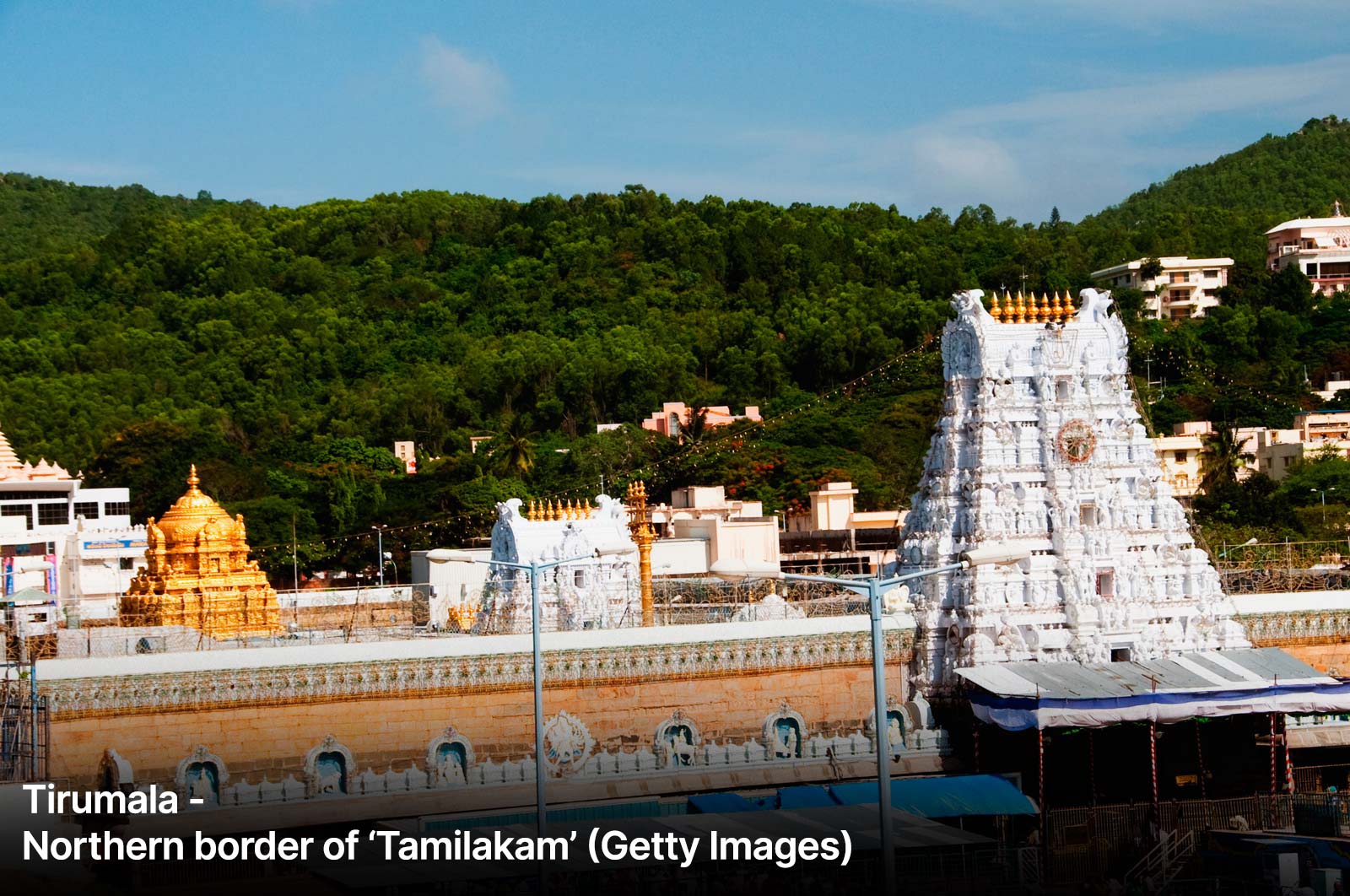
‘Tolkappiyam’, the ancient grammar text of Tamil literature, defines the boundaries of Tamilakam and brings it forward as a ‘nation’.
Tolkappiyam (Sutra 50, Chirappuppayiram) is registered “Vadvenkatam Tenkumari Aydai Tamilkuru Nallulakam” is the expansion between Venkata (Tirumala) and Kanyakumari in the north. The Jain epic of Ilongovdical ‘shilappadikaram’ also determines some limits.
There is repeated mention of an imaginary island ‘Kumarikandam’ at many places in Tamil and Sangam literature. Which is said to extend from east-west to the Indian Ocean. Even today, the desire to bring this imaginary world alive continues to stir in cinema, politics and social media.
How society divided into five parts
Within Tamilakam, land and power were seamlessly intermingled with each other. Chera, Chola and Pandya, all three were sovereign rulers of their respective regions. Apart from these, there were also small allied kings and local chieftains, who kept this political fabric together in the form of feudal lords. During this period, the Tinai system of governance comes into existence, in which the society was divided into five parts on the basis of geography.
Every region had its own specialty, distinct culture, folk deities, vegetation and lifestyle. Which were seen as mountains (Kurinji), forests (Mullai), agricultural land (Marudam), coast (Neydal) and barren land (Palai).
In this, Kurinji i.e. the lush green mountainous region is the land of hunter communities and hill tribes and their deity is Murugan (Kartikeya in the north). Whereas Mullai is a symbol of green plains, whose deity Mayon is actually the ancient shepherd form of Vishnu. The desert is part of agricultural land and perennial rivers. Here, Indra’s blessings are sought for good rain and harvest. It is here that rulers and farmers reside. It is a symbol of fertility, labor and governance, where human conflicts and domestic tensions also come to the fore.
Neydal i.e. the coastal area, whose deity is Varun. Whereas Palai means barren land. When there is drought in Mullai or Marudham and it becomes desolate, it becomes Palai. Its goddess is Kotravai (Durga). This is a land of suffering, pain and despair.
In this way, ‘Tamil pride’ is visible in the cultural ‘symbols’ that are clearly visible even today. The canvas of its image becomes bigger with this pride and the mountains laden with flowers, sea waves, swaying fields, forests resonating with bees and birds. All this remained the subject of Shringaar’s poems and Sangam literature brought it out beautifully on the pages.
Tamil literature and Tamil pride
Then if you pick up any book of Tamil literature, you will see the same kind of Tamil pride in all of them. In which the antiquity of Tamilakam will be described, its prosperity will be seen, which seems to establish it as a separate divine land. Purananooru, Agananooru, Pattinappalai, Shilappadikaram or Manimekalai are such literary works which tell the story of Tamil culture and prosperity. The ideals created in these regarding state religion, family relations, society and profession, culture and climate, love and lust, household responsibilities etc. are not born from any divine order, but from the experiences of life.
In an era when many civilizations in India and beyond were adopting their ideas, ideals and instructions from ‘sky-voices’, Tamilakam coined its philosophy from the ridges of the fields and adopted it with respect. As a result, a civilization was formed that assimilated many influences, resisted some and ultimately adapted them all to its lexicon while preserving its original identity.
In this way ‘Dravid’ came into common parlance. It did not erase Tamilakam, but added its own layering on top of it. This is the junction point where the ancient soil meets the evolving script.
—- End —-
Source link
[ad_3]

