
Beijing2 minutes ago
- copy link
America and its allied countries have imposed sanctions on Russia’s big oil companies and some of their customers, after which Chinese oil companies are now withdrawing from buying Russian oil.
According to Bloomberg report, Chinese government companies like Sinopec and PetroChina have recently canceled several oil consignments from Russia. This was done because the US last month imposed sanctions on Russia’s two largest oil companies, Rosneft and Lukoil.
Some of China’s smaller private refineries, called teapots, are also fearful of buying Russian oil. They fear that if they do a deal with Russia, they may face the same punishment as Britain and the European Union recently imposed on Shandong Yulong Petrochemical Company.
Earlier, a Reuters report had claimed that Indian refining company Reliance is adjusting its purchases of Russian oil according to government guidelines. Government companies are also checking the shipments. Read the full news…
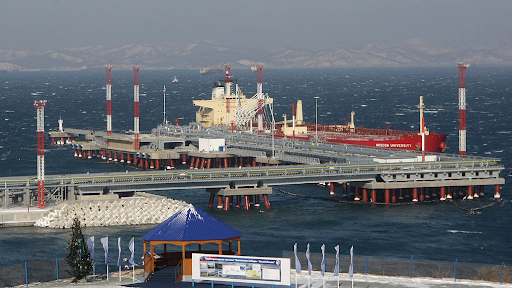
Kozmino Port of Russia situated on the shore of the Sea of Japan.
Russian oil prices fell due to the ban
Bloomberg quoted Rystad Energy as saying that due to the strike by buyers in China, about 45% of Russia’s oil exports to China have been affected.
Its biggest impact has been on ESPO crude oil. This is the Russian oil blend which is sold the most to Asian countries. Now its prices have fallen, because Russian sellers have to sell oil cheaper to attract buyers.
Earlier the price of ESPO oil was 1 dollar more than Brent crude, but now it is only 0.50 dollars more. Due to new US sanctions, many Indian refineries have stopped buying oil from Russia.
However, India’s largest company Indian Oil Corporation (IOC) has resumed purchasing Ural crude from suppliers that do not fall under the new US sanctions.
American sanctions affect Turkey also
The effect of the sanctions is also visible on Turkey. The largest oil refinery there, previously almost entirely dependent on Russian oil, is now buying oil from Iraq and Kazakhstan for December delivery.
Another big company, Tupras, has also stopped using Russian oil in one of its refinery plants, so that it can avoid difficulties in selling its fuel exports in European markets.
Russia remains China’s largest oil supplier. This was possible because due to the international sanctions imposed on Russia after the Ukraine War, its oil was becoming very cheap.
But now the US and its allies have increased sanctions on both Russian oil producers and their buyers, in order to curb Russia’s oil earnings and put pressure on it to end the war.
Russia is selling oil to blacklisted companies
However, it is not a complete loss deal for Russia. The Yulong company, which was blacklisted by the western countries and which had canceled oil deals with many countries, is now forced to buy oil from Russia because it has no other option left.
Other private sugar refineries are watching the situation and are currently not taking any steps that could lead to restrictions on them too. Moreover, these private refineries in China have almost exhausted their oil import quota for this year.
They are also not able to buy oil from other sources due to recent changes in tax policies. This means that even if they want to buy cheap oil from Russia, they will not be able to do so.
Situation complicated due to Trump-Jinping meeting
The report says that the situation has become more complicated due to the meeting between Trump and Xi Jinping. The two leaders made some new agreements on trade issues like semiconductors, rare earth metals and soybean, but there was no discussion on Russian oil.
Meanwhile, the US has announced that China will suspend new export controls imposed on its rare earth metals and end ongoing investigations on American semiconductor companies.
Additionally, shares of clean energy companies have seen a surge, giving green-energy investors hope that the long-running recession may now be over.
At the same time, China has also decided to end the tax exemption on gold, which is considered a blow to one of the world’s largest gold markets.
Source link
[ad_3]

