.
A crowd was gathering at bungalow number 17 of York Road in Lutyens’ New Delhi. This was the residence of Jawaharlal Nehru, who was to become the first Prime Minister of independent India within a few hours.
The monks dressed him in yellow and applied ash-tilak on his forehead. After wiping the ashes from his forehead, Nehru started preparing for the night’s speech. Just then the phone rang.
There was a trunk call from Lahore. As soon as the conversation ended, Nehru’s face fell. Not a single word came out of his mouth. As soon as he placed the receiver, he placed both his hands on his face. When the hands were removed there were tears in the eyes.
In the famous book ‘Freedom at Midnight’, Larry Collins and Dominic Lapierre write that Nehru’s daughter Indira Gandhi was nearby at that time. When asked, Nehru said – Water supply to Hindu-Sikh areas in Lahore has been cut, children are suffering from thirst, those coming out to get water are being killed, the city is burning.
Nehru said with a choked throat – How will I address the nation now? A piece of my heart, Lahore, is burning.
Indira consoled her father. Nehru controlled himself and reached the Central Hall of Parliament at exactly 11:55 pm. Nehru gave a historic speech by inserting a rose into the hinge of a cotton bundle – Tryst with Destiny।
As soon as the clock reached 12, the conch shell sounded. A crowd of thousands had surrounded the Parliament House, it was raining heavily and slogans echoed in that rain – ‘Victory to Mahatma Gandhi.’
But the man whose name was echoing in Delhi was sleeping in a dark, locked room of a dilapidated building in a stinking neighborhood of Calcutta, hundreds of kilometers away from Delhi.
Mahatma Gandhi is sitting with Suhrawardy, a prominent leader of Muslims in Calcutta. The photo is from August 1947.
33 hours before India’s independence, i.e. around 3 pm on 13 August 1947.
An old dilapidated Chevrolet car was moving slowly through the narrow streets of Calcutta’s largest slum. Sitting inside was 77 year old Mohandas Karamchand Gandhi. There was no trace of filth and smell in this colony of more than 4 lakh people.
As soon as the car reached the locality, the angry crowd started pelting stones and bottles. There were only Hindus in the crowd. The car door opened. Gandhi came down, held the shawl with one hand and raised the other hand in a gesture of peace.
Someone shouted from the crowd – ‘A year ago, Muslims massacred people in Noakhali, raped daughters-in-law, where were you then?’
Gandhi went straight into the crowd. Speak, ‘you want kill me? Okay, I’m in front. Beat.’
Gandhi further said – Now not a single Hindu will be killed in Noakhali, Muslim League leader Hussain Shaheed Suhrawardy himself has given this promise. If any Hindu still dies, they will give up their lives. The crowd became silent in a moment.
Gandhi stayed in a dilapidated house ‘Hydari Manzil’ in the same locality. Once the house of a rich Muslim, it was now a colony of rats and cockroaches, which was cleaned before their arrival. From here Gandhi started trying to save both the Muslims of Calcutta and the Hindus of Noakhali.
The next day, i.e. on 14 August, about 10 thousand people gathered in the prayer meeting. Gandhi said, ‘Tomorrow we will be free, but tonight at midnight the country will also be in pieces. Tomorrow will be a day of happiness and equally sadness. This freedom is handing us a big responsibility. Don’t give up your conscience and brotherhood. If it survived in Calcutta, then understand that it survived in the entire country.
At 12 o’clock in the night, when Nehru was giving the historic speech of India’s independence, neither bulb, nor lantern, nor candle lit in Hydari Manzil. Just darkness and silence. Gandhi had gone to sleep a little early that day.
More than 30 thousand people attended Gandhi’s prayer meeting on 15 August. Gandhi spent the whole day fasting, reciting Gita and spinning the charkha. Neither hoisted the flag nor gave any political speech. When the Information and Broadcasting Department asked for a message on independence, he clearly refused and said – ‘I do not have any message for the country. My heart has dried up.
That day, at Gandhiji’s prayer meeting, Surhavardy, the leader of the Muslims of Calcutta, said, ‘Now I will say, ‘Jai Hind’! You guys will also speak after me!’ In response, 30 thousand people shouted – Jai Hind.
The entire country was burning in the fire of communal riots, except Calcutta. After the prayer meeting, Gandhiji set out on a tour of the city in the same old Chevrolet car. This time the crowd of Calcutta welcomed the Mahatma’s car not with stones and bottles but with rose water. With tears of gratitude in its eyes, the city seemed to be saying – ‘Gandhiji! You saved us.’
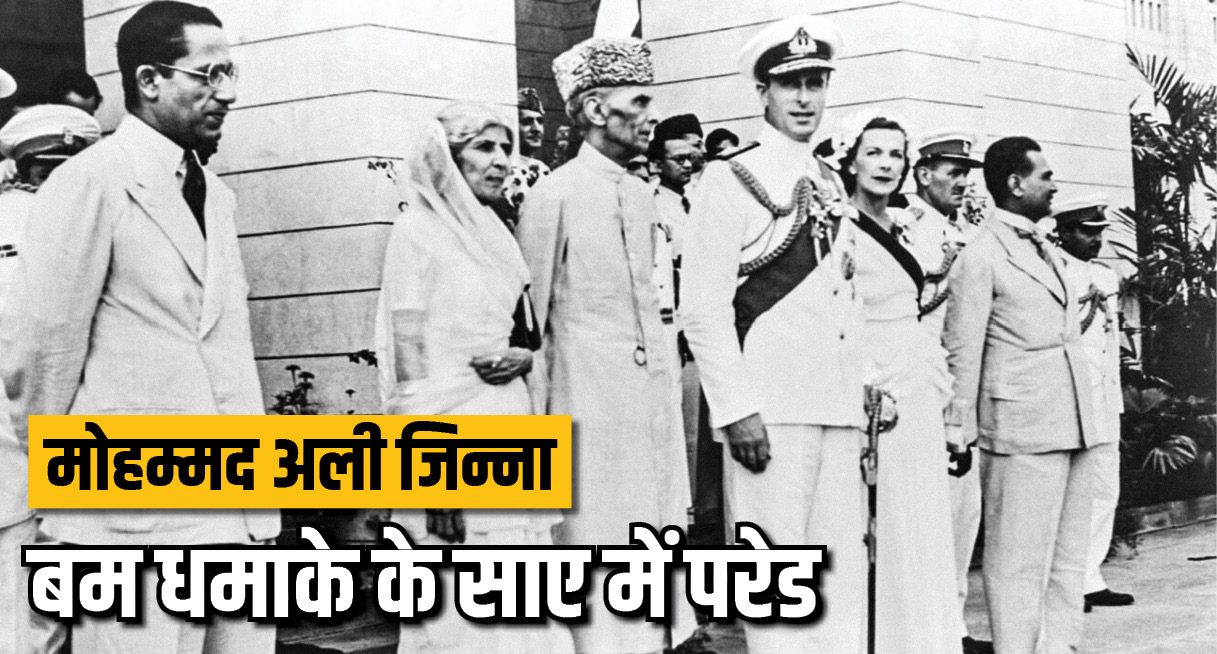
Mohammad Ali Jinnah participating in the celebration of Pakistan’s independence on 14 August 1947. Also present are Lord and Lady Mountbatten.
In Calcutta, Gandhi was risking his life to stop Hindus and Muslims from slitting each other’s throats, while in Karachi, Mohammad Ali Jinnah was preparing to celebrate the creation of Pakistan. One of Jinnah’s many programs that day was to take out a greeting parade on the streets of Karachi in an open car.
In ‘Freedom at Midnight’, Larry Collins and Dominic Lapierre write – A few hours before the parade, C.I.D. Had informed Viceroy Mountbatten that R.S.S. Some people are conspiring to drop a bomb on Jinnah’s open vehicle and the conspirators have not been identified yet.
Mountbatten requested Jinnah to travel in a closed car. Jinnah flatly refused. It was not possible for the Quaid-e-Azam to appear with his face hidden in the very first program of the country for which he sacrificed his life.
The celebration of the formation of Pakistan began in the Karachi Assembly Hall on the morning of 14 August, a day before India’s independence. Mountbatten, decorated with medals, sat next to Jinnah. According to ‘Freedom at Midnight’, both the leaders finished their speeches and moved towards the black open Rolls-Royce, which had already started looking like a hearse to Mountbatten.
The car started, the cannon salute echoed and a sea of people gathered on the three-mile long road. The crowd was continuously raising slogans of ‘Pakistan Zindabad’, ‘Quaid-e-Azam Zindabad’.
Suddenly the slogans stopped as soon as they reached Elphinstone Street. An eerie silence spread. Most of the shops here belonged to Hindus. Mountbatten prepared himself for death in his mind. but nothing happened. The vehicle reached Government House safely.
Jinnah’s face, which remained colorless with stress during the entire journey, lit up for the first time as soon as the car stopped. He held Mountbatten’s knees with his weak hands and said, ‘Thank God, I brought you back alive!’ Mountbatten replied, ‘My God. Who has rescued whom? You me or I you?’
According to ‘Freedom at Midnight’, later investigation revealed that R.S.S. People had actually reached Karachi. However, the leader who was supposed to give the signal to throw the bomb lost his courage at that very moment.
That scary car journey on 14th August ended safely. On 15 August, Jinnah took all the government powers in his hands. The leader, who always advocated democracy, almost became a dictator as soon as he took charge of the new nation.
The last Friday of Ramadan was falling on 15th August. The enthusiasm doubled throughout Pakistan. Jinnah’s picture was hung on every street, every nook and every shop window. Independence Day became like a personal celebration of Quaid-e-Azam.
‘Pakistan Times’ newspaper even wrote that the animals of Lahore Zoo are also sending greetings to Jinnah through their keepers and are busy in raising slogans of ‘Pakistan Zindabad’.
Jinnah’s only child Dina was not present in this celebration. She was in a dilemma in a flat in Colaba area of Bombay, hundreds of kilometers away from Karachi. He had hung flags of both India and Pakistan from his balcony.
She was not able to decide which country to call her own? To the India where he was born or to the Pakistan that his father created? Those two flags hanging on the balcony were the picture of the same unresolved question.
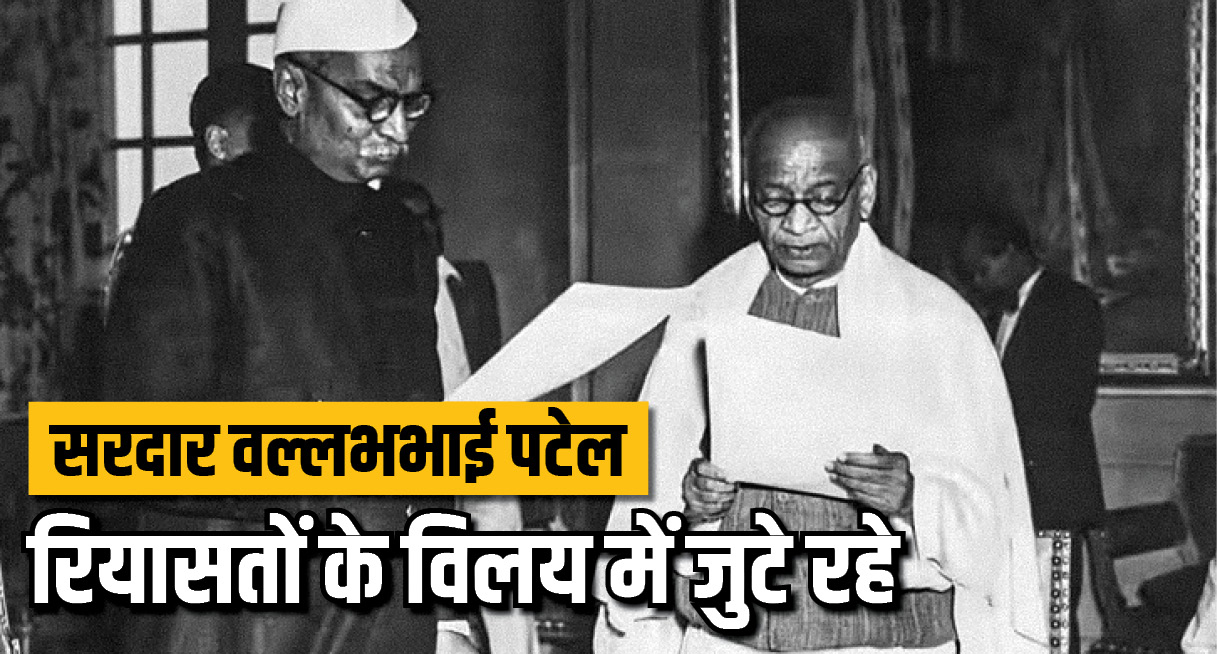
There were only a few hours left for independence and Sardar Patel was continuing the work of integrating the princely states into India.
August 13, 8:30 am. Home Secretary V.P. Menon approached Patel with bad news. Chittagong Hill Tracts, with more than 97% Buddhist and non-Muslim population, is becoming part of Pakistan. The same day two people from Chittagong came to meet Patel.
It is written in daughter Maniben Patel’s diary ‘Inside Story of Sardar Patel’, ‘Bapu (Patel) was surprised to hear. When Menon came again at 12 noon, he wrote a letter to the Viceroy.
There was a queue as early as 5.30 am on 14th August – the Diwan of Kutch, another Diwan, then another visitor. Menon, Morarji Desai, Jawaharlal kept coming and going throughout the day. At quarter to three in the afternoon, the rulers of Dholpur, Nabha and Jhawar handed over their signed instruments of accession to Patel.
At 7:30 in the evening, Menon told that Liaquat Ali Khan of Pakistan would come to meet the day after tomorrow and the Nawab of Bhopal would also send his signature soon.
At ten o’clock at night, Patel went to Rajendra Babu’s house, where some religious ritual was going on on the lawn. The entire lawn was filled with a crowd of women. The road was jammed with vehicles.
At eight o’clock in the morning of 15 August, Patel went to Viceroy Bhavan, where he witnessed the oath taking of ministers and the Governor-General. At quarter to ten we went straight to the Assembly, where the session began in the presence of Lord and Lady Mountbatten. Session ends at 11 o’clock, then informal cabinet meeting.
In the evening, the historic flag hoisting took place at India Gate, but amidst the same celebrations, a call was received twice regarding disturbances in Lahore.
On 16 August, Patel participated in the flag hoisting by Jawaharlal at the Red Fort. Went for the Defense Council meeting at 10.30 in the morning, but due to Liaquat Ali Khan’s plane not arriving, the meeting ended within half an hour.
After this a long discussion started with Shyama Prasad, Jawaharlal, Rajendra Babu, Baldev Singh and some officers, which continued till five in the evening. The topic was Radcliffe Line of Partition. Even just a day after independence, the country’s borders were still being decided on paper.
That is, while other leaders were giving speeches, hoisting flags and shedding tears, Patel was doing that unseen work among the files, signatures and maps, without which the map of independent India is not complete.
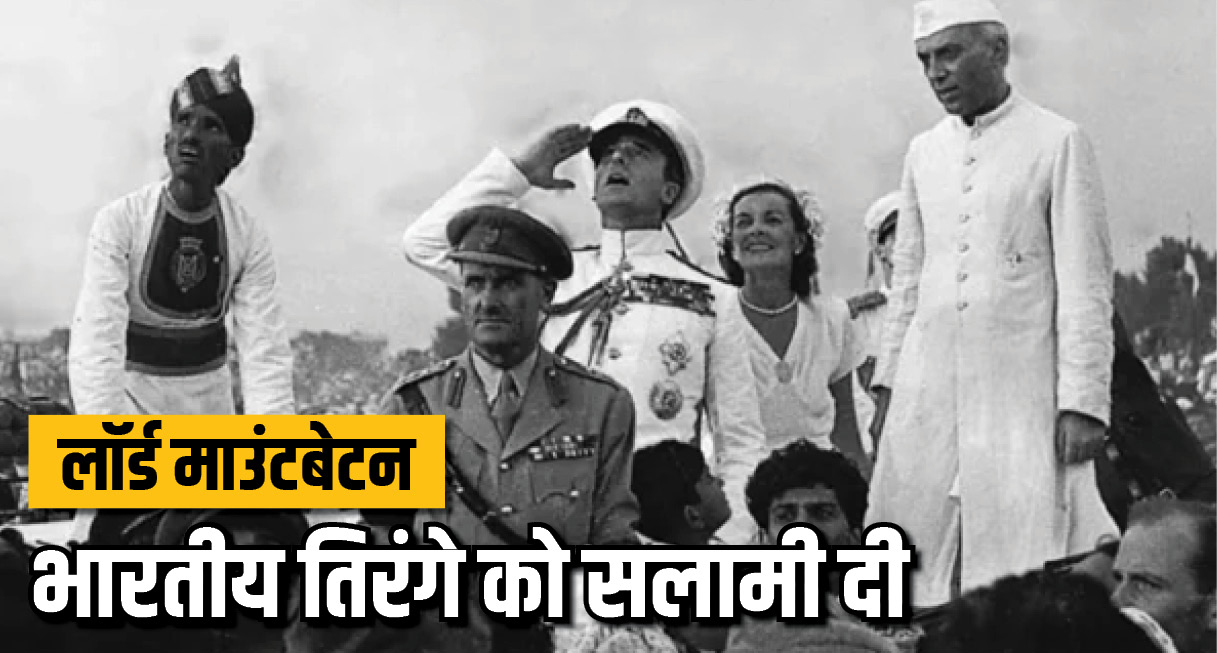
New Delhi, 15 August 1947 at five o’clock in the evening.
The British built India Gate in memory of 10 thousand Indian soldiers killed in the World War. It was here that Nehru was going to officially hoist the tricolor of independent India for the first time.
Mountbatten’s advisors had estimated that around 30 thousand people would come. The entire arrangement including the rope gallery, path was made accordingly. The guess turned out to be wrong. Not by two-four thousand, but by a distance of full five lakhs.
Delhi had never seen such a sea of humans before. The ropes and galleries which were made to handle 30 thousand people got lost somewhere in that crowd. The chairs were breaking like dry twigs. Many villagers, who had packed food from home, remained hungry. They were so engrossed in the crowd that they were not even able to move their hands to open the bundle.
Mountbatten’s 17-year-old daughter Pamela had arrived on time with her father’s staff, but when they were just a hundred yards away from the stage, it became impossible to proceed. There was such a dense crowd that there was no place to keep the needle.
Nehru standing on the stage sensed his problem. According to the book ‘Freedom at Midnight’, Nehru shouted – Come walking over the people.
Pamela said, ‘But I’m wearing high heels.’
Nehru said, ‘Take it off.’
It did not seem appropriate for a girl from a big family like Pamela to walk barefoot on such a big occasion. He refused. Nehru again said – Keep wearing it, climb over people, move ahead, no one will feel bad.
Pamela finally picked up the shoes and started walking on that living carpet of humans. The crowd liked this spectacle. They started laughing and helping him move forward.
As soon as the shining turbans of the bodyguards walking in front of Mountbatten’s carriage were visible from a distance, the crowd started moving forward like a surging wave.
It did not take long for Mountbatten, sitting in the carriage, to realize that the grand program that had been planned was no longer possible. The band was trapped in the crowd, the guards could not even move. Mountbatten himself was not in a position to get down from his carriage. He shouted to Nehru and said – Just hoist the flag, everyone else stops here.
The saffron, white and green flag slowly started climbing the pole. Queen Victoria’s great-grandson Mountbatten stood in his carriage and saluted her. As soon as the flag was fully hoisted, sounds of joy came from the throats of more than five lakh people.
At that very moment a rainbow bloomed in the sky. For that crowd who believed in omens and omens, this was no less than a divine sign. People started saying to each other- ‘This rainbow has been sent by God. Now let’s see who stands before us.
————————————-
Our country is Bharat or India: The national animal is lion or tiger; Quiz of 10 such questions on Independence Day, how much do you know about the country?
to play quiz Click
Source link
[ad_3]

