
Washington DC.41 minutes ago
- copy link
Voyager-1 is currently moving in space at a speed of about 61,155 kilometers per hour.
NASA’s famous spacecraft Voyager-1 has reached about 26 billion kilometers away from the Earth. It has completed one light-day i.e. the distance covered by light in one day. No other thing made by man has ever reached this far.
A light-day means the distance that light travels in 24 hours. The speed of light is about 3 lakh kilometers per second. According to this, one light-day is equal to about 16 billion miles (25.9 billion kilometers).
Now the radio signal sent from Earth will take about 24 hours to reach Voyager-1. It will take the same amount of time to get a reply from there. That means it may take about two days to negotiate.
In 1998, Voyager-1 held the record for the farthest human-made object, surpassing NASA’s other spacecraft Pioneer-10. Since then it has been continuously moving forward in space.
NASA launched Voyager-1 into space on September 5, 1977. It was launched from Kennedy Space Center in Florida, USA with the help of Titan/Centaur-6 rocket.
Was made for a mission of 4 years, has been working for 49 years
- Voyager-1 was sent into space in September 1977. Since then it has achieved many great achievements.
- Voyager-1 also has a twin spacecraft, Voyager-2, which was launched 16 days ago. However, despite being launched first, Voyager-2 lagged behind.
- The reason for this was the different paths chosen by both. Voyager-1 was given a shorter and faster path, so that it could reach Jupiter and Saturn quickly.
- At the same time, the path of Voyager-2 was decided in such a way that after Jupiter and Saturn, it could also reach Uranus and Neptune.
- Initially both the vehicles were designed to operate only for five years. Their main work was to discover the planets Jupiter and Saturn. But both vehicles have worked for about 10 times longer than expected.
- In comparison to Voyager-1, its twin spacecraft Voyager-2 has currently covered a distance of about 4.22 billion kilometers less than the Earth. Both are traveling through space in different directions.
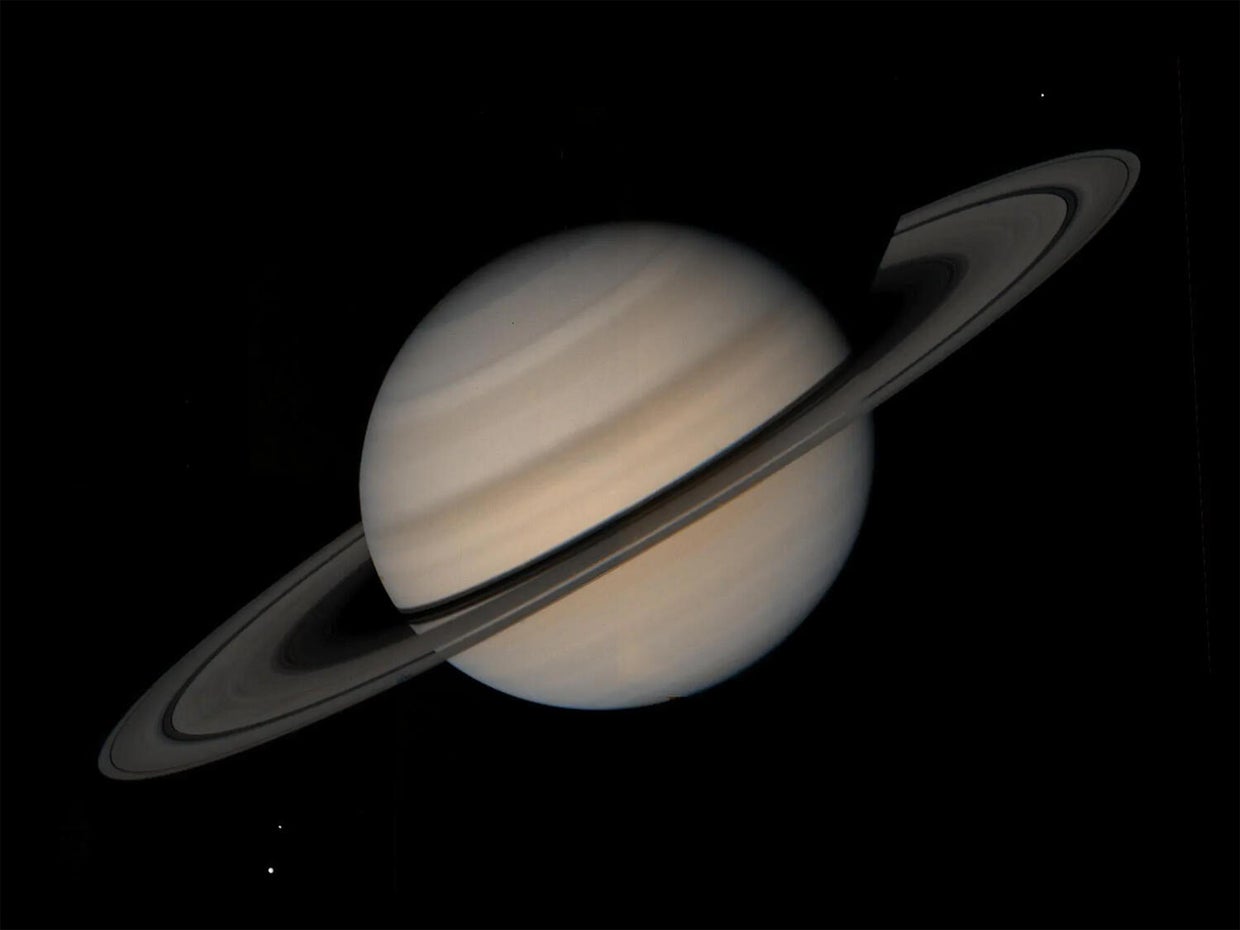
Voyager-1 took this picture of Saturn on November 16, 1980.
Both vehicles are studying the world outside the solar system
Voyager-1 and Voyager-2 are now studying interstellar space i.e. the space between the stars.
Both spacecraft have crossed the heliosphere, a huge protective layer formed by the Sun’s magnetic field. Voyager-1 crossed this limit in 2012 and Voyager-2 in 2018.
These vehicles were originally built to discover planets, but now they are being used to gather information about the space between the stars.
Scientists now have to understand how to make these old machines do work for which they were not originally designed.

Voyager-1 took this picture of Earth on February 14, 1990. Just 34 minutes later, his camera was switched off forever. The Earth looks like a small blue dot in space. This point is visible in the light falling on the camera.
NASA’s new trick to keep Voyager running
1. Switch off non-essential appliances
To save power, NASA gradually turned off scientific and other equipment. Of the 10 scientific instruments of Voyager-1, only 2 are now functional. They study magnetic fields and charged particles.
2. Change in distribution of power
Switched off 3 appliances that consume a lot of electricity. Replaced them with 3 other appliances, which consume less electricity overall. This saved about 10 watts of electricity.
3. Kept the fuel pipe hot
There is very low temperature in space. In such a situation, there is a danger of the vehicle’s fuel freezing. NASA chose the new equipment in such a way that heat is maintained in different parts of the vehicle.
4. Kept the computer warm
The spacecraft’s computers require a certain temperature to function properly. While making changes in power usage, engineers took care that computers do not cool down.
5. Used old equipment for new purposes
Voyager was originally created to explore planets like Jupiter and Saturn. But now it is being used to study the space between the stars.
6. Saved the system of maintaining radio contact
It is necessary for the spacecraft’s antenna to be pointed towards the Earth, so that it can send data and receive instructions from NASA. For this, it is necessary to keep the fuel and direction control system running.
A team of 10 people is handling the 49 year old mission
Today a small team of NASA is working to keep Voyager-1 running. In an interview given to Sky & Telescope, mission scientist Linda Spilker said that there are about 10 people in this team. Some people work on this mission full time, while others juggle it with other projects.
The youngest member of the team is a communication engineer, aged 25. His parents were also born after the launch of Voyager-1. At the same time, there is also an expert in the team, who has turned 90 years old and has been associated with the mission since its initial days.
Spilkar herself has been associated with this mission for a long time. She was associated with the Voyager mission since its launch in 1977. Later she separated for some time and again joined this team in 2020. At that time he thought that this mission would last only for a few more years. But Voyager-1 is still working today.
This photo was taken during Voyager-2’s passage near Neptune in August 1989. In the middle is Linda Spilker, wearing a red T-shirt.
Contact with Earth may stop by 2029
The biggest challenge facing Voyager-1 is that contact with it can be lost at any time. According to Nature’s report, due to complete depletion of its electricity, there is a possibility of loss of contact with it by 2029. Contact with its twin spacecraft Voyager-2 may be lost by 2031.
Recently, Voyager-1 could not be contacted for about 48 hours. Later it became active again and started receiving messages.
If there is a malfunction in this vehicle, there is no way for NASA scientists to go there to fix it. They have to solve the problem by sending instructions from Earth itself.
Same thing happened in 2024 also. Voyager-1 suddenly started sending wrong and useless data. Investigation revealed that a chip in his computer was damaged. It is possible that some particle coming from space may have damaged it.
Scientists worked for months on making changes to the computer program. Then a new instruction was sent from Earth. Since the spacecraft was still far away from Earth at that time, it took about two days for the instructions to reach and the response to come. Finally, in April 2024, scientists started getting correct data again.
Voyager-1 is trending on Google…
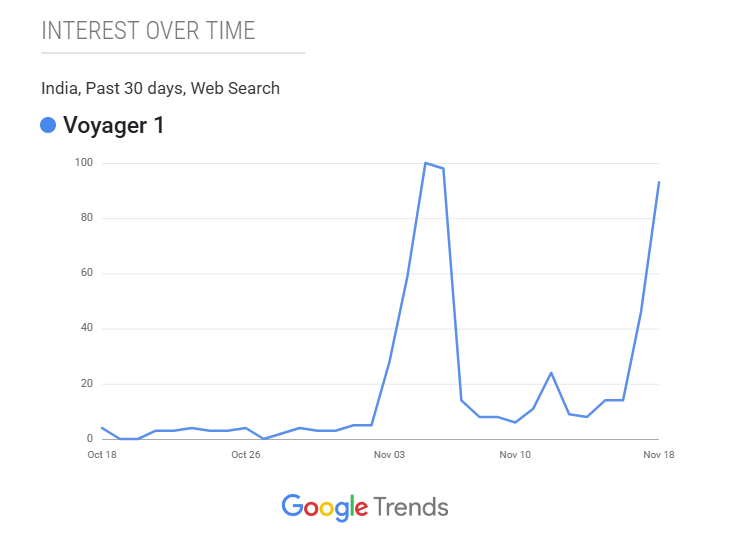
Source- Google Trends
—————————-

Source link
[ad_3]
