
- Hindi News
- National
- Dalit Houses Were Burnt In 2014, Now 98 Have Been Given Life Imprisonment
Bengaluru19 minutes ago
- copy link
After the court’s decision in Karnataka’s Marakumbi village, the fear of conflict between Dalits and upper caste people has increased.
Marakumbi village in Koppal district of Karnataka came into limelight recently when the highest number of 98 people in the country were given life imprisonment simultaneously. Now a poignant aspect has come to light in this matter.
Usually in such cases, the families of the culprits mourn after getting the punishment. The victims’ families are either happy or express satisfaction. However, the court’s verdict, 10 years after the attack and arson incident on Dalits, has brought mourning and despair to both the families of the victims and the culprits in Marakumbi village.
Now they fear that the decision will make it more difficult for them to live together in the village. This reality came to light when Dainik Bhaskar To know the ground truth of this famous case, I reached Marakumbi situated on the banks of Kanakagiri State Highway. first this background Read…

Why is this matter in discussion now? Read ground report
October 24, 2024 Koppal District and Sessions Court’s decision on the Dalit oppression case came. Sessions Court Judge Chandrashekhar C convicted 101 people in the case. Of these, 98 people were sentenced to life imprisonment and a fine of Rs 5,000 each under sections of the SC/ST (Prevention of Astrocytes) Act, 1989 and IPC.
Three Dalit accused were sentenced to 5 years imprisonment and a fine of Rs 2,000 each. The court had convicted the accused on October 21. On October 24, a Dalit convict died before being sent to jail. The remaining convicts were sent to Ballari Central Jail.
Here, the people of Marakumbi are in fear and shock. The fear of community tension has increased in this village with a population of about 2 thousand. Karnataka Reserve Police personnel are deployed 24 hours a day. There is anger among the people against the media also. He says that if the matter had not come in the headlines, the village would not have got such a bad name.
To avoid the anger of the people, media people reach the village in vehicles without press stickers. After much persuasion, both sides Dainik Bhaskar Talked to.

After the decision of the Sessions Court, Karnataka Reserve Police Force is deployed in Marakumbi.
Dalit said- People are blaming us for the court’s decision The Dalits refused to say anything in front of the camera. He also imposed the condition of not revealing his name. Some Dalit elders told off camera, ‘We are surprised by the life imprisonment awarded to the accused. We respect the verdict of the law, but we did not expect such a harsh punishment. Everything became normal after the 2014 incident.
‘We had buried animosity against each other. We used to work on their (upper caste) lands. Poor upper caste laborers also helped us in farming on our land. Some prosperous farmers also lent their tillers and tractors to plow our lands and transport the crops. But now with this decision everything is over.

There was silence on the road leading to the Dalit colony. Due to fear of stress, people leave for work early in the morning.
Dalits said, ‘Now we are afraid to even walk alone on the streets. Nasty comments are made on us. The people of the village are pointing fingers at us for the trouble that has happened to the families of the accused. We are being seen as villains. We are afraid for our future generations because we have come into the limelight due to media coverage.
‘We are at a loss even after getting justice. Neighboring villagers have also started blaming us for the court’s decision. We do not think that people of any village will marry their children to our children. Instead of getting relief from the court’s decision, we are more afraid for our future.
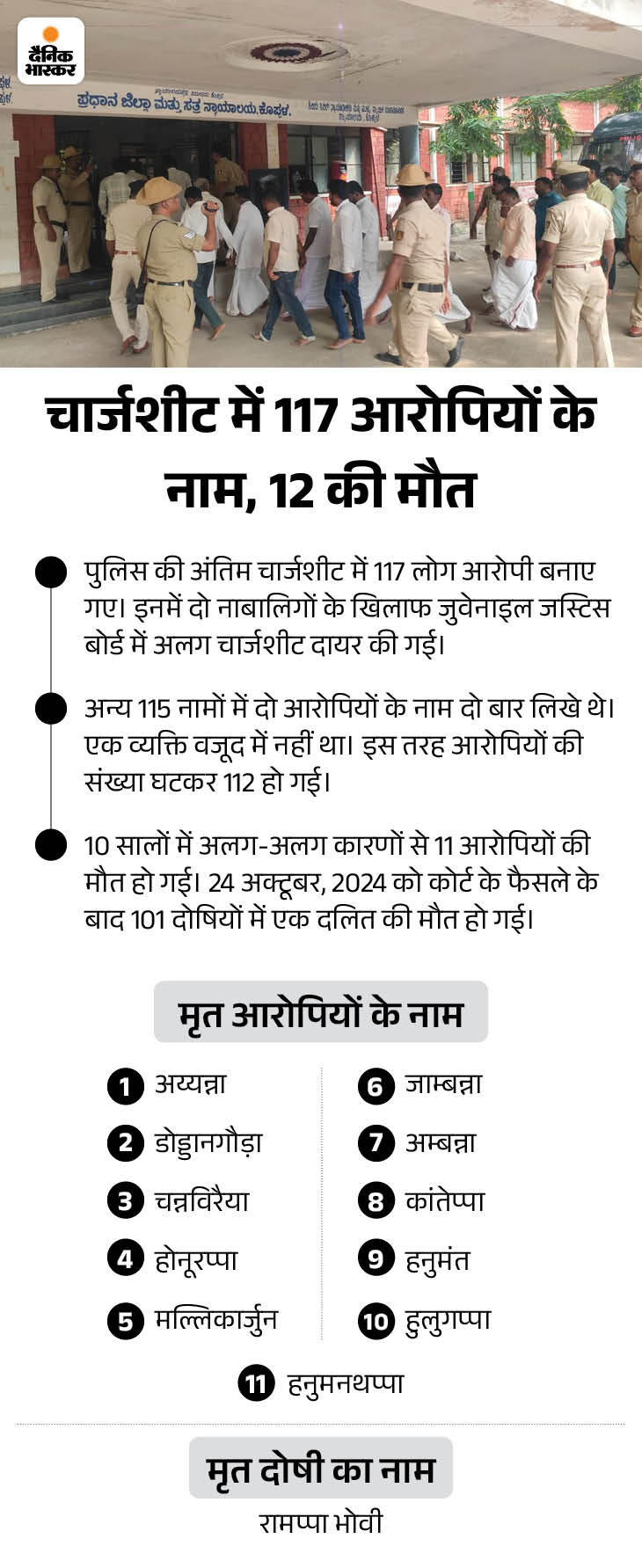
Except the main accused, 99 got bail from the High Court. After getting life imprisonment from the Sessions Court, except the main accused Manjunath, the remaining 99 convicts had filed a bail petition in the Karnataka High Court. On November 13, the Dharwad bench of the High Court granted bail to all.
Justice Srinivas Harish Kumar and Justice T.G. Shiv Shankar Gowda’s bench imposed a bond of Rs 50,000 on each of the convicts with one surety. Some of the convicts returned to the village in the dark of night on 16 November to avoid the media. Some people went to the homes of their relatives in other villages.

The family of the culprits said – we are devastated Unlike the Dalits, no one from the upper castes was ready to talk to the media. Everyone seemed busy in their daily work. The farmers’ families were busy preparing to sell the paddy crop after harvesting it. The elders and children were passing their time quietly.
We found an old man on a stone bench under a tree. Tried to talk to him several times. Asked some questions, but he flatly refused to talk by waving his hand. Later it was revealed that all his five sons had been convicted by the Sessions Court.

All the 5 sons of this elder have been convicted in the case. He refused to talk.
Then we met Parvati. Five members of his family have also been sentenced to life imprisonment by the Sessions Court. She was initially hesitant to talk to us. His allegation was that the media was manipulating his words and feelings as per its own. After much persuasion, Parvati agreed to speak.
Parvati said, ‘Some people committed crimes, but 98 people were punished. For the first time this year we did not celebrate Diwali. Most of the men of our community were lodged in Ballari jail. We are devastated by the Sessions Court’s decision.
‘We have got some relief after getting bail from the High Court, but the bail bond of Rs 50,000 is very high. There are some other families like ours whose four to five members have been convicted. We all earn our living from agricultural income and daily wage labour. In such a situation, how will you be able to pay this much bail amount? We are devastated.

Village sources said, ‘The upper caste people did not celebrate the bail much because the case is still pending in the High Court.’
Umesh Malekoppa, lawyer of one of the convicts, told Dainik Bhaskar, ‘The accused are relieved that they have got bail from the High Court. Some accused are hopeful that they will also be acquitted.
Police said- We were posted here in 2014 also, situation changed in ten years
A police officer posted in the village said, ‘Food and lodging facilities have been provided for the police personnel. Two vans are always stationed here. Our duty is done on rotation basis. We are monitoring the situation 24 hours.
‘Even after the violence in 2014, some of us were posted in this village. We were in junior positions then. A lot has changed in the village in ten years. Many people have become more wealthy. The facilities have become better.
The seeds of enmity were sown in 2003, the violence of 2014 was its result.
We delve deeper into the conflict between upper castes and Dalits in Marakumbi. Tried to find out what kind of relations existed between the two communities before 2014. It was revealed that the 2014 violence was a result of hostilities that began in 2003.
It was occupied by the landlord, the collector vacated it on the demand of the Dalits. Village sources said, ‘Enmity between the upper caste and Dalits has been going on for many generations in Marakumbi. Upper caste people accuse Dalit youth of teasing their sisters and daughters. Dalits say that upper castes feel untouchability. They also accuse the upper caste of physical exploitation.
‘Many sporadic clashes took place between the two communities. In the year 2003, tension increased regarding a community hall. It was made by the Social Welfare Department. An upper caste landlord used to keep his paddy crop in the community hall. Dalits objected to this.
‘Dalits demanded to vacate the community hall. He said that everyone has the right on the community hall. They wanted to use it for socio-cultural programs. Angered by this, the landlord beat up the Dalit youth. He was also accused of stealing paddy.

In 2003, there was a dispute between Dalits and upper castes regarding this community hall.
Dalits banned from going to salons and hotels
According to the villagers, ‘The then Collector Nagalambika Devi held a meeting with the villagers and got the paddy removed from the community hall and kept in the warehouse. Since then the tension between the two communities increased.
‘The upper caste people had banned Dalits from going to salons, hotels, even grocery shops. Despite being neighbours, there was no dialogue between the two communities. They didn’t even like to see each other. The violence of 2014 was the result of this hatred.

The salon is locked due to fear of dispute in Marakumbi.
However, time heals every wound. According to sources, the hostility of the Marakumbi people decreased with time. Everything went well till 2016. It seemed as if both communities had buried their hatred towards each other. They started doing their work peacefully. Now the Sessions Court has turned the matter upside down by awarding life imprisonment to 98 upper caste accused.

Source link
[ad_3]

